
$1.3 Billion Debt: BitDeer Faces Tough Battle

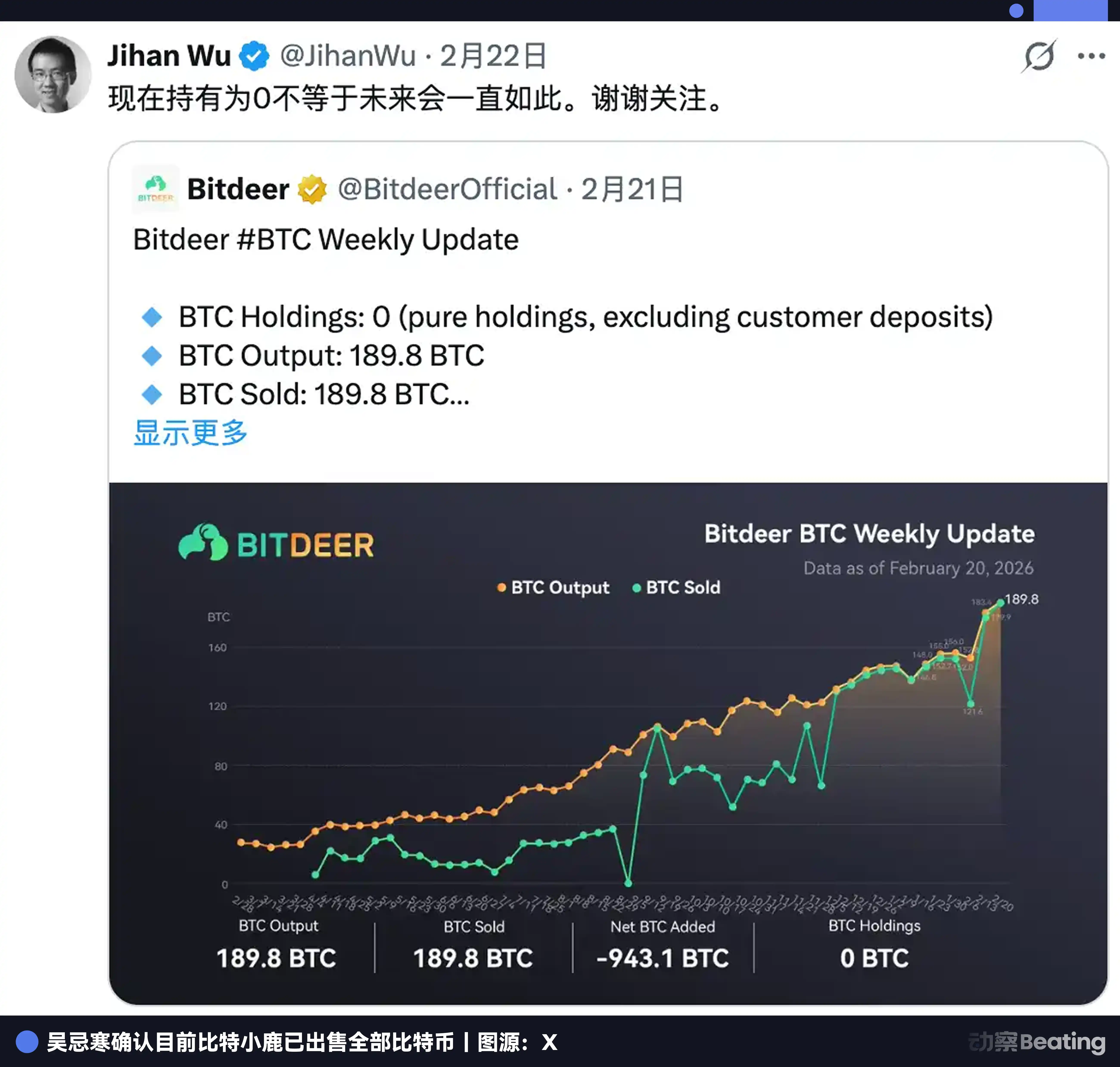
On February 20, 2026, BitDeer released its weekly production update on X: it self-mined 189.8 BTC for the week and sold it. The remaining inventory was 943.1 BTC, all sold at once.
Bitcoin Balance: 0.
In fact, Bitcoin mining has been a form of time arbitrage from day one.
Using today's electricity and machines to earn tomorrow's Bitcoin. No processing in the garage, no need for customers, no need for branding. What's invested is the current cost, and what's gambled is the future price. If the judgment is correct, time helps you make money.
This logic has been running for over a decade. What Wu Jihan is now doing is redirecting the target of this logic.
The goal has shifted from coin price to the long-term price of AI climate-adjusted computing power. The means have shifted from using electricity to mine coins to borrowing to buy land. The arbitrage target has changed, but the arbitrage structure hasn't.
Just in the same week Bitcoin was liquidated, BitDeer also completed the pricing of a new $325 million bond issue.
According to the BitDeer financial report, as of December 31, 2025, BitDeer's book borrowings amounted to $1 billion. So, the total debt is around $1.3 billion.
The debt is real, the land purchases are real, but the result of this tough battle may not be revealed until 2029.
1. A Mining Company That Doesn't Want to Be an AI Company Isn't a Good Company
BitDeer was founded in 2018, starting as a mining machine sharing platform. It is now one of the world's largest publicly listed mining companies, with a self-mining hash rate of 63.2 EH/s, making it the top self-mining hash rate among publicly listed companies globally, accounting for about 6% of the entire Bitcoin network hash rate.
However, now Wu Jihan doesn't want to sell hash rate; he wants to work on electricity.
Breaking down BitDeer's financial report reveals that as of early 2026, BitDeer's global power pipeline totaled 3002 MW, with 1658 MW already operational and 1344 MW under construction or in the planning stage. A single large data center for Microsoft or Google is typically in the range of 100 to 300 MW.
In other words, 3002 MW is equivalent to packaging the power demand of 10 to 30 Google-sized super data centers into one company. So, BitDeer's pipeline looks very impressive on paper.
The primary purpose of the $1.3 billion debt is to secure global power land assets to pave the way for the transformation into AI data centers.
The first one is Rockdale, Texas, 563 MW (including 179 MW expansion), operational, mining-focused. This is the traditional business, with stable cash flow.
Next, Clarington, Ohio, 570 MW, 30-year lease, power contracts signed, originally planned to be completed in Q2 2027, positioned as an HPC/AI core site. This is the core of the entire AI transformation plan. Also, it is currently the largest project, which we will detail later.
Next is Tydal, Norway, 175 MW, currently transforming the mining site into an AI data center, expected to be completed by the end of 2026, capable of providing 164 MW of effective IT load. With hydroelectric resources, competitive energy costs, and significantly lower transformation costs compared to new construction. It is currently the fastest progressing and lowest risk project.
Land, electricity, and data centers, these three things are referred to by the AI industry as the "hardest-to-replicate assets." Bit Deer has accumulated these over ten years of mining operation.
It is worth mentioning one rarely mentioned thing separately: SEALMINER. Bit Deer is not only building data centers but also developing proprietary mining machine chips. The SEAL series has iterated to the third generation, with SEAL03 achieving an energy efficiency of 9.7 joules per terahash. The A3 Pro, mass-produced in September 2025, has joined the top tier globally. SEAL04 is targeting 5 joules per terahash, and if achieved, it will surpass all commercially available mining machines on the market. The gross profit margin of proprietary chips exceeds 40%, far higher than mining itself.
This echoes what he did at Bitmain back then: from buying other people's shovels to making his own shovels.
II. How Much Borrowing and How Much Revenue AI Can Bring
To pursue AI, by the end of 2025, Bit Deer's book borrowings exceeded $1 billion. In addition, with a new $325 million debt in February 2026, the total debt amount exceeded $1.3 billion.
In less than two years, multiple rounds of financing. In May 2024, Tether invested $100 million, becoming the second-largest shareholder, with attached warrants that can add another $50 million. Three months later, the first convertible bond of $150 million was issued, with an 8.5% annual interest rate. In November of the same year, the second bond of $360 million was issued, pushing the interest rate down to 5.25%.
In November 2025, a packaged deal arrived: $400 million in convertible bonds plus a $148.4 million share rights issue, two supporting transactions. In February 2026, another $325 million in convertible bonds plus 43.5 million share rights were issued, with a portion of $135 million used to repurchase the earliest batch of old bonds due in 2029. The repayment deadline was extended to 2032.
Totaling over $1.4 billion. The money flows into mining machines, data centers, AI infrastructure, along with rolling over debt.
However, with each bond issuance, Bitdeer's stock price drops by 10% to 17%. This has become a fixed market reflex. Fortunately, the company still manages to receive the money each time.
The heart of the borrowing structure is convertible bonds. This batch of new bonds due in 2032, with an initial conversion price of around $9.93, carries a 25% premium over the concurrent equity issuance price of $7.94. If the stock price rises to that level, bondholders convert to shares, not cash. The company actually doesn't have to repay the money, just needs the stock price to rise.
The logic of convertible bonds is based on the belief that their stock price will increase. This in itself is a bet on whether the AI narrative can be accepted by the market. With an annual interest burden, calculated at an average 5% interest rate on a principal of $1.3 billion, annual interest expenses exceed $65 million. Yet the full-year 2025 AI/HPC Cloud revenue is less than a fraction of that interest for six months.
Currently, this interest is entirely reliant on continued debt issuance to roll over. It's impossible to say that there isn't significant pressure.
With such a large investment, there must be an expectation of more tangible returns. So how much revenue can Bitdeer's AI initiatives truly bring?
The AI business currently earns $10 million per year, accounting for less than 2% of total revenue. For a company with a market value of nearly $2 billion, this number is almost negligible.
Of course, this cannot be the endgame.
Bitdeer's GPU count has tripled from 584 to 1792 in three months. Utilization has dropped from 87% to 41%, mainly because the machines were deployed too quickly, with B200/GB200 still in customer testing phase, yet to start generating revenue. The power is already connected, machines are being set up, the denominator is skyrocketing, but the revenue hasn't caught up yet.
How high is the ceiling?
Roth/MKM estimates that with full HPC capacity deployed, the annualized revenue potential is $850 million. The management team is more aggressive: dedicating all 200 MW to AI cloud could exceed $2 billion annually, three times the full-year mining revenue in 2025.
However, both of these figures are contingent on three premises: completion of construction as scheduled, securing long-term contracts at hyperscaler levels, and running GPUs at full capacity.
As of now, none of these three conditions have been met.
This is the battle BitDeer is fighting: mining to support AI, AI creating fantasies, whether the fantasies can come true depends on the execution in the next two to three years.
III. The Tough Part Lies in How Narrow the Time Window Is
A $1.3 billion debt sounds risky. But BitDeer's debt structure is designed to be more stable than it appears on the surface.
Highly leveraged companies usually die for the same reason: debt concentrates and matures, cash is insufficient, forced to liquidate.
BitDeer has set the maturity dates of three batches of convertible bonds in 2029, 2031, and 2032, respectively.
To some extent, it can be considered a deliberately extended buffer zone. By the time of the first maturity, Tydal and Clarington should theoretically have landed; by the second maturity, AI revenue should have started to speak; by the third maturity, the true nature of this company will be judged by the market by then. Three nodes, three opportunities for renegotiation.
However, despite the time given by the convertible bonds, Wall Street is not buying it. Keefe Bruyette has cut the target price from $26.5 to $14. The current stock price is around $8. The signal the market is giving is very realistic: for a transformation story, revenue must be seen.
But all this pressure has given Wu Jihan what he needs most and what is most cruel: time.
The smooth path may run like this: by the end of 2026, the Tydal transformation is completed, the 164 MW hydroelectric data center in Norway is launched, and European customer contracts start to generate revenue. In 2027, Clarington wins the lawsuit, the 570 MW project in Ohio officially starts construction, and major U.S. customers follow suit. By 2028 to 2029, the two core assets are running at full capacity, revenue is approaching the $1 billion level, and analysts reposition BitDeer from a mining company at a discount to an AI infrastructure premium. In 2029, the first batch of bonds mature, bondholders look at the stock price, and they will most likely choose to convert to equity rather than cash out.
In every one of these tough battles, Wu Jihan must hit the timing just right.
Next is Clarington.
In the same industrial park in Ohio, there is a steel manufacturer called American Heavy Plate Solutions, which signed a 30-year lease for 9.9 acres of land in 2018. They sued BitDeer: the construction of an AI data center would disrupt shared power, roads, railways, and communication lines, violating zoning restrictions. Their demand is to ask the court to issue a permanent injunction to prevent BitDeer from breaking ground.
Clarington represents 42% of the pipeline under construction. If stuck, the entire timeline would need to be rewritten.
So BitDeer's current biggest single point of risk is not debt, not stock price, but a steel mill.
The mining side has not been idle either. In February 2026, Bitcoin's global network difficulty skyrocketed by 14.7%, the largest single jump since May 2021. With the same electricity cost, fewer coins are mined. The Q4 gross margin has dropped from 7.4% a year ago to 4.7%. The mining leg is slowly getting thinner.
The worst path is also clear: Clarington lawsuit drags on for two years, construction is halted; Tydal delayed, GPU utilization rate continues to hover around 41%; the first batch of debts mature in 2029, not enough cash on hand, forced to refinance, stock price continues to dilute, and the conversion threshold becomes harder to reach.
Two paths, both are real.
IV. Sell all the Bitcoin, and then what
There is a tradition in the mining community: HODLing coins is belief, it is an endorsement of Bitcoin's long-term value.
MARA holds 53,250 BTC, Riot holds 18,000, Strategy holds 710,000. The more you hold, the more the market believes in you.
BitDeer is now at zero.
The official explanation is: selling coins is to provide liquidity for land purchases. This statement is not wrong. Peers are also moving in the same direction, with Riot selling $200 million worth of Bitcoin for AI expansion, Bitfarms abandoning the positioning of a "Bitcoin company," and MARA also focusing on HPC.
But there is something more fundamental than identity iteration here.
From day one, the mining industry has been gambling on the same thing: something in the future will be more expensive than today's cost. Ten years ago in mining, the bet was that the coin price would rise. Now in land acquisition, the bet is that there will be an explosion in computing power demand.
The object has changed, but the logic of time arbitrage has never changed.
Wu Jihan's true acquisition is the position of "whoever wins, has to pay my electricity bill".
Not betting on the race, just blocking the entrance to the race. Amazon did not bet on which internet company would win, it just rented servers to everyone. AT&T doesn't care what you talk about on the phone, it's only concerned if you made the call or not.
From selling products, to selling services, to collecting rent, the direction of industrial evolution has always been this one path.
The only difference is whether you walk over on your own or are pushed over by someone else.
Wu Jihan bought this opportunity for over a billion dollars. He is waiting for AI to make money at the speed of debt.
You may also like

The survival dilemma of small and medium exchanges behind the withdrawal anomalies exposed by AscendEX

Why Is Bitcoin Falling Below $60K? 5 Key Market Drivers Explained
Bitcoin has dropped sharply amid ETF outflows, Strategy stock weakness, AI stock rallies, and changing Fed expectations. Explore the key forces driving BTC’s latest correction and what traders should watch next.

The shift in the cloud of the air: from despising stablecoins a year ago to the high-profile entry of capital today

ETH has entered a non-consensus phase, and the turning point is approaching!

Bitcoin vs. Gold in 2026: Which Asset Performs Better in Different Markets?

What is your view on Binance's competitive advantages?
I never expected that the first application of AI x Crypto would be in security auditing

Global Launch: As predictions become the most scarce asset in the AI era, Manadia is defining the next generation of the value internet

Who is footing the bill for the $64 billion accounting frenzy?

Morning Report | CoinEx becomes a key hub for Iran to evade sanctions, involving over $3.8 billion in funds; Kalshi seeks a new round of financing, with a valuation potentially rising to $40 billion

Why do cryptocurrency projects always like to change their names?

From the white-haired stock god to the billionaire fund mogul, the smart people shorting Nvidia are all getting rich using the same framework

Morning News | The draft amendment to the People's Bank of China Law aims to clarify the legal status of digital renminbi; South Korea will transfer about 40 unregistered virtual asset service providers to law enforcement agencies

The cryptocurrency industry has entered the "Show Me" era: merely relying on vision is no longer enough

Interpreting the Ethereum Foundation's new structure: Reaffirming self-sovereignty amid institutional trends

Former SpaceX engineer reconstructs the financial execution system using first principles
Standard Chartered Bank sings a 50x rhapsody again, aiming for AAVE to reach 3500 USD
Tidal Investment: We still have a positive outlook on the AI industry chain, but the reasons have changed
The survival dilemma of small and medium exchanges behind the withdrawal anomalies exposed by AscendEX
Why Is Bitcoin Falling Below $60K? 5 Key Market Drivers Explained
Bitcoin has dropped sharply amid ETF outflows, Strategy stock weakness, AI stock rallies, and changing Fed expectations. Explore the key forces driving BTC’s latest correction and what traders should watch next.
The shift in the cloud of the air: from despising stablecoins a year ago to the high-profile entry of capital today
ETH has entered a non-consensus phase, and the turning point is approaching!
Bitcoin vs. Gold in 2026: Which Asset Performs Better in Different Markets?
What is your view on Binance's competitive advantages?


