
$1,500,000 Salary Job: How to Achieve with $500 AI?

Original Title: "A $1.5 Million Annual Salary Job Done by $500 AI: Personal Business Agent Upgrade Guide"
Original Author: XinGPT, Crypto Researcher
During the 2026 Chinese New Year, I made a decision: to automate my entire business process with an Agent.
Today, one week later, this system has been implemented for nearly 1/3 of the process. Despite the system still being refined, my daily routine tasks have decreased from 6 hours to 2 hours. Surprisingly, business output has increased by 300%.
Most importantly, I validated an assumption: personal business Agent transformation is feasible, and I believe everyone should develop such an operating system.
Having an Agent system means a fundamental shift in your thinking, from "how do I complete this task" to "what kind of Agent should I build to complete this task." The impact of this shift from a passive to an active thinking mode is enormous.
In this article, I will not output any AI-generated inspirational content, nor will I deliberately create AI replacement anxiety. Instead, I will thoroughly break down how I step by step completed this transformation and how you can freely replicate this method.
This is the first article on building an agent productivity system. Bookmark this now, so you can easily track future updates.

Why Agent Transformation Is Not an Option but a Necessity
Let me start with a harsh fact:
If your business model is based on "trading time for income," then your income ceiling has been locked by physical laws. There are only 24 hours in a day, and even if you work all year round, the hourly billing limit is there.
· Fund Manager Annual Salary ¥1.5 million ≈ Hourly ¥720 (based on 2080 work hours)
· Consulting Partner Annual Salary ¥2 million ≈ Hourly ¥960
· Top Financial KOL Annual Income ¥3 million ≈ Hourly ¥1440
Seems high? But this is already the limit of a human-centric model.
Agent transformation logic, on the other hand, is entirely different: Your income is no longer determined by working hours but by the operational efficiency of the system.
A Real Turning Point
On a Friday night in January 2026 at 11 p.m., I was still at my computer sorting through the day's market data.
On that day, the US stock market experienced a significant drop, and I needed to:
· Go through 50+ important news articles
· Analyze the after-hours performance of 10 key companies
· Update my investment portfolio strategy
· Write a market analysis article
I calculated that I would need at least another 3 hours. And the next morning at 8 a.m., I would have to repeat the same process.
That moment, I suddenly realized: My time was not spent on thoughtful investment analysis and decision-making; I was merely a data porter.
The actual decisions that required my judgment probably only accounted for 20% of the time. The remaining 80% was all repetitive information gathering and organization.
That was the starting point of my decision to Agentize.
My investment research Agent system now automatically processes:
· 20,000+ global financial news articles
· Updates on financial reports for 50+ companies
· 30+ macroeconomic indicators
· 10+ industry research reports
If done manually, this work would require a team of 5 people. But my cost is: $500 monthly API call fee + 1 hour of review time every day.
This is the essence of Agentization: Use algorithms to replicate your decision-making framework and replace labor costs with API costs.
01 Deconstruct Your Business: The Three-Tier Architecture from Human to System
Any knowledge work can be broken down into three layers:
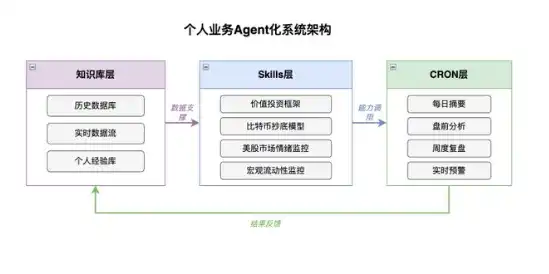
First Layer: Knowledge Base
This is the Agent's "memory system."
Using investment research as an example, my approach involved building a knowledge base containing the information and data I need for my investments, including:
1. Historical Database
· Past 10 years of macroeconomic data (Fed, CPI, Nonfarm)
· Financial Report Data of Top 50 US Stocks
· Recap Notes on Major Market Events (2008 Financial Crisis, 2020 Pandemic, 2022 Rate Hike Cycle)
2. Key Metrics and News
· Major Financial Media and Information Channels I Follow
· Fed Policy and Key Company Earnings Release Dates
· 50 Twitter Accounts I Follow (Macro Analysts, Fund Managers)
· Key Macro Indicators
· Important Industry Research and Data Tracking
3. Personal Knowledge Base
· Record of My Investment Decisions in the Last 5 Years
· Review of Each Decision's Accuracy
A Specific Case: Market Plunge in Early February 2026
In early February, the market suddenly plunged, with gold and silver collapsing, cryptocurrency flooding, and US, Hong Kong, and A-shares consecutively plummeting.
There are several main interpretations in the market:
· Anthropic's Legal AI is too powerful, causing a crash in software stocks
· Google's capital expenditure guidance was too high
· Incoming Fed Chair Warsh is a hawk
My Agent system issued a warning 48 hours before the plunge because it detected:
· Surge in US Treasury yield, significant narrowing of US2Y-JP2Y spread
· High balance in the TGA account, Treasury Department continuously draining liquidity from the market
· CME raising gold and silver futures margins for the 6th consecutive time
All of these were clear signals of liquidity tightening. In my knowledge base, there is a complete review of the August 2022 yen carry trade unwinding that caused market turbulence.
The Agent system automatically matched historical patterns and provided a "Liquidity Tightness + High Valuation → Reduce Position" recommendation before the plunge.
This warning helped me avoid at least a 30% drawdown.
This knowledge base contains over 500,000 structured data entries, with 200+ updates daily. If maintained manually, it would require 2 full-time researchers.
Layer Two: Skills (Decision Framework)
This is the most easily overlooked but crucial layer.
Most people interact with AI in the following way: Open ChatGPT → Input question → Receive answer. The issue with this approach is that AI doesn't know what your criteria for judgment are.
My approach is to break down my decision-making logic into individual Skills. Taking investment decisions as an example:
Skill 1: US Stock Value Investing Framework
(The following Skill is an example and does not represent my actual investment criteria, which are subject to real-time updates):
markdown
Input: Company financial data
Judgment criteria:
- ROE > 15% (sustained for over 3 years)
- Debt ratio < 50%
- Free cash flow > 80% of net profit
- Moat assessment (Brand/Network effect/Cost advantage)
Output: Investment rating (A/B/C/D) + Reasoning
Skill 2: Bitcoin Bottom Fishing Model
markdown
Input: Bitcoin market data
Judgment criteria:
- Candlestick technical indicators: RSI < 30 and weekly oversold
- Trading volume: Contraction after panic selling (below 30-day average volume)
- MVRV ratio: < 1.0 (Market value below realized value, overall holder loss)
- Social media sentiment: Twitter/Reddit panic index > 75
- Miner capitulation price: Current price near or below mainstream miner capitulation price (e.g., S19 Pro cost line)
- Long-Term Holder (LTH) behavior: Rising LTH supply ratio (bottom fishing signal)
Trigger conditions:
- Meet 4 or more indicators → DCA signal
- Meet 5 or more indicators → Heavy bottom fishing signal
Output: Bottom fishing rating (Strong/Medium/Weak) + Recommended position allocation
Skill 3: US Stock Market Sentiment Monitoring
markdown
Monitoring indicators:
- NAAIM Exposure Index: Active investment managers' stock exposure ratio
· Value > 80 with median hitting 100 → Institutional buying climax alert
- Institutional stock allocation: Data from large custodian institutions like State Street
· At historical extremes since 2007 → Contrarian warning signal
- Retail net inflows: Daily retail fund flows tracked by J.P. Morgan
· Daily buy volume > 85% historical levels → Overheating signal
- S&P 500 Forward P/E Ratio: Monitoring proximity to historical valuation peaks
· Approaching levels seen in 2000 or 2021 → Fundamental vs. price disconnect
- Hedge Fund Leverage Ratio: Crowded positions in a high-leverage environment
· Leverage at historical highs → Potential volatility amplifier
Trigger Conditions:
- Alert from 3 or more indicators simultaneously → Reduce Position Signal
- Alert from all 5 indicators → Significant Position Reduction or Hedging
Output: Sentiment Rating (Extreme Greed/Greed/Neutral/Fear) + Position Advice
Skill 4: Macro Liquidity Monitoring
markdown
Monitoring Indicators:
- Net Liquidity = Federal Reserve Total Assets - TGA - ON RRP
- SOFR (Secured Overnight Financing Rate)
- MOVE Index (Treasury Market Volatility)
- USDJPY + US2Y-JP2Y Spread
Trigger Conditions:
- Net Liquidity weekly decrease>5% → Alert
- SOFR breakout above 5.5% → Reduce Position Signal
- MOVE Index>130 → Risk Asset Stop Loss
The essence of these Skills is: to make my judgment criteria explicit and structured, allowing AI to work according to my mindset.
Layer 3: CRON (Automated Execution)
This is the key to getting the system truly up and running.
I have set up the following automation tasks:
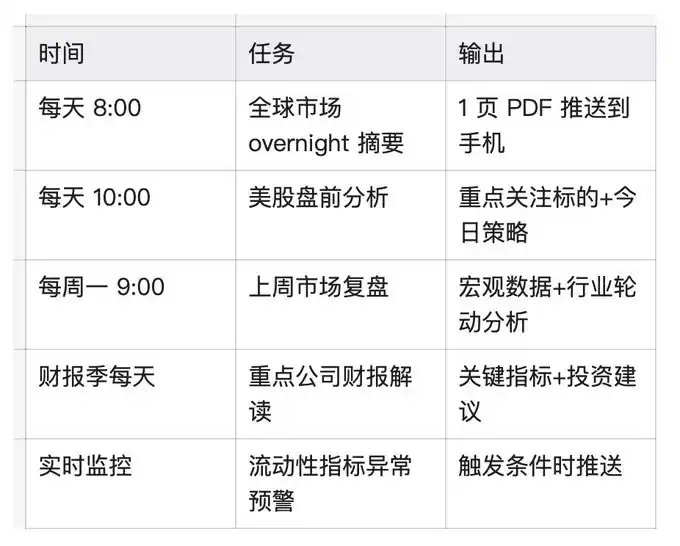
Now, my mornings look like this:
7:50 Wake up, check the phone while brushing my teeth. The Agent has already completed the overnight global market summary push:
· Slight increase in US stocks last night, led by tech stocks
· Bank of Japan maintains interest rates, slight depreciation of the yen
· Crude oil prices rise 2% due to geopolitical factors
· Today's key focus: US CPI data, NVIDIA earnings report
8:10 Have breakfast, open the computer for detailed analysis. The Agent has generated today's strategy:
· CPI data expected in line with market expectations, neutral market impact
· Key focus on NVIDIA earnings report for AI chip order guidance
· Recommendation: Maintain position in tech stocks, focus on opportunities in the energy sector
8:30 Start working, I only need to make the final decision based on the Agent's analysis: whether to rebalance, and by how much.
The entire process takes 30 minutes.
I no longer need to rush to read the news every morning, AI has already prepared a preview for me.
More importantly, investment decisions are no longer easily influenced by emotions, but are based on a complete investment logic, clear judgment criteria, and retrospective analysis, summary, and iteration based on investment performance; this is the correct path for investment in the AI era, instead of continuing to hire a bunch of interns to work overtime updating the excel profit projection table every day, or relying on intuition to go all-in with 50x leverage, waiting for a miracle to happen.

02 Agentification of Content Production: From Craft Workshop to Assembly Line
My second main business is creating content, currently mainly on Twitter, and also exploring YouTube and other video formats.
Previously, the general process of writing an article was:
· Find a topic (1 hour)
· Research (2 hours)
· Writing (3 hours)
· Editing (1 hour)
· Publishing + Engaging (1 hour)
A total of 8 hours per article, and the quality was inconsistent.
I reviewed the biggest issues with my previously published articles, mainly:
· The topic was too broad, lacking a focus
· The content was too theoretical, lacking specific examples
· The title was not engaging enough
· Timing of publication
Integrating Agentification into content production can be a systematized engineering process!
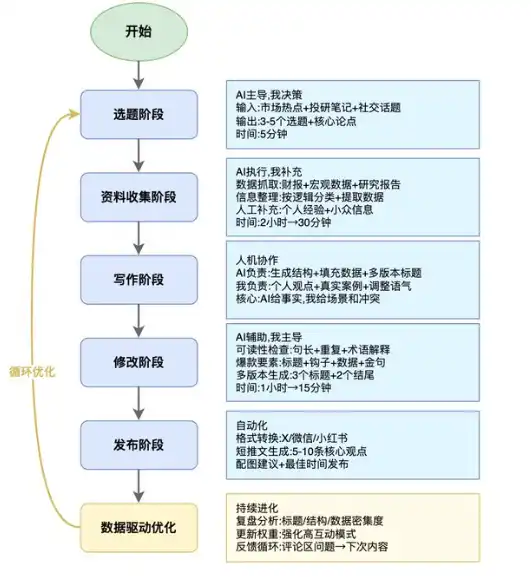
Therefore, at the content level, my Agentification transformation is divided into three steps:
Step One: Establishing a Viral Content Knowledge Base
I did something that many people overlooked: systematically studied the patterns of viral articles.
Specific approach:
1. Scraped the top 200 viral articles in the financial/tech field on Platform X in the past year
2. Used AI to analyze their commonalities: title structure, introduction method, argumentation logic, conclusion design
3. Extracted reusable "viral formulas"
Here are a few examples:
Title Formula:
· Digital Impact Type: "After my assets shrank by 70%, I realized..."
· Counterintuitive Type: "The Internet is dead, but the Metaverse lives on"
· Value Proposition Type: "Helping you save... without resorting to secondhand platforms"
Opening Formula:
· Specific Event Entry: "In January 2025, I made a decision..."
· Extreme Comparison: "If you keep up at the current pace... but 6 months later..."
· Breakdown and Reconstruction: "There are several prevailing interpretations in the market... I believe none of the above are correct"
Argument Structure:
· Point → Data Support → Case Validation → Counterargument
· Clearly outlined in 1/2/3 layers
· Professional Terms + Layman's Explanation
I have organized these patterns into an "Explosive Content Framework Library" and fed them to AI.
Step Two: Human-Machine Collaborative Content Production Line
Now my content production process has become an efficient human-machine collaborative production line, with clear delineation of responsibilities at each stage.
Topic Selection Phase (AI-led, my decision-making)
Every Monday morning, my Agent will automatically suggest 3-5 topics.
Input Sources:
· Global market hot topics of the week (auto-fetch)
· My research notes and latest reflections
· High-frequency discussion topics on social media
· High-frequency reader questions in the comment section
AI Output Format:
markdown
Topic 1: The Liquidity Logic Behind Bitcoin Breaking $100,000
Key Point: Not demand-driven, but a result of USD liquidity expansion
Potential Hotspot: Data-intensive + Counterintuitive viewpoint
Estimated Engagement Rate: High
Topic 2: Why AI Companies Are Losing Money But Their Stock Prices Are Soaring
Key Point: Market pricing is based on future discounted cash flows, not current profits
Potential Hotspot: Addressing public confusion
Estimated Engagement Rate: Medium-High
Topic 3: Retail Investor Sentiment Index at an All-time High, Is It Time to Exit?
Key Point: Sentiment indicators need to consider the liquidity environment
Potential Hotspot: Practical tools + Methodology
Estimated Engagement Rate: Medium
I will choose a topic that best fits the current market sentiment and also offers my unique perspective.
Data Collection Stage (AI Execution, I Supplement)
Once the topic is selected, the Agent automatically initiates the data collection process:
1. Data Curation (Automation)
Latest financial data of relevant companies
Historical trend of macroeconomic indicators
Key points from industry research reports
Representative viewpoints on social media
2. Information Organization (AI Processing)
Organize scattered information according to argumentative logic
Extract key data and reference sources
Generate a preliminary argumentative framework
3. Manual Enhancement (My Value)
Incorporate my personal experience and cases
Supplement niche information sources that the Agent cannot find
Mark which viewpoints require emphasis in the argument
This stage has been reduced from the original 2 hours to 30 minutes.
Writing Stage (Human-AI Collaboration)
This is the most critical step, and the division of labor between me and AI is very clear:
AI is responsible for:
· Generating an article structure based on popular content frameworks
· Filling in data and factual content
· Generating multiple titles and opening versions for selection
· Ensuring the integrity of the argumentative logic
I am responsible for:
· Injecting personal opinions and value judgments
· Adding real-life cases and details
· Adjusting tone and expression
· Removing the AI-generated "correct fluff"
· Revision Stage (AI Assisted, I Lead)
After the initial draft is completed, I will have the Agent do a few things:
1. Readability Check
· Identify excessively long sentences (sentences exceeding 30 characters are highlighted in red)
· Check for repetitive expressions
· Determine if any professional terms need explanation
2. Popularity Element Check
· Assess if the title follows a high interaction rate pattern
· Verify if the first 3 paragraphs have hooks
· Confirm the presence of specific supporting data
· Ensure there are notable quotes for reference
3. Multi-Version Generation
· Generate 3 different styles of titles
· Generate 2 different angles for conclusions
· I select the most appropriate version
This stage has been shortened from the original 1 hour to 15 minutes.
Publishing Stage (Automation)
After the article is finalized, the Agent automatically performs:
· Conversion to formats for each platform (X/WeChat Official Account/Little Red Book)
· Generate image suggestions (generated after my confirmation)
· Automatically publish at the best time (based on historical data analysis)
Step Three: Data-Driven Continuous Optimization
Key Insight: The Content Agent is not a one-time setup but an evolving system.
I conduct a weekly retrospective:
· Which type of title has the highest engagement rate? → Update title formula weights
· Which argument structure gets the most shares? → Strengthen this template
· What do readers most commonly ask in the comments? → Add to FAQ and respond in the next article
As a specific example: I found that articles with a "data-intensive" nature (containing a large amount of specific numbers and charts) have a 40% higher engagement rate than opinion-based articles. So I adjusted the content framework, requiring the AI to:
· Ensure that each core argument is supported by at least 1 piece of data
· Include at least 3 charts in each article
· Properly label the data sources
Results: The average engagement rate of the last 5 articles has increased from 8% to 12%.
In January 2026, I wrote an article titled "The Era of Agent's Great Awakening: How Should We Deal with AI Anxiety?"
This article contained minimal data but had an exceptionally high share rate, reaching 20%.
I had the Agent analyze the reasons and found:
· The article touched on deep-rooted issues of values (AI vs. human meaning)
· It used the specific scenario of "Saving a Cat or a Famous Painting in the Louvre Fire"
· The conclusion's statement "It is important to become someone who is proficient in AI, but more importantly, do not forget how to be human" resonated with the readers
I included this finding in the framework library: In technical articles, appropriately incorporating philosophical reflections and discussions on values can significantly increase the share rate.
This is the compounding effect of the Agent system: the system is helping me optimize the system. The Content Agent is not built all at once but is a system of continuous evolution.
03 From Personal Ability to Consulting Service: Verifying the Reproducibility of the Methodology
After I successfully ran my own investment research and Content Agent system, I began to think: can this methodology help others?
Last December, I had dinner with a fund manager who said he was overwhelmed. He managed a $500 million private fund with nearly 10 staff members but still felt dragged around by the market's news, running around frantically every day.
His daily routine was as follows:
· Wake up at 6:30 a.m. to check the overnight global markets
· 7-8 a.m.: Review key news from the overnight global markets
· 8:30-9:30 a.m.: Conduct morning meeting to discuss investment strategy
· 9:30 a.m.-3 p.m.: Monitor the market and execute trades
· 3-6 p.m.: Research companies and review financial reports
· 6-8 p.m.: Write investment journals and review
· 10 p.m.: Watch the opening of overseas markets
I did a workflow analysis for him and found:
· 60% of the time was spent on information collection and organization (can be Agentized)
· 20% of the time was spent on repetitive analysis (can be Agentized)
· 15% of the time was spent on decision-making (human-machine collaboration)
· 5% of the time was spent on trade execution (can be automated)
Therefore, I spent two weeks helping him build a simplified version of an investment research Agent:
· Week 1: Interview his workflow, identify segments that can be Agentized
· Week 2: Build a knowledge base + configure 3 core Skills + set up automated tasks
After 2 weeks, he sent me a WeChat message: After having more time to think, his investment mindset has become more stable.
This project made me realize: there is a universal need for Agentization transformation, and reducing information processing time is key to improving investment efficiency.
However, I quickly discovered that there are two issues with just providing consulting:
1. Time Bottleneck: Each project requires 2-4 weeks, and I can take on a maximum of 3 projects per month.
2. Unscalable: Each client's needs are different, making standardization difficult.
This led me to start thinking about the next stage: From Service to Product.
04 Agent as a Service: Shifting from SaaS to AaaS Paradigm
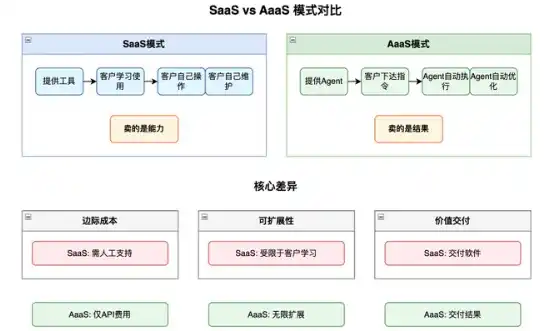
Traditional software is SaaS (Software as a Service):
· You provide the customer with a tool
· The customer needs to learn how to use it
· The customer operates and maintains it themselves
The future is AaaS (Agent as a Service):
· You provide the customer with an Agent
· The customer only needs to give commands
· The Agent executes automatically and self-optimizes
The difference is: SaaS sells "capability," AaaS sells "results."
In January this year, I had dinner with that fund manager friend again.
He said, "The Agent system you helped me build is so easy to use. I've recommended it to several peers, and they all want it. But as a solo consultant, how many clients can you serve?"
I said, "Indeed, that is a problem."
He said, "Why don't you turn it into a product? Like Salesforce, but not selling software, selling Agent services."
Indeed, I believe a good Agent should be made into a service to replace SaaS, just as predicted by Peter, the creator of Openclaw, that the future belongs to Agents, and users will no longer need to install software.
Therefore, I think that after refining this Agent system, I will turn it into an open-source project so that everyone can replicate and use it; for institutional clients with commercialization needs, advanced features will be available through paid subscriptions or usage-based billing.
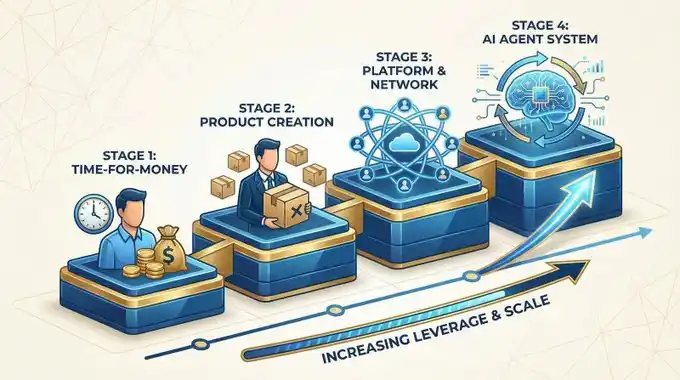
05 The Essence of Agent Transformation: From Time Leverage to Algorithmic Leverage
As I write this, I want to share some deeper thoughts.
The traditional personal business growth path is:
1. Beginner Stage: Selling time (hourly rate)
2. Intermediate Stage: Selling products (develop once, sell multiple times)
3. Advanced Stage: Selling systems (building a platform for others to transact on)
The Agent model provides a fourth path: Selling algorithmic capability.
You no longer need to:
· Hire a team (saving on management costs)
· Develop complex software (avoiding technical barriers)
· Build a platform (skipping the network effect cold start)
You just need to:
· Structure your expertise
· Configure an Agent system to execute
· Continuously optimize the algorithm framework
This is a new leverage: Algorithmic leverage.
Its characteristics are:
· Low cost: Mainly API call fees, much lower than labor costs
· Replicable: The same set of Agents can serve countless clients
· Evolvable: As big model capabilities grow, your Agent automatically becomes stronger
Your Agent Model Action Plan
If this article resonates with you, here are suggested action steps:
Step One: Diagnosis (to be completed this week)
List out your daily task list, noting:
· What tasks are repetitive (information gathering, data organization, format conversion)
· What tasks are judgment-based (decision-making, creativity, strategy)
· What tasks are execution-based (publishing, tracking, responding)
Principle: Prioritize Agentizing repetitive tasks, human-machine collaboration for judgment-based tasks, automation for execution-based tasks.
A Simple Exercise
Take out a piece of paper and write down your task list from yesterday.
For each task, ask yourself three questions:
1. Can this task be standardized? (If yes, it can be automated)
2. Does this task require creative thinking? (If not, it can be automated)
3. Does this task require my unique judgment? (If not, it can be automated)
You will find that at least 50% of the work can be automated.
Step Two: Build (to be completed this month)
Start experimenting with a minimum viable scenario.
Some examples:
· If you are an investor → Build a "Daily Market Summary Agent"
· If you are a content creator → Build a "Topic Suggestion Agent"
· If you are in sales → Build a "Customer Background Research Agent"
· If you are a designer → Build a "Design Inspiration Collection Agent"
Don't aim for perfection; start by closing a minimum loop.
Step Three: Optimize (to be completed this quarter)
Record how much time the Agent system has saved you and whether the output quality is stable.
Conduct a weekly retrospective:
· Which parts did the Agent perform well?
· Which parts still require manual intervention?
· How can you adjust the Skills to better align the Agent with your standards?
Step Four: Monetize (to be completed this year)
Once your Agent system is running smoothly, consider:
· Is this approach valuable to your peers?
· If yes, how much are they willing to pay?
· Can you turn it into a product?
If the answer is yes, congratulations, you have found a new business model.
You may also like

Morning News | The draft amendment to the People's Bank of China Law aims to clarify the legal status of digital renminbi; South Korea will transfer about 40 unregistered virtual asset service providers to law enforcement agencies

The cryptocurrency industry has entered the "Show Me" era: merely relying on vision is no longer enough

Interpreting the Ethereum Foundation's new structure: Reaffirming self-sovereignty amid institutional trends

Former SpaceX engineer reconstructs the financial execution system using first principles

Tidal Investment: We still have a positive outlook on the AI industry chain, but the reasons have changed

Standard Chartered Bank sings a 50x rhapsody again, aiming for AAVE to reach 3500 USD

The interim executive director of the Ethereum Foundation speaks out: What is our mission?
Why does OKX want to start a new company with the parent company of the New York Stock Exchange?

Why Is PAXG Price Different From Gold? 5 Reasons Crypto Traders Should Know

WEEX OpenAPI 101: 5 Powerful Modules, AI Trading Tools, and Grab Up to 70% Revenue Opportunities
Learn how WEEX OpenAPI connects traders, developers, AI agents, and trading platforms. Discover WEEX API features, Binance-compatible integration, automated trading workflows, revenue opportunities, and ecosystem possibilities.

Interview with NDV Founder Jason Huang: Popping the AI Bubble and the Myth of Microstrategy, Seeking the Ultimate Ace in the Crypto Market

Morning Report | Former Ethereum Foundation researcher establishes Ethlabs; EU Parliament Economic Committee passes digital euro regulatory proposal

Dragonfly partner Haseeb: The fastest-growing companies in the future may all be stuck at 149 people

How xBubble Breaks the Deadlock in VC's Heavy Investment in the OPC Economy

The encrypted unicorn Blockstream is deeply embroiled in a serious fraud case

Morning Report | The South Korean Financial Services Commission plans to expand the regulatory sandbox to include virtual assets; the parent company of the New York Stock Exchange, ICE, has reached a partnership with OKX to jointly establish a cryptocu...

Exclusive Interview with Strategy CEO: Putting Aside the Sale of 32 BTC, the 60 Trillion AI Intelligence is the Ultimate Fate of Bitcoin

TRON revitalizes the image of the bull, creating a more approachable brand character
Morning News | The draft amendment to the People's Bank of China Law aims to clarify the legal status of digital renminbi; South Korea will transfer about 40 unregistered virtual asset service providers to law enforcement agencies
The cryptocurrency industry has entered the "Show Me" era: merely relying on vision is no longer enough
Interpreting the Ethereum Foundation's new structure: Reaffirming self-sovereignty amid institutional trends
Former SpaceX engineer reconstructs the financial execution system using first principles
Tidal Investment: We still have a positive outlook on the AI industry chain, but the reasons have changed
Standard Chartered Bank sings a 50x rhapsody again, aiming for AAVE to reach 3500 USD


