
95% of Web3 projects don't tell a story. Have you stepped on any of these landmines?

Original Article Title: 95% of Web3 Fails at Storytelling - Here's The Quick Fix
Original Article Author: @leonabboud_, Founder and CEO of Unfungible
Article Translation: zhouzhou, BlockBeats
Editor's Note: This article emphasizes the importance of Web3 brand storytelling. Firstly, there needs to be high stakes and conflict to create resonance. Secondly, brands should not position themselves as heroes but rather focus on customers or the community as the protagonists of the story. The story should create an emotional connection with the audience, and simple phrases like "I'm sharing this story because..." can help the audience see themselves in the narrative. By combining these three elements, a brand can truly captivate hearts, leave a lasting impression, and foster long-term customer loyalty.
Below is the original content (rearranged for better readability):
95% of Web3 projects fail in storytelling—here's a quick fix.
Imagine a team investing thousands of dollars in content, consistently releasing it for weeks, and spending thousands more on influencer promotions. In the end, after pouring tens of thousands of dollars, the project garnered no attention. The team was in despair.
"Where did everyone go?" the CEO asked the marketing team. The team's only response was, "The market is tough."
Web3 is an ongoing battle for attention. But attention alone is not enough; attention coupled with retention is the real key.
So, how do you improve retention? The secret is—storytelling.
Now, I'll provide you with a crash course in storytelling using three key elements.
High Stakes: Without Conflict, Your Story is Meaningless

Great stories are always built on high stakes. Without these risks, there is no excitement, no challenge to overcome, and no reason for people to care.
Take Walt Disney, for example. In 1928, Walt Disney ran his own creative studio called Laugh-O-Gram and created some of the era's most popular animations, one of them being Oswald the Lucky Rabbit. As Oswald's popularity grew, Walt thought he had succeeded. So, what did he do next? He went to New York to renegotiate for a higher animation budget.
What happened next continues to resonate in the story I'm telling you today. When Walt went to renegotiate the budget, he faced betrayal. Employer Charles Mintz not only rejected his proposal but also weakened Disney's pitch with a lower budget. This meant that Walt would have to work at a loss.
Even worse, Mintz had already secretly signed contracts with all of Walt's animators, inviting them to work for him. This meant Walt lost his team, his business, and his future. In that moment, everything vanished, and Walt left the meeting with a sense of failure.
He boarded a train back to Los Angeles, sent a telegram to his brother, concealing the full extent of the disaster. The telegram read: "Don't worry, everything is fine, I will explain in detail when I arrive." However, when he arrived in Los Angeles, he had already sketched a new character. And this new character was Mickey Mouse.
Why am I sharing this story with you? Walt's story is a case study often explored in advertising copywriting and storytelling because it illustrates a key principle of a good story: high stakes.
All the best stories have the greatest conflicts. If your brand lacks conflict, it lacks purpose. Take Elon Musk, for example—behind each of his brands is a significant conflict. Tesla's mission is "to make electric cars to save the earth," and his mission to Mars is "we are going to Mars to save humanity." If your brand story lacks conflict, it lacks meaning.
You are not the hero of your own story
This is the biggest mistake 95% of Web3 brands make. They position themselves as the hero. This is something I learned from Donald Miller's book, "Building a StoryBrand."

For example, when Pudgy Penguins launched their PENGU token, their marketing campaign was not centered around Luca Nitz or the company's success. Instead, the teaser trailer started by talking about liquidity providers, hinting that many projects appeared as beams of light, but in the coldest of winters, Pudgy Penguins came together, creating light in the darkness.
Who is the hero of the story? Not Pudgy, but the community.
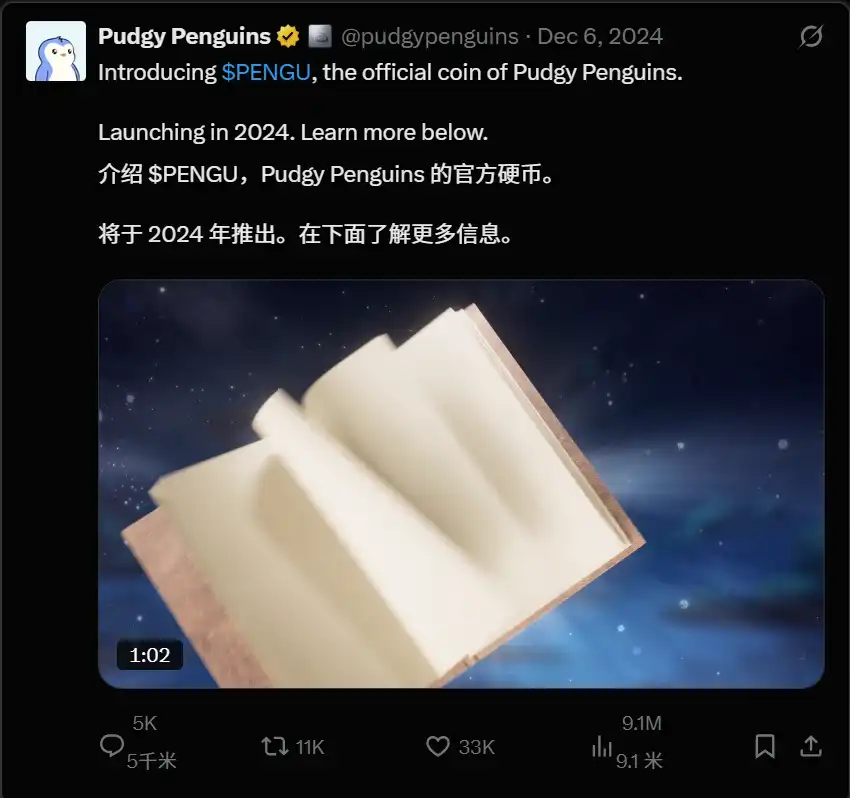
It's the people who persevered in the bear market, the ones who continued to build even when everything was falling apart. Nike actually does this too. "Just Do It" is not about Nike; it's about athletes, about those who overcome obstacles and strive for greatness. Nike is just a facilitator in this story.
Apple's legendary ad "Here's to the Crazy Ones" is no exception. The heroes of the ad are artists, dreamers, rebels—those crazy enough to believe they can change the world. Apple is just a tool to help them do so.
If you're a Web3 founder, your brand is not the hero; your community is. Position them as the driving force of the movement, and you'll have a truly meaningful brand.
Your Story Needs a Personal Resolution
Don't tell a story just for the sake of storytelling.
A great story should come back to the personal. I learned this during my university years through firsthand experience. One day in 2019, a friend invited me to join Toastmasters—a public speaking workshop held at my university.

I walked into this event happening in a rundown basement classroom, not knowing what to expect. Ten minutes later, the organizers started calling people up on stage for impromptu speeches, with each person getting two minutes. No prep, no script.
The first person froze on stage after 30 seconds. The second person spoke for a minute and then went silent for the remaining 60 seconds. It was excruciating to watch.
But what happened next made my heart race. My name was called... it was my turn. I stood up, walked to the front, and started speaking. 25 seconds in, I suddenly blanked on what to say next. Panic set in.
I started rambling to fill the silence, knowing it was the worst two minutes of my life. Finally, my time (thankfully) was up. Adrenaline still coursing through me, I moved to the side of the classroom to watch others give their impromptu speeches.
The following impromptu speeches were reserved for the club's senior members. You could call them the 'OGs.' As they took the stage, I noticed a few things, some of which I still remember to this day.
The best speakers weren't the ones who could improvise a 2-minute speech or tell a good story but rather the ones who could connect that story with the audience.
I recall one person being called up to speak and sharing a story of his mother's battle with cancer. He then miraculously connected this story to the audience, stating that everyone has their own battles and it is in these moments that we need strength and belief the most.
In the "Stage Academy" public speaking course, I learned a simple technique, which is to use the phrase: "The reason I'm sharing this story is...".
This sentence shifts the protagonist of the story from yourself to the audience, suddenly, the protagonist of the story becomes them.
Returning to the story of that OG Toastmaster member, he can connect the story with the audience in this way: "The reason I'm sharing my mother's story is because, just like her, each of us is facing our own challenges...".
This simple sentence links the lesson to the audience's own challenges, struggles, and desires. When the audience can see themselves in your story, you are not just building a brand, you are building emotion and connection.
This is why when you combine these three elements, you have the ability to leave a lasting impression and make them stay.
Summary:
· Your story needs to be high stakes.
· Your customer is the hero of your story, not you.
· Use the simple phrase "The reason I'm sharing this story is..." to connect any story with the audience.
You may also like

The AI gamble of mining companies: Valuations enter a phase of differentiation, and it's hard to turn the tide

A letter from Alliance to entrepreneurs: Written on the occasion of Cursor selling for 60 billion dollars

Will MicroStrategy fall into a death spiral? What will the macro trend be in the second half of the year?

Blockchain Capital Partner: The Core Secret of Arbitrage

STRC unanchored by 11%, can the perpetual motion machine of Strategy still operate?

Bitcoin Market Analysis 2026: Can BTC Reach $150K by Year-End?

Bitcoin ETF Outflows Hit a Record $4.4 Billion: What Are Traders Doing With Their Cash?

WEEX App Just Got Smarter – New Tabs for Faster Trades & Easy Asset Management

WEEX All-New Search Features: Find, Trade & Earn Faster Than Ever

Morning Report | Illinois signs the strictest digital asset tax law in the U.S.; RWA tokenization market size surpasses $43 billion, institutions accelerate the migration of on-chain assets

Full version of the debut Q&A! Federal Reserve Chairman Waller: Sticking to the 2% inflation target, establishing five special working groups, individual did not submit the dot plot

From Disruptor to Shadow Market: The Crypto Market is Becoming a Colony of Traditional Finance
Dalio's important long article: How to position in the current market environment?
OKX Star analyzes Binance's competitive advantages: when regulation levels the playing field, competition has just begun

New gameplay for participating in initial offerings on cryptocurrency exchanges
Why Is Bitcoin Down Today? What the Hawkish FOMC Means for SpaceX, Gold and Nasdaq

DeepSeek Financing Story

Morning Report | DeepSeek completes over $7 billion in financing, with a valuation exceeding $50 billion; Musk's personal wealth has surpassed the total market value of Bitcoin
The AI gamble of mining companies: Valuations enter a phase of differentiation, and it's hard to turn the tide
A letter from Alliance to entrepreneurs: Written on the occasion of Cursor selling for 60 billion dollars
Will MicroStrategy fall into a death spiral? What will the macro trend be in the second half of the year?
Blockchain Capital Partner: The Core Secret of Arbitrage
STRC unanchored by 11%, can the perpetual motion machine of Strategy still operate?
Bitcoin Market Analysis 2026: Can BTC Reach $150K by Year-End?


