
A $70K Winning Trade: How Ethereum's Founder Plays the Prediction Market

 Prefer us on Google

「My method is actually very simple,」 Vitalik Buterin said last week when asked about how he made $70,000 in a year, 「I would look for markets that have already entered a 'madness mode,' and then bet against it — these crazy things will not happen.」
When the world goes mad, rationality is the best arbitrage
At the end of January 2026, in an interview in Chiang Mai, Ethereum founder Vitalik Buterin publicly discussed his trading experience on the prediction market Polymarket: in 2025, he used about $440,000 in capital and made approximately $70,000 in profit.
Although this amount is inconsequential to Vitalik, whose net worth is in the hundreds of millions of dollars, his mentioned trading strategy and understanding of Polymarket's settlement mechanism indicate that he is not just "playing around," but has built a very sophisticated trading logic after delving deep into the entire prediction market system.
To make it easier for the audience to understand, he even gave several specific examples: for instance, last year's highly controversial Nobel Peace Prize laureate, Trump, has repeatedly publicly stated that he is the most qualified person to receive the award.
After being widely reported by the media, Trump's probability of receiving the award once exceeded 15%, and many traders believed that in Trump's style, he would use various coercive means to force the Norwegian Nobel Committee to eventually compromise and award him.
Vitalik's assessment of this matter is very straightforward: this 15% does not reflect the true probability but reflects emotion. What I need to do is stand on the opposite side of emotion and use rationality to profit from that segment of overestimated probability difference.
Starting from "Trump will not receive the Nobel Prize," deduce Vitalik's Polymarket account
Based on the clues revealed by Vitalik in the interview and Polymarket's mechanism for traders' "track records," we can actually try to outline his account profile: $440,000 in capital, $70,000 in annual profit, making money by betting that Trump will not receive the 2025 Nobel Peace Prize.
After a set of filters, two accounts came to light: momom and terremoto.
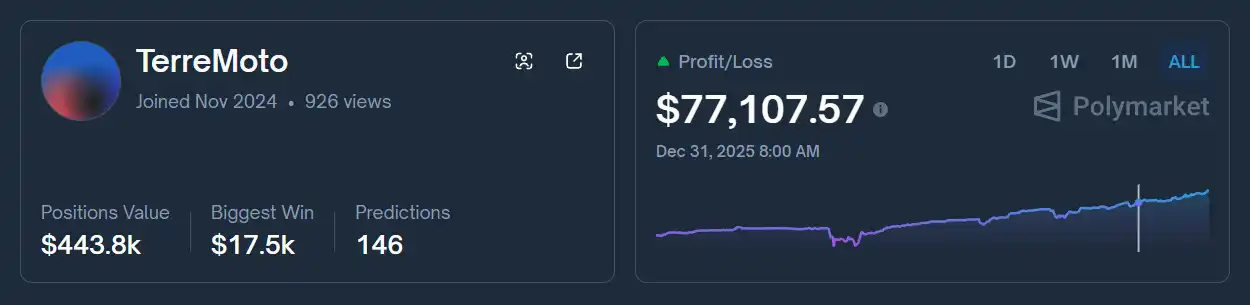
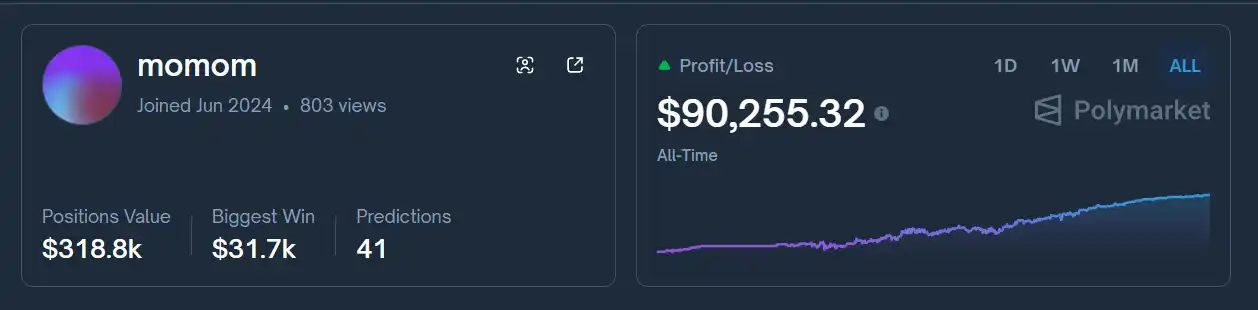
In addition to matching the principal and profit, the transaction logic of both parties perfectly aligns with Vitalik's profit system for the "short sentiment": over 70% of the trades are betting that something will not happen, with no speculative price, sports sector-related trades.
Further on-chain fund tracing revealed that although the amount of terremoto's fund deposit matches $440,000, the money was split into dozens of small deposits of thousands of dollars, with no activity between multiple on-chain wallets other than fund transfers.
On the other hand, momom's on-chain deposits were several large transfers of over one hundred thousand dollars. Combining the fact that momom's account only made one "Yes" bet transaction, along with terremoto's transaction frequency resembling that of a full-time trader actively participating in prediction markets every day, we ultimately believe that momom better fits Vitalik's profile.
If momom is indeed Vitalik: what is his strategy?
Imagine this: Today is March 3, 2025. As a die-hard Trump supporter, you are convinced that he is different from past puppet presidents controlled by the deep government. Within a year of Trump taking office, he fulfilled various campaign promises (ICE cracking down on immigrants, imposing tariffs to "protect domestic companies," etc.).
You also vividly remember that he mentioned during his campaign that he would push for the disclosure of UFO and extraterrestrial-related documents.
Just yesterday, you saw a news report about US lawmakers pushing new legislation to establish a "UFO Task Force." There was a comment mentioning another related piece of news:
A former US Air Force and intelligence officer, David Grusch, disclosed that the US government ran a "decades-long UAP crash retrieval and reverse engineering program," recovering "non-human-origin" aircraft and "non-human biological remains."
Connecting these clues, you realized something incredible: Trump is highly likely to disclose alien files!
At this point, you see in the prediction markets that the probability of "Will the US announce the existence of aliens in 2025?" is only 10%. This means that Trump has nearly 11 months to disclose the relevant documents.
"This probability is severely underestimated!" After just examining news, comments, and even adding information you searched for, you came to this conclusion and subsequently placed a "Yes" bet.
This is a bet with a potential return of nearly tenfold, which you believe to be your most successful investment since the beginning of 2025. What you don't know is that the counterparty on the other side of the order book is none other than Vitalik.
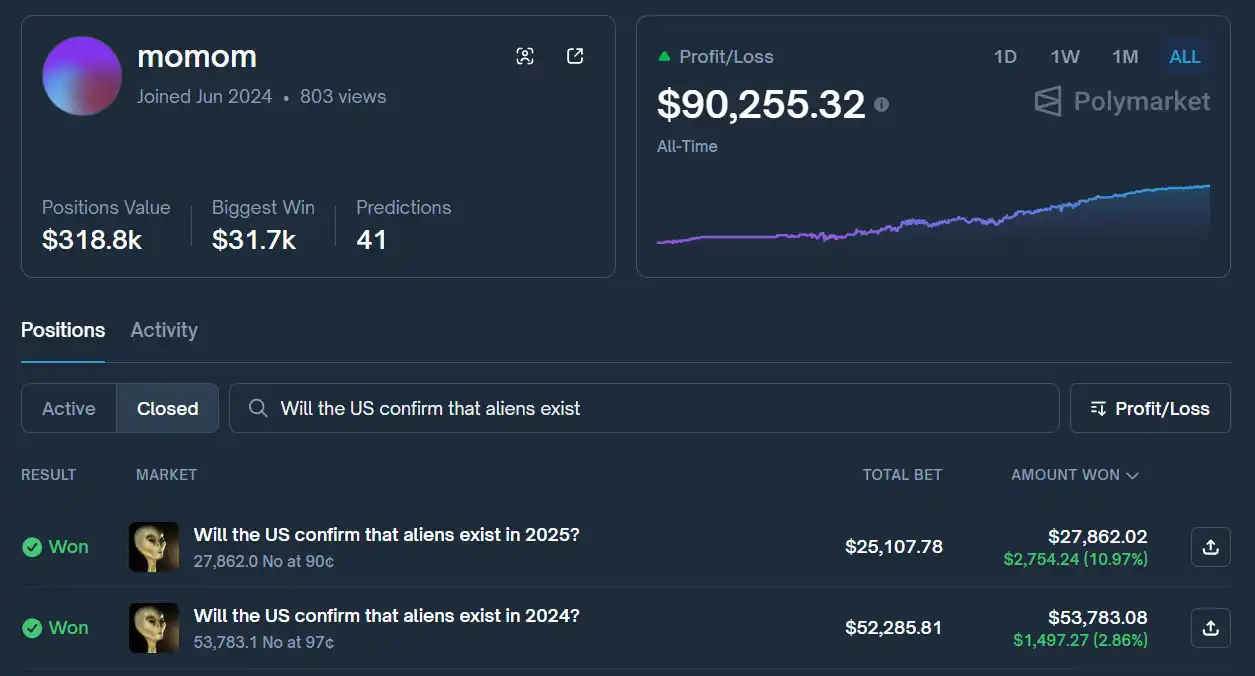
This is exactly what this account did back in March last year: amidst a lot of market noise and overwhelming related media coverage, he bet at 10% odds that the U.S. would not announce the existence of aliens in the next ten months. This transaction ultimately brought him a 10% gain.
Interestingly, an identical bet is once again available, and he is once again betting that this event will not happen this year. Even as of the time of writing, his trade is still in the red. You can even piggyback on this trade at a cost lower than Vitalik's.
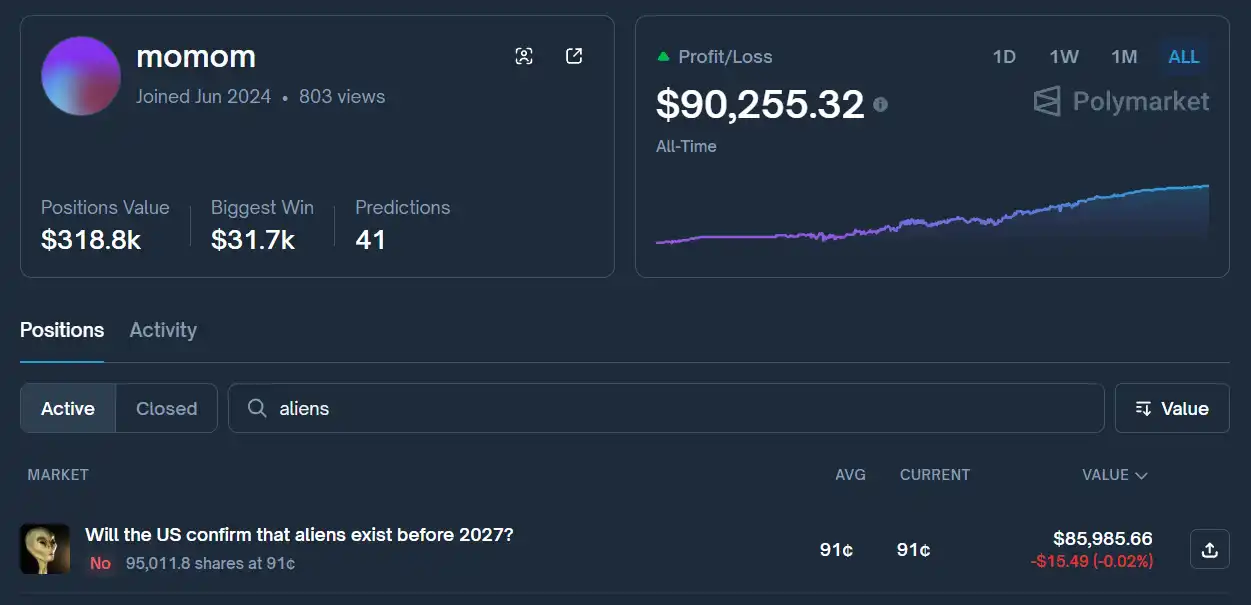
-- Price
Conclusion
Just a month into 2026, all sorts of seemingly impossible things have repeatedly filled the headlines of major media outlets: the President of Venezuela, Maduro, was snatched from his country by the U.S. like a chick and flown back to the U.S., Trump went so far as to try to buy Greenland even alienating NATO allies, and nearly every U.S. political and business titan was mentioned in the Epstein files.
Undeniably, we are living in an era engulfed by uncertainty. In such a context, "it seems like anything could happen".
Prediction markets emerge to directly translate this illusion into probability: every breaking news, every tweet, every exaggerated media interpretation briefly inflates the price of a "Yes" on a certain outcome.
And many star traders like Vitalik capitalize on overestimated probabilities to bet that some extreme event will not occur. After optimizing such strategies through robust trading systems based on mathematics, statistics, etc., such a strategy has become one of the most stable investment methods in prediction markets today.
This content is provided for general informational purposes only and doesn't constitute financial, investment, legal, or tax advice. Any events, rewards, online promotions, or related information mentioned herein should not be considered a recommendation, solicitation, or invitation to purchase, sell, trade, or otherwise deal in any crypto assets. Crypto assets are highly volatile and may result in loss. The availability of WEEX services, products, and related events may vary by region. You are responsible for ensuring that your participation is in accordance with applicable local laws and regulations.
You may also like

EU staking review threatens crypto yields and network security could pay the price

Vitalik Confirms Attendance at ETHShanghai 2026 and Will Deliver Keynote Speech

Toyosa adds BTC alongside USDT for Toyota purchases

Kevin O'Leary, the 'Shark' of Canadian Business, Names the Main Threat to Bitcoin on Its Path to $1 Million

Why the Robinhood Chain Boom Has Not Led to Growth in the Ethereum Mainnet

Speeding Up Without Sacrificing Decentralization? Ethereum EIP-8198 Adjusts Timing Before Reducing Block Size
Ethereum and Base Abandon Common Standard for Crypto Wallets

Zcash Spot Funds Attract $98.2 Million in Investment

Avalanche Treasury Warning: Large-scale Entry of AI Agents into Financial Markets Will Severely Deplete L1 Blockchain Capacity
$140.6 Million Exits from Ethereum ETFs, $60.7 Million Inflows to Solana

BlackRock Transfers 54,096 ETH and 2,015 BTC to Coinbase Prime

RISEx Proposes 20% Retention Condition for Stolen Funds

Best Crypto Exchange in Italy in 2026: What to Choose for Systematic Trading
Ethereum co-founder Vitalik Buterin argues that local AI can protect your privacy without losing speed

Ethereum Spot ETF Sees $144 Million Net Inflow Yesterday, BlackRock's ETHA Leads with $114 Million

Fake AI trading bot tutorials steal 274.6 ETH from 224 victims
Bitwise Evaluates Clarity Act's Failure as a Speed Bump

Morpho Opens Borrowing Against Coinbase's Tokenized Stocks
Your crypto hardware wallet can stay secure while everything around it fails
Concrete Establishes Foundation and Launches Governance Token CT

Deutsche Bank to Launch Cryptocurrency Custody Services by Year-End for Corporate and Institutional Investors

Ethereum: 'Any teenager' can derail the Glamsterdam test

Arc Launches AI Programming Tool Arc Studio Supporting Natural Language Generation for On-Chain Applications

Renaiss Completes TCG Card Machine Application Integration with GIWATER, Becoming the First DEX in Korea to Connect
Attackers Use Testnet ETH to Win Sepolia Block Auction
Shareholders Lose Approximately $50 Billion, Investors Scrutinize Compensation and Related Transactions
Ethereum Glamsterdam Completes Devnet-11 Drill, Gas Limit Proposed to Increase to 200 Million

Toss Completes Blockchain-Based Payment Technology Verification with Korea Minting and Security Printing Corporation

After Congress killed its landmark crypto bill, the SEC unlocked the $77 trillion US stock market through tokenization

Optimism approves Upgrade 20 for Superchain interoperability
EU staking review threatens crypto yields and network security could pay the price
Vitalik Confirms Attendance at ETHShanghai 2026 and Will Deliver Keynote Speech
Toyosa adds BTC alongside USDT for Toyota purchases
Kevin O'Leary, the 'Shark' of Canadian Business, Names the Main Threat to Bitcoin on Its Path to $1 Million
Why the Robinhood Chain Boom Has Not Led to Growth in the Ethereum Mainnet
Speeding Up Without Sacrificing Decentralization? Ethereum EIP-8198 Adjusts Timing Before Reducing Block Size
Contents
Latest articles


Latest coin listings on WEEX


