
A Century of an Egg's Wandering, from Wall Street to Polymarket


The phrase "We went from eggs to yen" comes from CME legend Leo Melamed's financial memoir, witnessing a time when eggs were one of the most actively traded futures products globally.
In the first half of the 20th century, egg futures were once one of the most popular trading commodities in Chicago. Trading volume in some years ranked only behind grain varieties, and there were even times when futures trading volume far exceeded physical market circulation.
The predecessor of the world's largest derivatives market, the Chicago Mercantile Exchange (CME), was the "Chicago Butter and Egg Exchange," the precursor to the entire derivatives empire. This exchange, as the name suggests, initially traded only two things: butter and eggs.
In the 1970s, the U.S. egg industry rapidly industrialized, the cold chain matured, and price fluctuations were gradually smoothed out. As uncertainty began to dissipate, the hustle and bustle of trading pit faded away. In 1982, egg futures officially exited the Chicago Mercantile Exchange. It didn't collapse dramatically but rather quietly went out of favor with the times.
In 2013, the Dalian Commodity Exchange reignited interest in this commodity on the mainland. At that time, the mainland's egg industry was still highly fragmented, with prices fluctuating dramatically and a genuine and urgent need for hedging.
Egg futures trading did not disappear; it just migrated. And today, this migration has taken another step forward. The venue for trading egg prices has shifted to Polymarket.
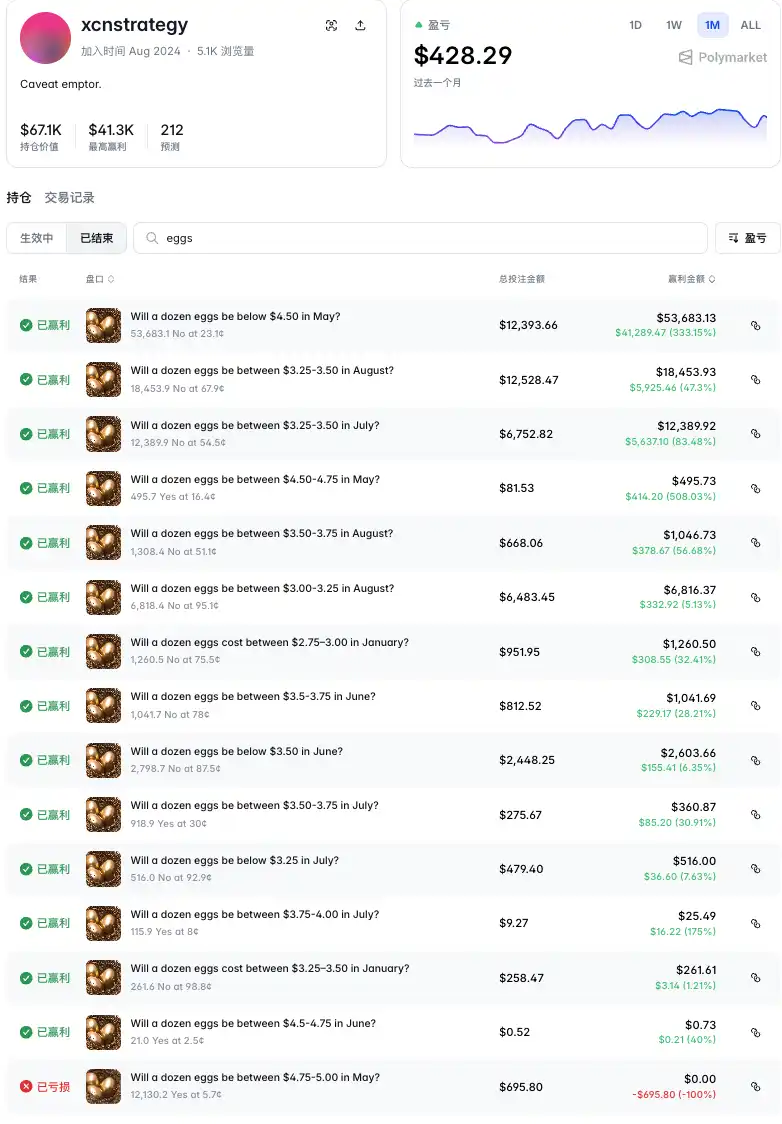
A trader with the ID "xcnstrategy" established positions on egg price predictions in multiple expiry months such as January, May, June, July, and August, with the majority of trades shorting the "Yes" in a specific price range, betting that the egg price would not be at a certain level. The total amount wagered was $44,800, with nearly $100,000 in profit. Out of 15 trades, all were profitable except for the first one.
The most recent trade was also the most profitable one, investing $12,393 on a "No" bet for "May one dozen eggs below $4.50," winning $41,289 (+333%).
Speculation about the true identity of xcnstrategy, besides being a possible "egg enthusiast," includes many believing they are likely someone with a background in commodity markets or agricultural data research. They analyzed that the egg price surge triggered by the U.S. avian flu starting in 2025 was a short-term phenomenon, suggesting the market overestimated the probability of a sustained high price. Others think they may be an industry participant in the egg supply chain, mitigating the volatility brought by the hedging industry itself.
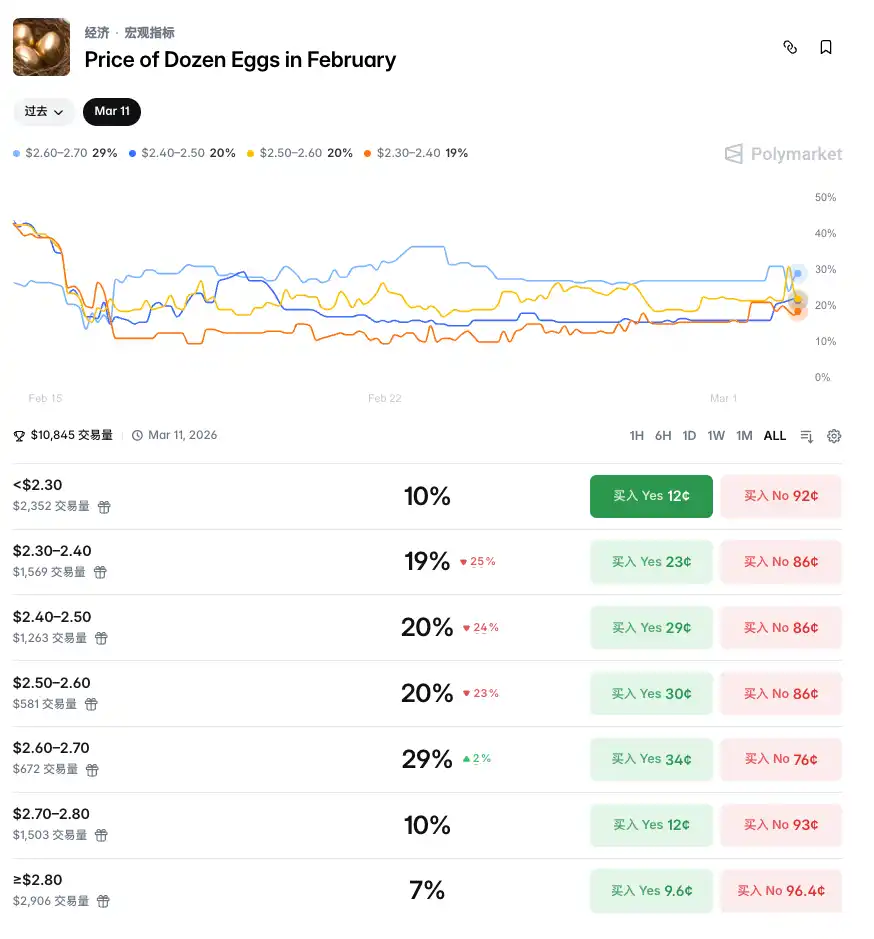
Eggs are just one example; the range of traditional asset references tradable on Polymarket is much broader than we might imagine: from commodities like crude oil (CL), gold (GC), and silver (SI), to various forex prices, to housing data, all can be found on Polymarket.
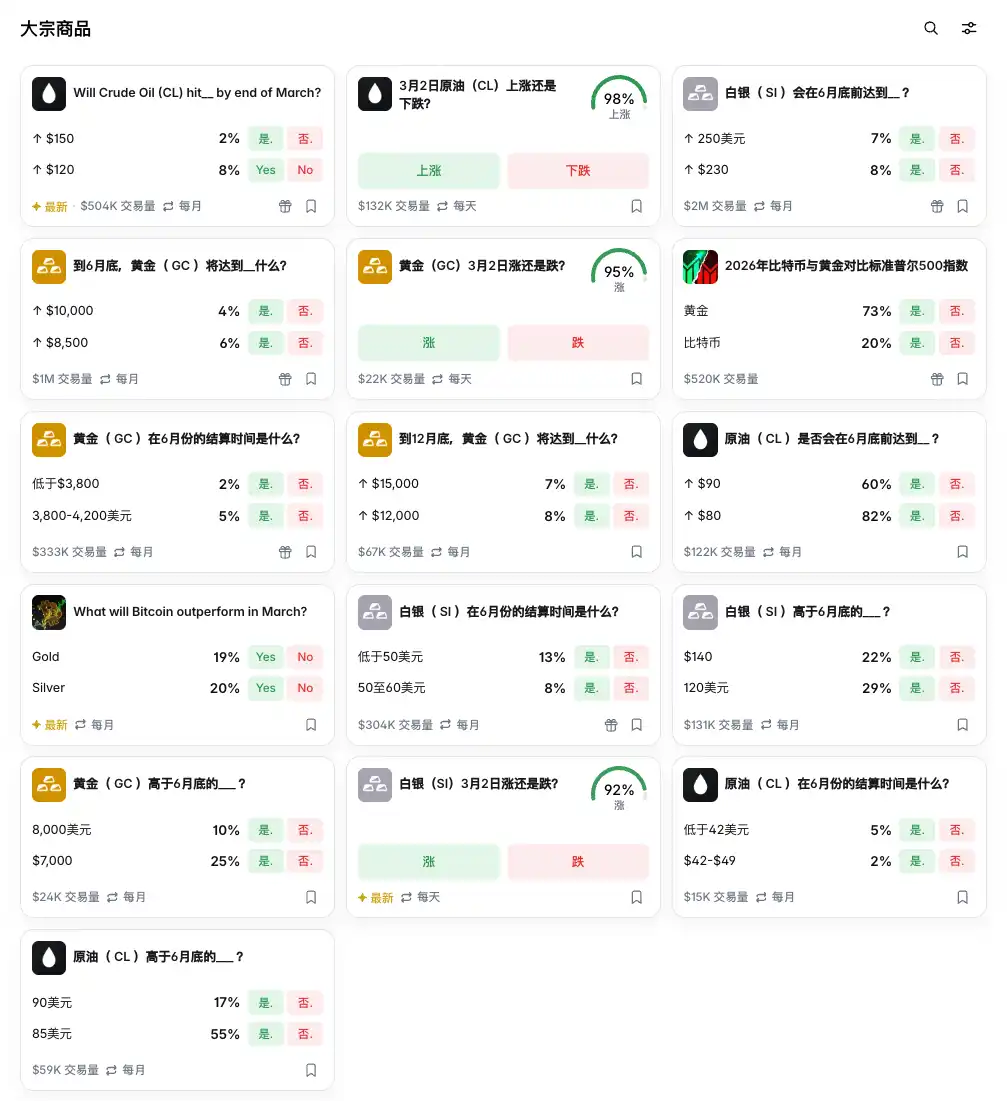
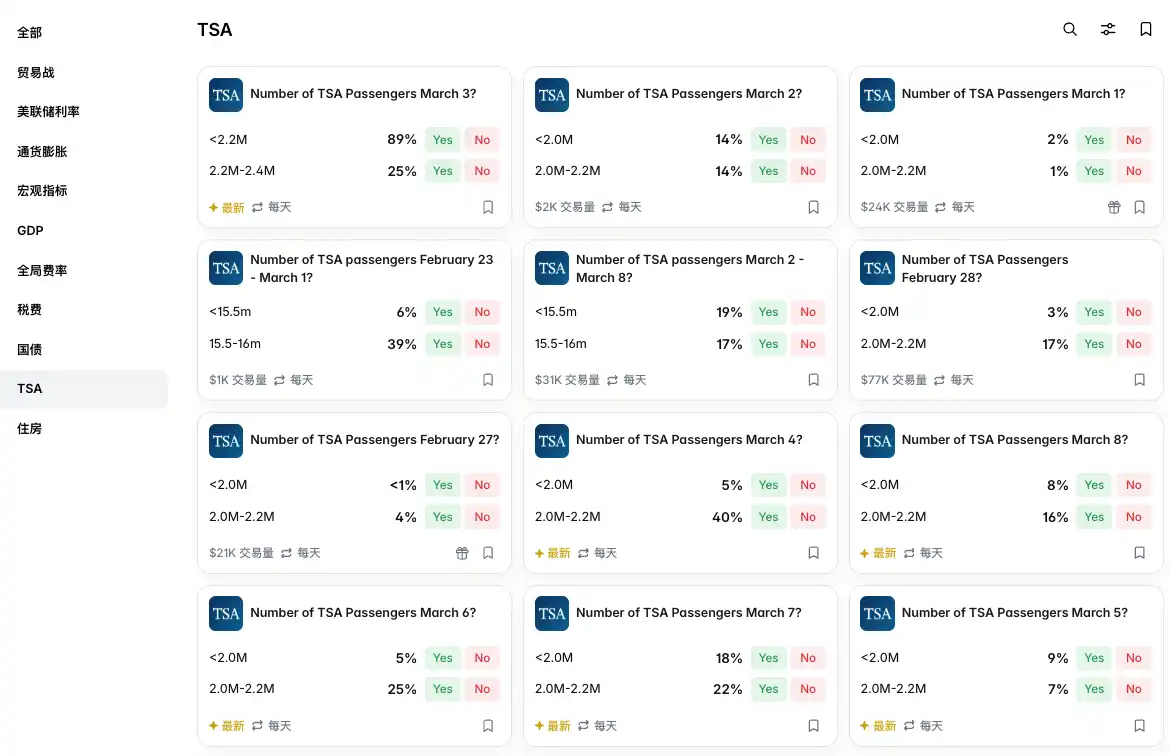
Trading around the clock, 24/7, is also one of the biggest advantages of trading such markets on Polymarket. This advantage becomes especially evident when traditional financial markets are closed. Last weekend's escalation of US-Iran conflict is a prime example.
And in this regard, Hyperliquid offers the same advantage. The perpetual contracts on Hyperliquid linked to oil and gold have no expiration date and operate 24/7 continuously.
This highlights an increasingly hard-to-ignore phenomenon: the crypto market is quietly taking on the price discovery function of traditional financial markets, especially when the latter are closed.
Traditional futures markets have fixed trading hours; CME's crude oil and gold contracts are closed on weekends, and the forex market faces liquidity drying up in the late night. This means that when geopolitical shocks erupt after Friday's close, traditional market participants are left waiting in the dark, unable to hedge, express views, or price in the event.
Last weekend, the escalation of US-Iran conflict was the latest validation. According to Bloomberg, before and after the conflict erupted, a large number of traders flocked to Hyperliquid, trading perpetual contracts linked to oil and gold to respond to geopolitical shocks—while traditional markets remained closed, the crypto derivative market was the only place with lights still on. Avi Felman, a senior executive at an investment institution, had previously predicted that "Hyperliquid will become indispensable for fund managers due to its 24/7 trading." This assessment was concretely validated in this round of conflict.
Simultaneously, gold tokenization is also accelerating another logic: when gold exists in tokenized form on-chain and is continuously priced in decentralized markets, it no longer needs to wait for the London Metal Exchange or CME to open. To some extent, the tokenized gold market is acting as a "shadow pre-market" for the traditional gold market, pricing gold in advance over the weekend, allowing price discovery to happen before the traditional market opens.
In 2020, when FTX, then the world's second-largest derivatives exchange, launched stock tokens, allowing platform users to trade Tesla and NVIDIA stocks with stablecoins, the idea was to gain pricing power. When US stocks are not trading, FTX's Tesla tokens can fill the market void, enabling users to trade Tesla stock when Tesla unveils its latest model on Saturday, influencing Nasdaq's Monday open.
Unfortunately, due to liquidity reasons, the pricing effect was never realized. Today, 6 years later, the vision of tokenizing everything has come full circle. Nowadays, platforms like Polymarket and Hyperliquid are not just considered cryptocurrency exchanges. Polymarket has been officially recognized as a polling institution and information hub, while Hyperliquid has long been seen as a new type of fully reserved product-class trading platform.
Price discovery power has always been one of the most core powers in financial infrastructure.
Back in the day, Chicago butter and egg merchants established the CME because they needed a place to discover prices and transfer risk. Over a hundred years later, the same logic is playing out on-chain, just with a different medium.
You might think the market is trading eggs, but it's actually competing for pricing power.
You may also like

The survival dilemma of small and medium exchanges behind the withdrawal anomalies exposed by AscendEX

Why Is Bitcoin Falling Below $60K? 5 Key Market Drivers Explained
Bitcoin has dropped sharply amid ETF outflows, Strategy stock weakness, AI stock rallies, and changing Fed expectations. Explore the key forces driving BTC’s latest correction and what traders should watch next.

The shift in the cloud of the air: from despising stablecoins a year ago to the high-profile entry of capital today

ETH has entered a non-consensus phase, and the turning point is approaching!

Bitcoin vs. Gold in 2026: Which Asset Performs Better in Different Markets?

What is your view on Binance's competitive advantages?
I never expected that the first application of AI x Crypto would be in security auditing

Global Launch: As predictions become the most scarce asset in the AI era, Manadia is defining the next generation of the value internet

Who is footing the bill for the $64 billion accounting frenzy?

Morning Report | CoinEx becomes a key hub for Iran to evade sanctions, involving over $3.8 billion in funds; Kalshi seeks a new round of financing, with a valuation potentially rising to $40 billion

Why do cryptocurrency projects always like to change their names?

From the white-haired stock god to the billionaire fund mogul, the smart people shorting Nvidia are all getting rich using the same framework

Morning News | The draft amendment to the People's Bank of China Law aims to clarify the legal status of digital renminbi; South Korea will transfer about 40 unregistered virtual asset service providers to law enforcement agencies

The cryptocurrency industry has entered the "Show Me" era: merely relying on vision is no longer enough

Interpreting the Ethereum Foundation's new structure: Reaffirming self-sovereignty amid institutional trends

Former SpaceX engineer reconstructs the financial execution system using first principles
Standard Chartered Bank sings a 50x rhapsody again, aiming for AAVE to reach 3500 USD
Tidal Investment: We still have a positive outlook on the AI industry chain, but the reasons have changed
The survival dilemma of small and medium exchanges behind the withdrawal anomalies exposed by AscendEX
Why Is Bitcoin Falling Below $60K? 5 Key Market Drivers Explained
Bitcoin has dropped sharply amid ETF outflows, Strategy stock weakness, AI stock rallies, and changing Fed expectations. Explore the key forces driving BTC’s latest correction and what traders should watch next.
The shift in the cloud of the air: from despising stablecoins a year ago to the high-profile entry of capital today
ETH has entered a non-consensus phase, and the turning point is approaching!
Bitcoin vs. Gold in 2026: Which Asset Performs Better in Different Markets?
What is your view on Binance's competitive advantages?


