
a16z Partner Manifesto: Boutique VC is Dead, Go Big or Go Home

Original Article Title: The Case for Scaling Venture
Original Article Author: Erik Torenberg, a16z
Translation Credit: TechFlow of DeepTide
DeepTide Summary:
In the traditional narrative of venture capital (VC), people often praise the "boutique" model, believing that scaling would lose its soul. However, a16z partner Erik Torenberg presents a contrasting view in this article: as software becomes the backbone of the American economy and the AI era dawns, startup companies' need for capital and services has undergone a qualitative change.
He believes that the VC industry is in the midst of a paradigm shift from being "judgment-driven" to being "deal-winning driven." Only "giant institutions" like a16z, equipped with a scalable platform and able to provide founders with comprehensive support, can emerge victorious in the trillion-dollar game.
This is not just an evolution of the model but also the VC industry's self-evolution under the wave of "software is eating the world."
Full Text:
In Greek classical literature, there is a meta-narrative that rises above all: that of reverence for the gods and disrespect for the gods. Icarus was burned by the sun not fundamentally because of his great ambition, but because he did not respect the divine order. A more recent example is professional wrestling. You only need to ask, "Who is respecting wrestling, and who is disrespecting wrestling?" to distinguish between the face and the heel. All good stories take one form or another of this.
Venture capital (VC) also has its own version of this story. It goes like this: "VC has been boutique in the past and has always been boutique. Those large institutions have become too big and set their goals too high. Their downfall is inevitable because their approach is simply disrespectful to this game."
I understand why people want this story to hold true. But the reality is that the world has changed, and so has venture capital.
There is now more software, leverage, and opportunity than ever before. There are also more founders building larger companies than before. The time companies stay private is longer than before. And founders' demands on VC are higher than before. Today, founders building the best companies need partners who can truly roll up their sleeves to help them win, not just write a check and wait for the outcome.
Therefore, the primary goal for venture capital firms now is to create the best interface to help founders succeed. Everything else—how to staff, how to deploy capital, what size fund to raise, how to aid in transactions, and how to allocate power to founders—is derived from this.
Mike Maples has a saying: your fund size is your strategy. Equally true is that your fund size is your belief in the future. It is your bet on the output scale of startups. Raising massive funds over the past decade may have been seen as "hubristic," but this belief is fundamentally correct. Therefore, as top firms continue to raise massive funds to deploy over the next decade, they are betting on the future and committing real resources to fulfill that promise. Scaled Venture is not a corruption of the venture capital model: it is the venture capital model finally maturing and adopting the characteristics of the companies they support.
Yes, Venture Capital Firms Are an Asset Class
In a recent podcast, Sequoia's legendary investor Roelof Botha put forth three points. First, despite the expansion of venture capital, the number of companies "winning" each year is fixed. Second, the scale of the venture capital industry means too much capital is chasing too few outstanding companies—hence, venture capital cannot scale; it is not an asset class. Third, the venture capital industry should shrink to align with the actual number of winning companies.
Roelof is one of the greatest investors of all time, and he is also a great person. However, I disagree with his points here. (Of course, it's worth noting that Sequoia has also scaled: it is one of the world's largest VC firms.)
His first point—that the number of winners is fixed—is easily disproven. In the past, about 15 companies annually reached $1 billion in revenue; now there are about 150. Not only are there more winners than before, but the winners are also much larger in scale. Although entry prices are higher, the output is much larger than before. The growth ceiling for startups has risen from $1 billion to $100 billion and now to $1 trillion or even higher. In the 2000s and early 2010s, YouTube and Instagram were considered massive $1 billion acquisitions: back then, such valuations were so rare that we referred to companies valued at $1 billion or more as "Unicorns." Now, we inherently assume that OpenAI and SpaceX will become trillion-dollar companies, with several more companies expected to follow.
Software is no longer a fringe department in the U.S. economy made up of odd, quirky individuals. Software is now the U.S. economy. Our largest companies, our national champions, are no longer General Electric and ExxonMobil but Google, Amazon, and Nvidia. Private tech companies represent 22% of the S&P 500. Software has not yet finished eating the world—indeed, it's just getting started due to the acceleration brought by AI—and it is more critical now than it was fifteen, ten, or even five years ago. Therefore, the scale that a successful software company can reach is larger than ever before.
The definition of a "software company" has also changed. Capital expenditure has increased significantly—large AI laboratories are turning into infrastructure companies with their own data centers, power facilities, and chip supply chains. Just as every company has become a software company, now every company is becoming an AI company, perhaps also an infrastructure company. More and more companies are entering the atomic world. Boundaries are becoming blurred. Companies are aggressively verticalizing, and the market potential of these vertically integrated tech giants is much larger than that of any purely software company imaginable.
This leads to why the second point—that too much capital is chasing too few companies—is wrong. Output is much greater than before, competition in the software world is much fiercer, and companies are going public much later than before. All of this means that great companies only need to raise much more capital than before. The presence of venture capital is to invest in new markets. What we have repeatedly learned is that, in the long run, the size of new markets is always much larger than we anticipate. The private market is mature enough to support top companies reaching unprecedented scales—just look at the liquidity available to today's top private companies—investors in the private and public markets now believe that the output scale of venture capital will be astonishing. We have consistently misjudged how large VC as an asset class can and should become, and venture capital is scaling up to catch up with this reality and opportunity set. The new world needs flying cars, a global satellite grid, abundant energy, and intelligence cheap enough to be unmeasured.
The reality is that many of today's best companies are capital-intensive. OpenAI needs to spend billions of dollars on GPUs—much more than anyone can imagine in computing infrastructure. Periodic Labs needs to build automated labs at an unprecedented scale for scientific innovation. Anduril needs to build the defense of the future. And all these companies need to recruit and retain the world's top talent in historically the most competitive talent market. The next generation of large winners—OpenAI, Anthropic, xAI, Anduril, Waymo, and others—are all capital-intensive and have completed massive initial fundraising at high valuations.
Modern tech companies often require hundreds of millions of dollars because the infrastructure needed to build world-changing cutting-edge technology is just too expensive. In the Internet bubble era, a "startup" entered into a greenfield, envisioning the needs of consumers still waiting for dial-up connections. Today, a startup enters an economy shaped by three decades of tech giants. Supporting "Little Tech" means you must be prepared to arm David to fight against a few Goliaths. Companies in 2021 did indeed receive overfunding, with a large portion of funds going to sales and marketing to sell products that are not even close to a 10x improvement. But today, funds are flowing into research and development or capital expenditure.
Therefore, the winner's scale is much larger than before and requires raising much more funding than before, often from the outset. So, the venture capital industry naturally had to become much larger to meet this demand. Given the scale of the opportunity set, this scalability makes sense. If the VC scale were too large for the opportunities venture capitalists invest in, we should see the largest institutional returns not performing well. But we have not seen this at all. As top venture capital firms expanded, they repeatedly achieved very high multiple returns—so did the limited partners (LPs) who could access these firms. A prominent venture capitalist once said that a $1 billion fund could never achieve a 3x return: because it's too large. Since then, certain companies have already exceeded a 10x return on a $1 billion fund. Some point to underperforming institutions to criticize this asset class, but any industry conforming to a power-law distribution will have significant winners and a long tail of losers. The ability of institutions to win deals without relying on pricing is why they can sustain returns. In other major asset classes, products are sold to or loans are made to the highest bidder. But VC is a typical asset class that competes on dimensions other than price. VC is the only asset class with significant persistence in the top 10% of institutions.
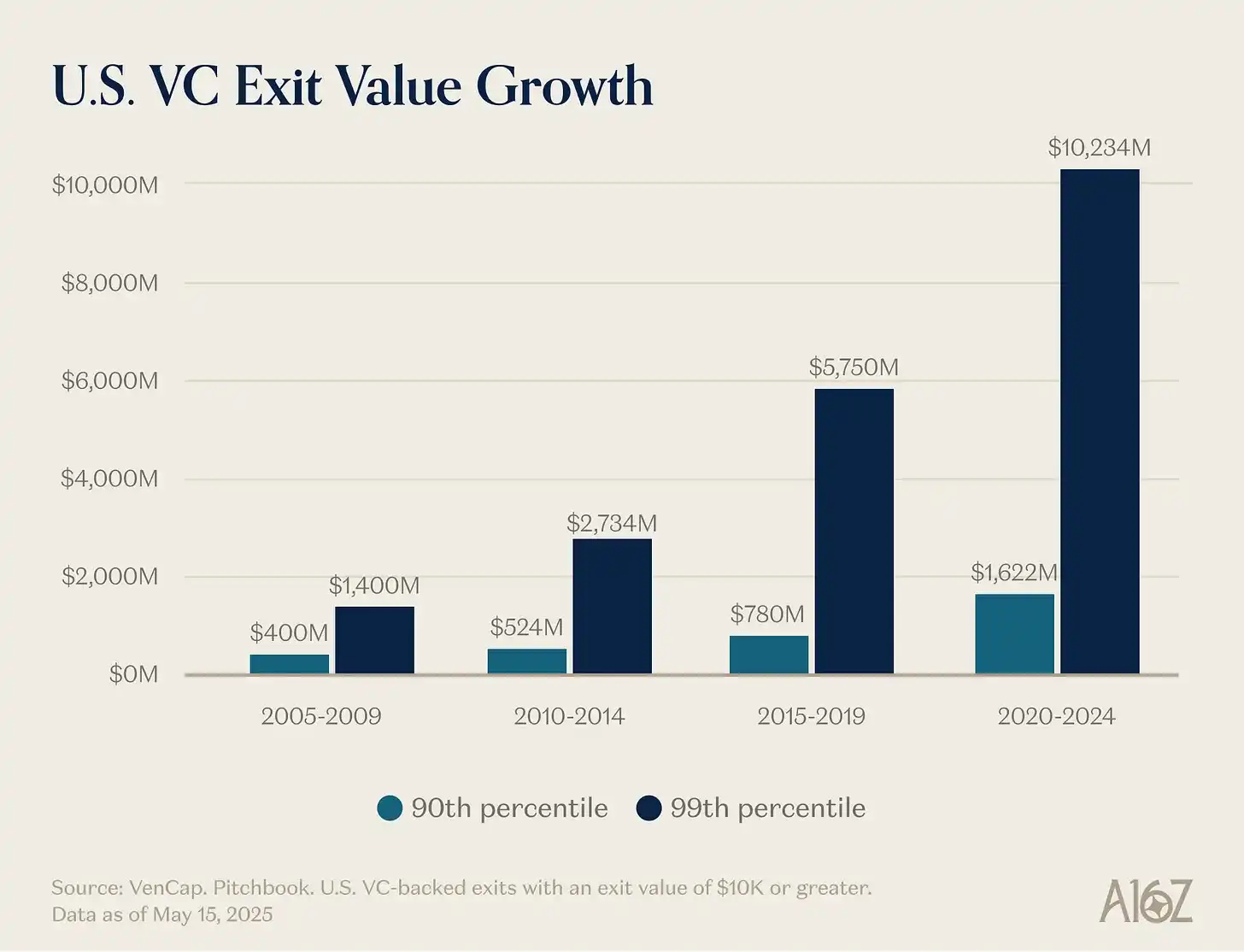
The final point—that the venture capital industry should shrink—is also a misconception. Or, at least, it is a bad thing for the tech ecosystem, for the goal of creating more generational technology companies, and ultimately for the world. Some complain about the secondary effects of increasing venture funding (there are indeed some!), but it also comes with a significant increase in startup valuations. Advocating for a smaller VC ecosystem likely means advocating for smaller startup valuations, which may result in slower economic development. This perhaps explains why Garry Tan said in a recent podcast, "Venture capital can and should be 10 times larger than it is today." Indeed, if there is no longer competition, if an individual LP or GP is the "only player," it may benefit them. But having more venture capital than today is clearly better for founders and the world.
To further illustrate this point, let's consider a thought experiment. First, do you think there should be many more founders in the world than there are today?
Second, if we suddenly had many more founders, what kind of institutions could best serve them?
We don't intend to spend too much time on the first question, as if you are reading this article, you probably know we believe the answer is obviously yes. We don't need to tell you much about why founders are so exceptional and essential. Great founders create great companies. Great companies create new products that improve the world, aligning our collective energy and risk appetite toward productive goals and creating disproportionate new enterprise value and interesting job opportunities in the world. And, we are far from such an equilibrium state: where everyone capable of founding a great company has already done so. That's why more venture capital helps unlock more growth in the startup ecosystem.
But the second question is even more interesting. If we were to wake up tomorrow and the number of entrepreneurs was 10 times or 100 times what it is today (spoiler alert: this is happening), what would the world of entrepreneurship look like? In a more competitive world, how should venture capital evolve?
Win Some, Not No Lose
Marc Andreessen likes to tell a story about a famous venture capitalist who said the VC game is like being in a sushi-go-round restaurant: “A thousand startups go by, you meet with all of them. And then every once in a while, you reach out and pick up one of the startups off the sushi-go-round and make an investment in it.”
The kind of VC that Marc describes—that was pretty much every VC for most of the past few decades. Back in the 1990s or 2000s, winning deals was this easy. And because of that, for a great VC, the only skill that really mattered was judgment: the ability to tell good companies from bad ones.
Many VCs still operate this way—essentially the same as VCs did in 1995. But beneath their feet, the world has changed enormously.
Winning deals used to be easy—just as easy as picking sushi off the conveyor belt. But now, it’s insanely difficult. People sometimes describe VC as akin to poker: knowing when to pick companies, knowing what price to get in, etc. But that might overlook the total war you must now wage to win the best deals. Old-school VCs fondly remember the days when they were “the only game in town” and could dictate terms to founders. But now there are thousands of VC firms, and founders have an easier time than ever getting a term sheet. So, more and more, the best deals involve extremely intense competition.
The paradigm shift is that the ability to win deals is becoming just as important—if not more so—as picking the right companies. What good is getting into a deal if you can’t win it?
Several things have driven this change. First, the surge in venture capital firms means VCs need to compete with each other to win deals. With more companies now than ever competing for talent, customers, and market share, the best founders need strong institutional co-investors to help them win. They need firms with resources, networks, and infrastructure to give their portfolio companies an edge.
Second, as companies stay private longer, investors can invest in later stages—when companies have more validation, making deal competition fiercer—and still achieve venture-like returns.
The final reason, and perhaps the least obvious one, is that picking has become slightly easier. The VC market has become more efficient. On one hand, there are more serial entrepreneurs constantly creating iconic companies. If Musk, Sam Altman, Palmer Luckey, or a genius serial entrepreneur start a company, VCs will quickly line up to try to invest. On the other hand, companies are reaching crazy scale faster (due to staying private longer and having more upside), so the risk of Product-Market Fit (PMF) has decreased relative to the past. Finally, because there are now so many great institutions, founders contacting investors is much easier, making it hard to find a deal that other firms are not already pursuing. Picking is still at the core of the game — selecting the right enduring company at the right price — but it is no longer the most critical step to date.
Ben Horowitz hypothesizes that the ability to win consistently automatically makes you a top-tier firm: because if you can win, the best deals will come to you. Only when you can win any deal do you have the right to pick. You may not pick the right one, but at least you have the chance. Of course, if your firm can repeatedly win the best deals, you will attract the best pickers to work for you because they want to get into the best companies. (As Martin Casado said when recruiting Matt Bornstein to join a16z, "Come here to win deals, not lose deals.") Therefore, the ability to win will create a virtuous cycle, thus enhancing your picking ability.
Because of these reasons, the game rules have changed. My partner David Haber describes the transformation that venture capital needs to undergo in response to this change in his article: "Firm > Fund."
In my definition, a fund has only one objective function: "How can I generate the most carry with the fewest people in the shortest time?" And a firm, in my definition, has two goals. One is to deliver outstanding returns, but the second is equally intriguing: "How can I build a compounding source of competitive advantage?"
The best firms will be able to invest their management fee to strengthen their moat.
How Can I Help?
Ten years ago, as I entered the venture capital world, I quickly noticed that among all the VC firms, Y Combinator was playing a different game. YC was able to secure preferential terms with excellent companies at scale, while also seemingly able to serve them at scale. Compared to YC, many other VCs were playing a commoditized game. I would go to Demo Day and think to myself: I'm at the poker table, and YC is the house. We are all happy to be there, but YC is the happiest.
I quickly realized that YC has a moat. It has a positive network effect. It has several structural advantages. People used to say that VC firms couldn't have a moat or an unfair advantage — after all, you're just providing capital. But YC clearly has one.
That's why YC remains so strong even as it scales. Some critics don't like the scale of YC; they believe YC will eventually fail because they feel it lacks a soul. People have been predicting YC's demise for the past 10 years. But it hasn't happened. During that time, they changed the entire partner team, and yet demise did not occur. A moat is a moat. Just like the companies they invest in, the moat possessed by a scaled VC firm is more than just the brand.
Then I realized I didn't want to play the homogenized VC game, so I co-founded my own firm, along with other strategic assets. These assets are highly valuable and have generated significant deal flow, so I tasted the differentiation game. Around the same time, I began observing another firm building its own moat: a16z. So, when the opportunity arose to join a16z a few years later, I knew I had to seize it.
If you believe in venture capital as an industry, you — almost by definition — believe in power law distribution. But if you truly believe the VC game is governed by power laws, then you should believe that venture capital itself will follow a power law. The best founders will cluster around those institutions that can most decisively help them win. The best returns will concentrate in those institutions. Capital will follow suit.
For founders trying to build the next iconic company, scaled VC firms offer an extremely attractive product. They provide expertise and full-service support for everything a rapidly growing company needs — hiring, go-to-market strategy (GTM), legal, financial, PR, government relations. They offer enough funding to truly get you where you need to go, rather than forcing you to penny-pinch and struggle when faced with well-funded competitors. They provide immense reach — access to everyone you need to know in the business and government spheres, introductions to every key Fortune 500 CEO and world leader. They offer a 100x opportunity to talent, with a global network of tens of thousands of top engineers, executives, and operators ready to join your company when needed. And they are omnipresent — meaning everywhere for the most ambitious founders.
At the same time, for LPs, scaled VC firms are also an extremely attractive product for the most critical simple question: Are the companies driving the most returns choosing them? The answer is simple — yes. All major companies are partnering with scaled platforms, usually at the earliest stages. Scaled VC firms have more swings at bat to capture those critical companies and more ammunition to persuade them to accept their investment. This is reflected in the returns.
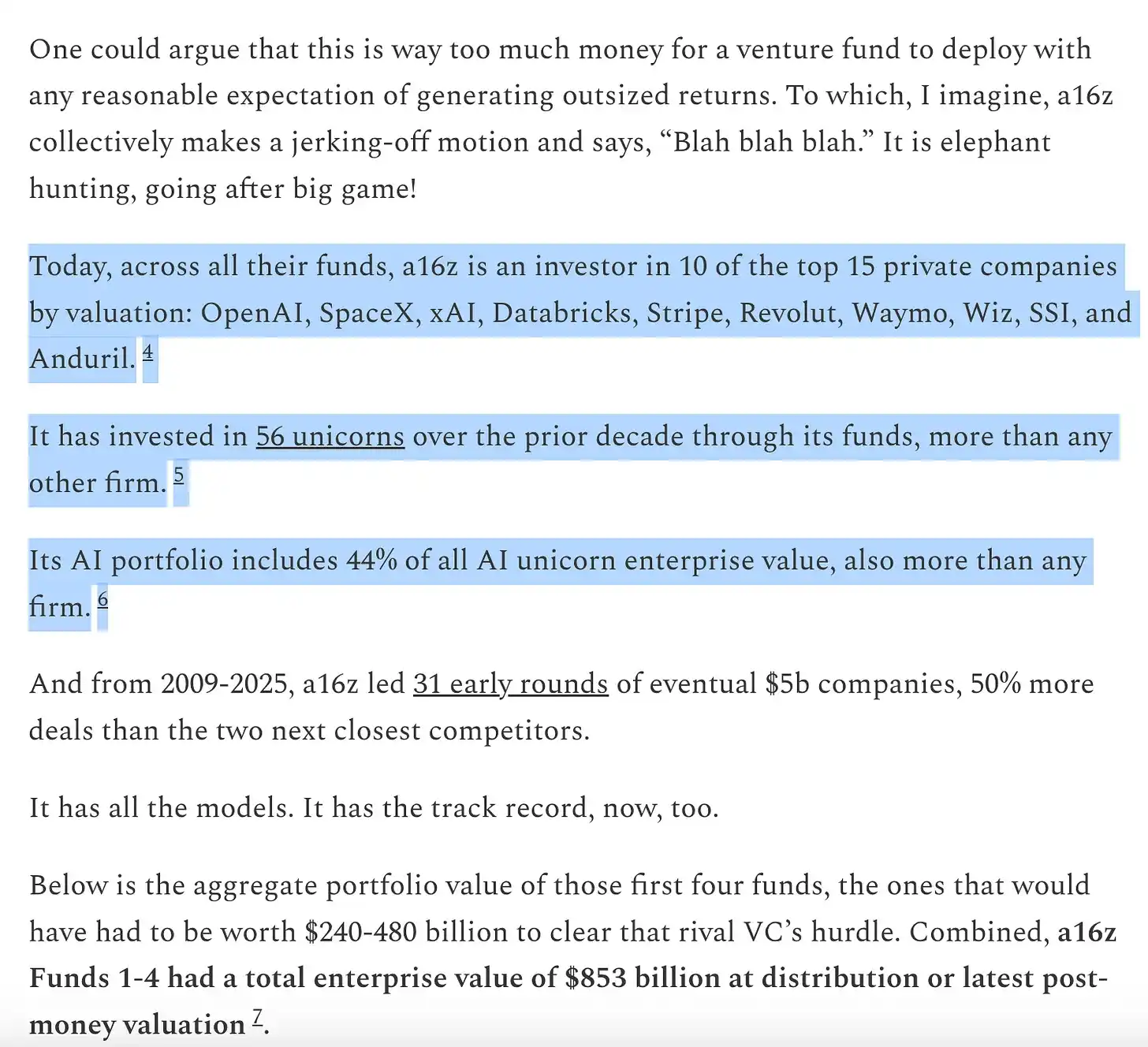
Excerpt from Packy's work: https://www.a16z.news/p/the-power-brokers
Think about where we are right now. Eight of the world's top ten companies are headquartered on the West Coast, backed by venture capital. Over the past few years, these companies have provided most of the global new enterprise value growth. At the same time, the world's fastest-growing private companies are also primarily venture-backed West Coast-based companies: those that emerged just a few years ago are rapidly heading towards trillion-dollar valuations and the largest IPOs in history. The best companies are winning bigger than ever before, and they all have the support of scaled institutions. Of course, not every scaled institution performs well—I can think of some epic meltdown cases—but almost every great tech company has the backing of scaled institutions.
Go Big or Go Boutique
I don't think the future is solely about scaled venture capital institutions. Like in all areas touched by the internet, venture capital will become a "barbell": at one end, a few super large players, and at the other end, many small, specialized institutions, each operating in specific domains and networks, often collaborating with scaled venture capital institutions.
What venture capital is going through is what typically happens when software eats the services industry. On one end are four or five large powerful players, usually vertically integrated service organizations; on the other end are highly differentiated small long-tail suppliers whose establishment is benefiting from an industry being "disrupted." Both ends of the barbell will thrive: their strategies are complementary and mutually empowering. We also back hundreds of boutique fund managers outside institutions and will continue to support and work closely with them.
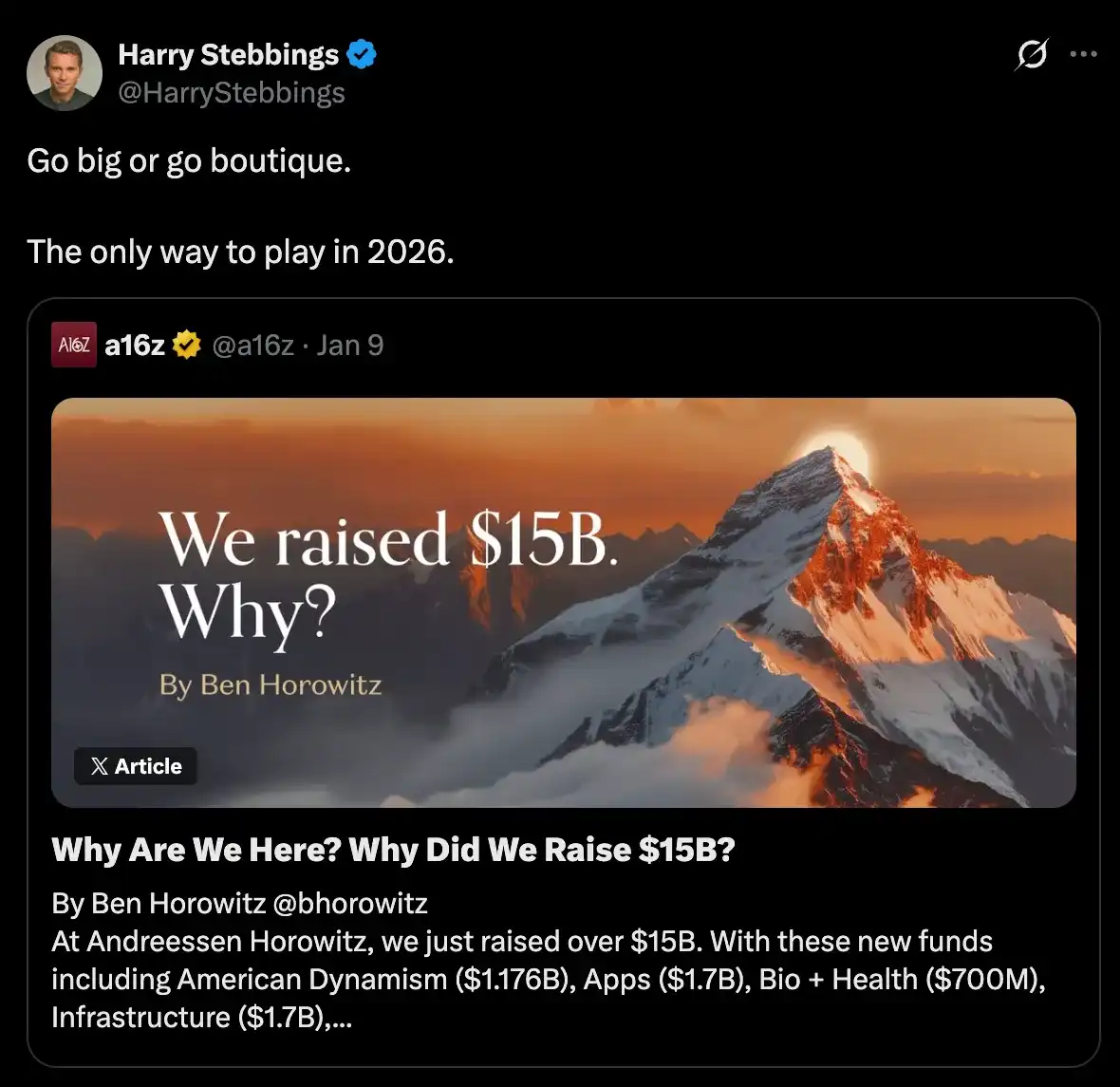
Both scaled and boutique will do well, the institutions in the middle will be in trouble: these funds are too large to bear the cost of missing out on giant winners, yet too small to compete with larger institutions that can provide better products for founders structurally. a16z's uniqueness lies in being at both ends of the barbell—it is both a set of specialized boutique institutions and benefits from a scaled platform team.
The institutions that can best collaborate with founders will win. This could mean super large backup funds, unprecedented reach, or a huge complementary service platform. Or it could mean irreplicable expertise, excellent advisory services, or simply incredible risk tolerance.
The venture capital world has an old joke: VCs think every product can be improved, every great technology can be scaled, every industry can be disrupted—except their own.
In fact, many VCs don't like the presence of scale-focused venture firms at all. They believe that scale sacrifices some soul. Some say Silicon Valley is now too commercial, no longer the land of misfits. (Anyone who claims there aren't enough misfits in tech clearly hasn't been to a San Francisco tech party or listened to the MOTS podcast.) Others resort to a self-serving narrative — that change is "disrespect for the game" — while ignoring that the game has always served founders, and always will. Of course, they will never express the same concerns about the companies they support, whose very existence is built on achieving massive scale and changing the rules of their respective industries.
To say that scale-focused venture firms are not "real venture capital" is like saying NBA teams shooting more three-pointers are not playing "real basketball." You may not think so, but the old rules of the game no longer dominate. The world has changed, and a new paradigm has emerged. Ironically, the way the rules are changing here mirrors how the startups supported by VCs are changing the rules of their industries. When technology disrupts an industry and a new set of scale players emerges, something is always lost in this process. But more is gained as well. VCs understand this trade-off firsthand — they have always supported this trade-off. The disruption VCs want to see in startups is the same disruption they expect in venture capital itself. Software is eating the world, and it certainly won't stop at VC.
You may also like

Why does OKX want to start a new company with the parent company of the New York Stock Exchange?

The interim executive director of the Ethereum Foundation speaks out: What is our mission?

Standard Chartered Bank sings a 50x rhapsody again, aiming for AAVE to reach 3500 USD
Tidal Investment: We still have a positive outlook on the AI industry chain, but the reasons have changed

Former SpaceX engineer reconstructs the financial execution system using first principles

Why Is PAXG Price Different From Gold? 5 Reasons Crypto Traders Should Know

The cryptocurrency industry has entered the "Show Me" era: merely relying on vision is no longer enough

WEEX OpenAPI 101: 5 Powerful Modules, AI Trading Tools, and Grab Up to 70% Revenue Opportunities
Learn how WEEX OpenAPI connects traders, developers, AI agents, and trading platforms. Discover WEEX API features, Binance-compatible integration, automated trading workflows, revenue opportunities, and ecosystem possibilities.

Morning News | The draft amendment to the People's Bank of China Law aims to clarify the legal status of digital renminbi; South Korea will transfer about 40 unregistered virtual asset service providers to law enforcement agencies

Interpreting the Ethereum Foundation's new structure: Reaffirming self-sovereignty amid institutional trends

Interview with NDV Founder Jason Huang: Popping the AI Bubble and the Myth of Microstrategy, Seeking the Ultimate Ace in the Crypto Market
Morning Report | Former Ethereum Foundation researcher establishes Ethlabs; EU Parliament Economic Committee passes digital euro regulatory proposal

Dragonfly partner Haseeb: The fastest-growing companies in the future may all be stuck at 149 people

How xBubble Breaks the Deadlock in VC's Heavy Investment in the OPC Economy

The encrypted unicorn Blockstream is deeply embroiled in a serious fraud case

Morning Report | The South Korean Financial Services Commission plans to expand the regulatory sandbox to include virtual assets; the parent company of the New York Stock Exchange, ICE, has reached a partnership with OKX to jointly establish a cryptocu...

Exclusive Interview with Strategy CEO: Putting Aside the Sale of 32 BTC, the 60 Trillion AI Intelligence is the Ultimate Fate of Bitcoin

TRON revitalizes the image of the bull, creating a more approachable brand character
Why does OKX want to start a new company with the parent company of the New York Stock Exchange?
The interim executive director of the Ethereum Foundation speaks out: What is our mission?
Standard Chartered Bank sings a 50x rhapsody again, aiming for AAVE to reach 3500 USD
Tidal Investment: We still have a positive outlook on the AI industry chain, but the reasons have changed
Former SpaceX engineer reconstructs the financial execution system using first principles
Why Is PAXG Price Different From Gold? 5 Reasons Crypto Traders Should Know


