
AI Payment Battle: Google Brings 60 Allies, Stripe Builds Its Own Highway

By Lin Wanwan
Money is already living in the code.
Half a year ago, AI payments were just PowerPoint slides at conferences. Today's AI is becoming the "cashier."
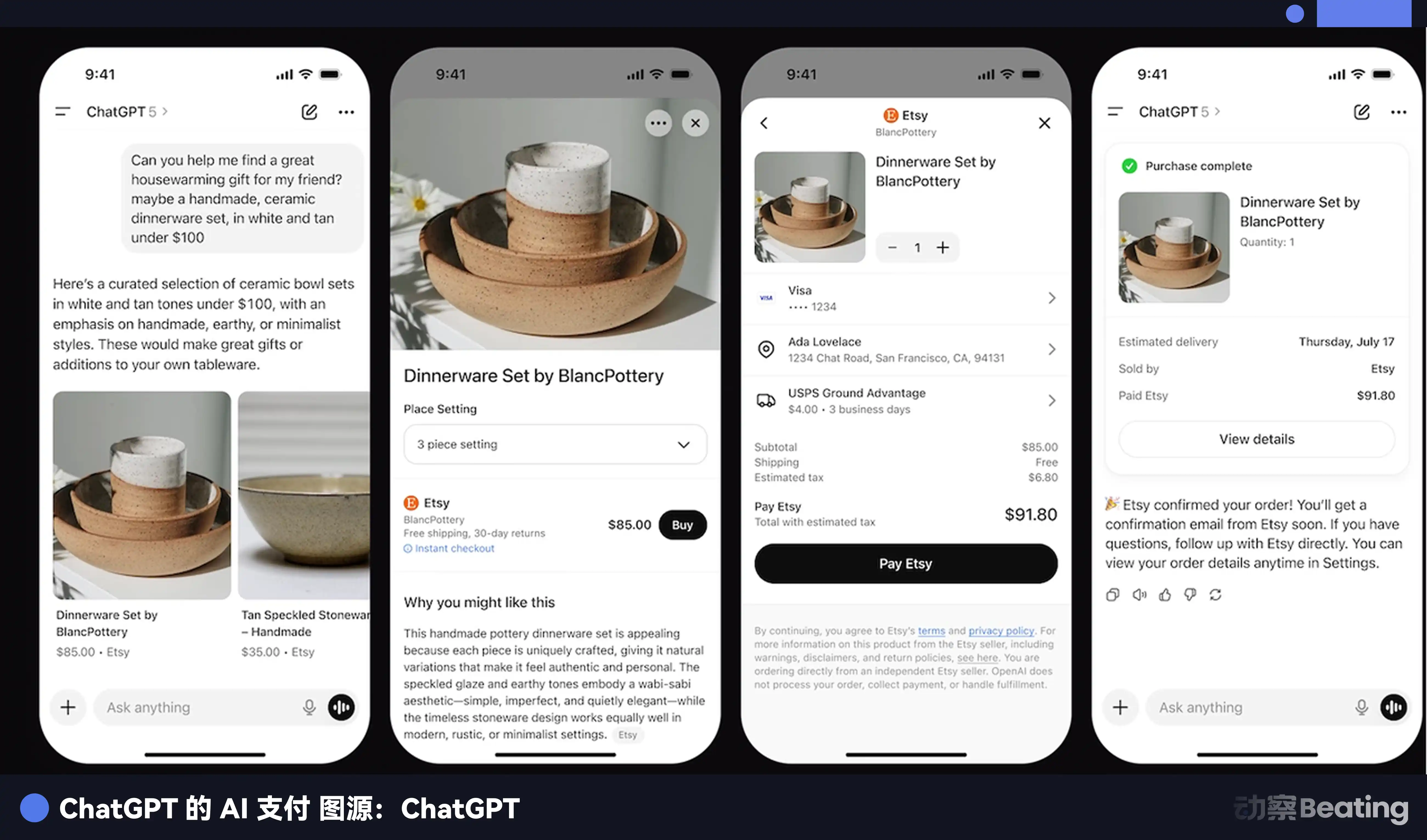
Now, when you open ChatGPT and search for any product, you will see a blue Buy button. Enter your address, make the payment, and receive the shipment. No redirects, no opening of any web pages throughout the process.
Last week, Google also caught up by integrating Etsy and Wayfair products into search and Gemini, enabling direct checkout within the conversation. Microsoft's Copilot simultaneously launched shopping checkout features. Meta's Zuckerberg just announced a full shift to AI-powered commerce agents.
However, a more covert commercial story is quietly unfolding—the toll war of AI payments, which traces back to the two major AI payment camps in the fall of 2025.
On September 16, Google brought together over 60 companies and released an "AI Agent Payment Protocol."
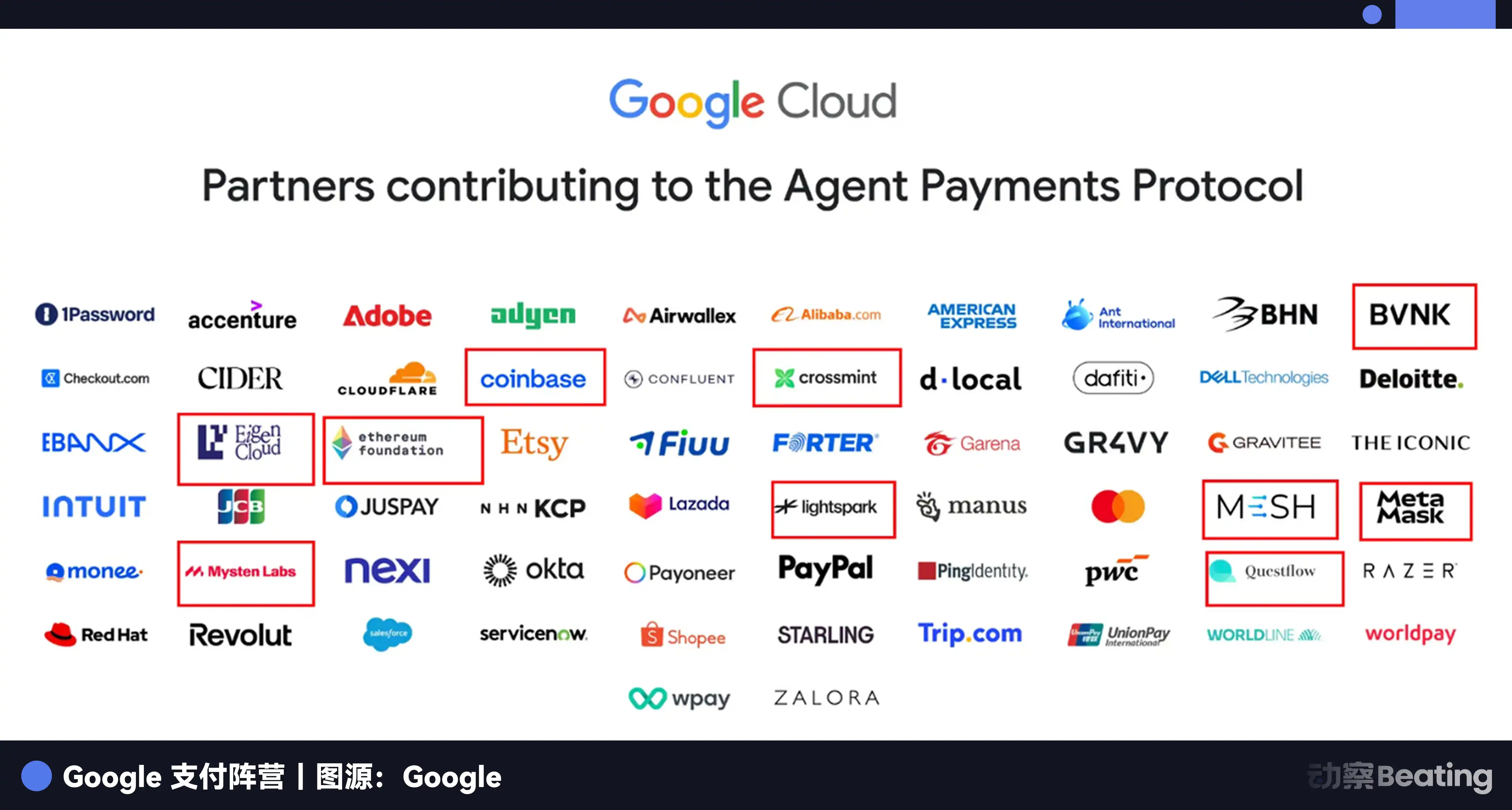
The list is full of familiar faces from traditional finance: Mastercard, PayPal, American Express, along with several allies from the tech industry.
On the 29th of the same month, Stripe, in collaboration with OpenAI, released another set of protocols called the Agentic Commerce Protocol, referred to as ACP. Stripe also announced that it is testing agent-based business solutions based on ACP with AI companies such as Microsoft Copilot, Anthropic, Perplexity, all of which are native AI players.
These two lists have very little overlap. Coinbase appears in both Google's AP2 ecosystem and is also a long-term partner of Stripe.
What these two camps are fighting for is a seemingly mundane but trillion-dollar question: When AI spends money on behalf of humans, whose pipes does the money flow through?
You may think this matter is far from you. But consider this: you now let ChatGPT help you book flights, let AI assistants help you compare prices when shopping, let agents automatically purchase office supplies—these scenarios are visibly becoming a reality. Every transaction requires a pipeline to move money from your pocket to the merchant.
Whoever fixes this pipe will be able to toll every transaction.
That's the essence of this war.
12 Months That Changed the Roundtable
The story starts with a dinner.
In the summer of 2024, Stripe hosted a fintech roundtable at its San Francisco headquarters with then-U.S. Deputy Secretary of the Treasury Wally Adeyemo.
A group of payment company bosses sat together, including two people who had never met before: Stripe's CEO Patrick Collison, and a young man named Zach Abrams.
Abrams had an impressive background. He and his partner Sean Yu were serial entrepreneurs who sold their first company, Evenly (a P2P payment app similar to the U.S. version of Venmo), to Square (now called Block) in 2013.
Later, Abrams joined Coinbase as a consumer product lead and also served as Chief Product Officer at Brex; Yu had previously worked as an engineer at DoorDash and Airbnb. In 2022, the two teamed up again to found Bridge, helping businesses access stablecoin payments with clients including Coinbase and SpaceX.
The roundtable discussion was initially broad, but Abrams later recalled being shocked: over 90% of the time was spent talking about stablecoins, even though his was the only stablecoin company present.
Prior to that, Bridge had been pursuing Stripe as a client, looking to integrate its technology into Stripe's payment system. However, after that roundtable, things took a different turn. Collison began to frequently meet with Abrams, not to discuss collaboration, but to discuss acquisition.
In October 2024, Stripe announced the acquisition of Bridge for $1.1 billion. Bridge had just closed a $40 million Series A round in March 2024, valuing the company at $200 million.
The acquisition price was 5.5 times the valuation, potentially exceeding 100 times based on revenue multiples. In a post-investment statement, Sequoia Capital said they believed Bridge would join the ranks of Instagram, YouTube, PayPal, and WhatsApp, becoming "the kind of company that, after being acquired, actually achieves its full potential."
In February 2025, the transaction officially settled. A 60-person team from Bridge moved into Stripe's San Francisco headquarters and joined the biweekly new employee bootcamp.
This was just the beginning.
Things then quickly took off. In May 2025, Stripe launched the Stablecoin Treasury, enabling businesses in 101 countries to hold stablecoin balances directly and transact globally in stablecoins.
Also in the same month, ChatGPT introduced a shopping recommendation feature, allowing users to search for products, compare options within the chatbox, and then proceed to the merchant's website to place an order.
In June, Stripe acquired the wallet company Privy.
Privy's mission was simple: to enable any app to embed a digital wallet, allowing users to make on-chain payments without the need to download any additional cryptocurrency wallet software. At that time, already over 75 million accounts were using it.
Patrick Collison tweeted a very straightforward statement: "Money has to reside somewhere, and Privy builds the world's best programmable vaults."
In September, a joint incubation with crypto investment giant Paradigm led to the launch of Tempo Chain, a new blockchain designed specifically for payments. Paradigm's co-founder Matt Huang (also a board member of Stripe) personally led the initiative.
The lineup of companies joining the Tempo design camp reads like an all-star game for the payment industry: OpenAI, Anthropic, Deutsche Bank, Visa, Shopify, Standard Chartered Bank, Brazil's largest digital bank Nubank, DoorDash, Revolut, and South Korea's e-commerce giant Coupang.
Stripe CEO Patrick Collison said Tempo could achieve processing tens of thousands of transactions per second, sub-second confirmations, transaction fees of less than 0.1 cent, with fees denominated in a US dollar stablecoin, eliminating the need for holding highly volatile native tokens.
In the same month, Stripe and OpenAI officially released the ACP protocol and simultaneously launched ChatGPT's Instant Checkout feature—allowing users to directly place orders and make payments within the chat box without redirection or card swiping.
The first batch of support came from Etsy merchants, followed by Shopify's millions of merchants.
In October, Tempo completed a $500 million Series A funding round led by Greenoaks and Thrive Capital, with participation from Sequoia, Ribbit Capital, and SV Angel, valuing the company at $5 billion. A blockchain project that had just been established for less than two months achieved a $50 billion valuation. Neither Stripe nor Paradigm participated in this funding round.
In December, Tempo opened for public testing. UBS, Mastercard, and European buy now, pay later giant Klarna joined the list of partners.
Bridge's Zach Abrams also announced that Bridge had applied for a national bank trust charter in the United States to comply with the requirements of the "GENIUS Act," a stablecoin regulatory act that will take effect in July 2025.
Connecting these events: an $11 billion token issuance capability, creating a stablecoin financial account, acquiring a wallet company, incubating an exclusive blockchain, and applying for a banking license.
From issuance to establishing a blockchain to wallet creation to protocol definition to licensing, Stripe has done each layer on its own.
In contrast, Google has over 60 alliances, an open protocol, and a single code repository. Google has everything except its own blockchain, stablecoin, and wallet.
An alliance is the result of a group of people sitting down for a meeting. What Stripe has done is a system that can go live with a single person's decision.
The month Google released AP2, Tempo was already in testing.
Regardless of the winner, Circle is always a stable winner
In this war, there is a player even smarter than Stripe.
It does not take sides, it does not fight, it does not even speak much. But regardless of who wins, it always comes out as a stable winner.
This character is called Circle.
Circle has issued a stablecoin called USDC, which is currently the most compliant digital dollar in the world.
Another company, Tether, has issued a larger-scale USDT, but there are concerns about reserve adequacy, audit reliability, and regulatory uncertainty. Retail investors may not care about these issues, but in the world of AI, there may be hundreds of thousands of automated trades executed daily, each requiring robust audits. No reputable company would dare to base its AI trading on a compliant but questionable stablecoin.
And Circle? It's a publicly traded company on the NYSE. The SEC has reviewed its books, financial reports are disclosed quarterly, and the composition of reserves — how much is in U.S. Treasury bonds and how much in cash — is visible to the world.
So, you can observe an interesting situation: Stripe's Stablecoin Financial Account supports USDC. OpenAI uses USDC through Stripe. Within the Google camp, Coinbase's integration also uses USDC.
The two camps are in a fierce battle for the "entry point," contending for control over the interface and protocol through which AI spends money. But regardless of who controls the entry point, money will ultimately need to be converted into a stablecoin to operate on the blockchain. In the compliant stablecoin market, USDC has almost no rival.
While the two camps fight for the entry point, Circle holds the settlement volume.
Let's look at some data. By 2024, the global stablecoin transfer volume will reach $15.6 trillion. What does this number represent? It's nearly equivalent to Visa's total annual transaction volume.
Something less than a decade old has already matched the network Visa took sixty years to build.
And AI transactions are just getting started. Consulting firm Edgar Dunn & Co. predicts that by 2030, AI-driven transactions will reach $1.7 trillion. It's highly probable that each of these $1.7 trillion transactions will flow through stablecoins.
In June 2025, U.S. Treasury Secretary Scott Bessent publicly stated during a Senate hearing that a $2 trillion market cap for stablecoins is "a very reasonable expectation."
Patrick Collison himself has said: the average interest rate on U.S. bank deposits is only 0.40%, and $4 trillion in bank deposits even have a zero interest rate.
He believes this unfriendly consumer practice is a "losing strategy," and young people will sooner or later convert their money into higher-yielding stablecoins.
He was talking about the trend. And Circle happens to be right in the middle of that trend.
Epilogue
Finally, let's zoom out a bit.
The debate over the standardization of AI payments appears to be a turf war between two business camps on the surface. But what it reflects is a deeper question: Is our human-designed financial system adequate as AI starts to independently participate in economic activities?
Patrick Collison envisions a future where AI Agents are the primary participants in economic activities. They compare prices, make purchases, process payments, settle transactions, all without the need for any human to push a button. This is the epitome of efficiency, but also the frontier of risk.
Google and the alliance of traditional finance see another future: AI should be grafted onto existing human financial infrastructure, operating within the existing regulatory framework, and functioning within the established framework of trust.
Two futures, two logics, two camps.
But regardless of which future arrives, one thing is certain: AI will spend money, money will run on the chain, and on-chain settlement will require stablecoins.
So Circle continues to win. Stripe and Google continue to fight. Regulation continues to chase. Merchants continue to onboard. Consumers continue to be oblivious to which pipe their money is flowing through.
Until one day, when something goes wrong with a purchase made by AI on your behalf, and you realize that neither a person nor an AI knows who to contact for a refund.
On that day, everyone will suddenly remember those unanswered questions from today.
But by that day, the pipe will have been fixed, and tolls will have started to be collected.
History is always like this: you board first, then pay the fare later.
It's just that this time, the vehicle is moving too fast.
You may also like

Why does OKX want to start a new company with the parent company of the New York Stock Exchange?

The interim executive director of the Ethereum Foundation speaks out: What is our mission?

Standard Chartered Bank sings a 50x rhapsody again, aiming for AAVE to reach 3500 USD
Tidal Investment: We still have a positive outlook on the AI industry chain, but the reasons have changed

Former SpaceX engineer reconstructs the financial execution system using first principles

Why Is PAXG Price Different From Gold? 5 Reasons Crypto Traders Should Know

The cryptocurrency industry has entered the "Show Me" era: merely relying on vision is no longer enough

WEEX OpenAPI 101: 5 Powerful Modules, AI Trading Tools, and Grab Up to 70% Revenue Opportunities
Learn how WEEX OpenAPI connects traders, developers, AI agents, and trading platforms. Discover WEEX API features, Binance-compatible integration, automated trading workflows, revenue opportunities, and ecosystem possibilities.

Morning News | The draft amendment to the People's Bank of China Law aims to clarify the legal status of digital renminbi; South Korea will transfer about 40 unregistered virtual asset service providers to law enforcement agencies

Interpreting the Ethereum Foundation's new structure: Reaffirming self-sovereignty amid institutional trends

Interview with NDV Founder Jason Huang: Popping the AI Bubble and the Myth of Microstrategy, Seeking the Ultimate Ace in the Crypto Market
Morning Report | Former Ethereum Foundation researcher establishes Ethlabs; EU Parliament Economic Committee passes digital euro regulatory proposal

Dragonfly partner Haseeb: The fastest-growing companies in the future may all be stuck at 149 people

How xBubble Breaks the Deadlock in VC's Heavy Investment in the OPC Economy

The encrypted unicorn Blockstream is deeply embroiled in a serious fraud case

Morning Report | The South Korean Financial Services Commission plans to expand the regulatory sandbox to include virtual assets; the parent company of the New York Stock Exchange, ICE, has reached a partnership with OKX to jointly establish a cryptocu...

Exclusive Interview with Strategy CEO: Putting Aside the Sale of 32 BTC, the 60 Trillion AI Intelligence is the Ultimate Fate of Bitcoin

TRON revitalizes the image of the bull, creating a more approachable brand character
Why does OKX want to start a new company with the parent company of the New York Stock Exchange?
The interim executive director of the Ethereum Foundation speaks out: What is our mission?
Standard Chartered Bank sings a 50x rhapsody again, aiming for AAVE to reach 3500 USD
Tidal Investment: We still have a positive outlook on the AI industry chain, but the reasons have changed
Former SpaceX engineer reconstructs the financial execution system using first principles
Why Is PAXG Price Different From Gold? 5 Reasons Crypto Traders Should Know


