
An Analysis of the Solana Re-Staking Market, Nurturing Exciting New DeFi Opportunities



Original Article Title: The bullish case for Solana (Re)staking
Original Author: tradetheflow_, Crypto Researcher
Original Translation: Ashley, BlockBeats
Editor's Note: Currently, Ethereum is the main battleground for restaking, but with Solana's rapid development in this bull market cycle, its low cost, high throughput, and strong network effects make it a potential hotbed for restaking. The author explores the market opportunity for Solana restaking, including its ecosystem maturity, innovative potential, network scalability, and optimization for DeFi capital efficiency.
The following is the original content (slightly reorganized for better readability):
Restaking is a simple yet powerful concept: it allows staked assets to be reused across multiple decentralized services, or what Jito calls Node Consensus Networks (NCNs).
This approach brings several advantages. Most notably, it enhances the security and integrity of decentralized services, enabling them to leverage Layer 1 economic security without having to expend significant resources designing their own security model (which is often more fragile). For stakers, it also improves capital efficiency, as a single asset can simultaneously secure multiple decentralized services, potentially achieving a higher return on capital.
In fact, many industry thought leaders believe that restaking is a disruptive innovation that can build a more secure, flexible, and scalable blockchain environment, accelerating industry development. This has also attracted high market attention, making restaking one of the largest tracks by TVL on Ethereum.
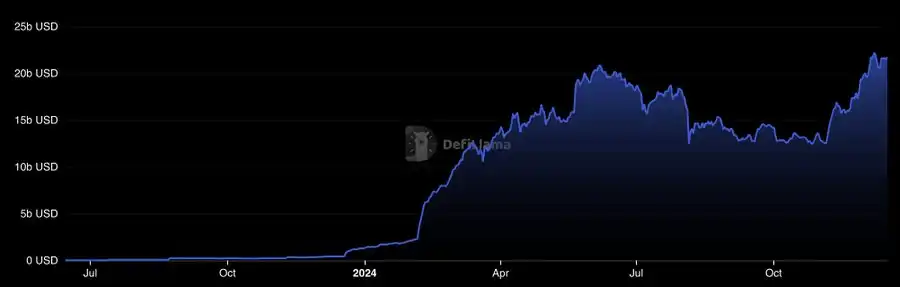
However, so far, restaking has been mainly concentrated on Ethereum, as it is considered the blockchain with the highest current economic security and broadest PoS adoption. But with Solana's strong growth during this bull market cycle—especially in contrast to Ethereum's mainnet activity relatively stagnant and significant liquidity moving to L2 solutions (like Base)—a new question arises: Does Solana have enough reasons to support restaking?
In this article, we will explore the potential of restaking on Solana from various perspectives and analyze the feasibility of this market opportunity. Let's delve deeper.
Solana's Maturity is Sufficient to Support Staking
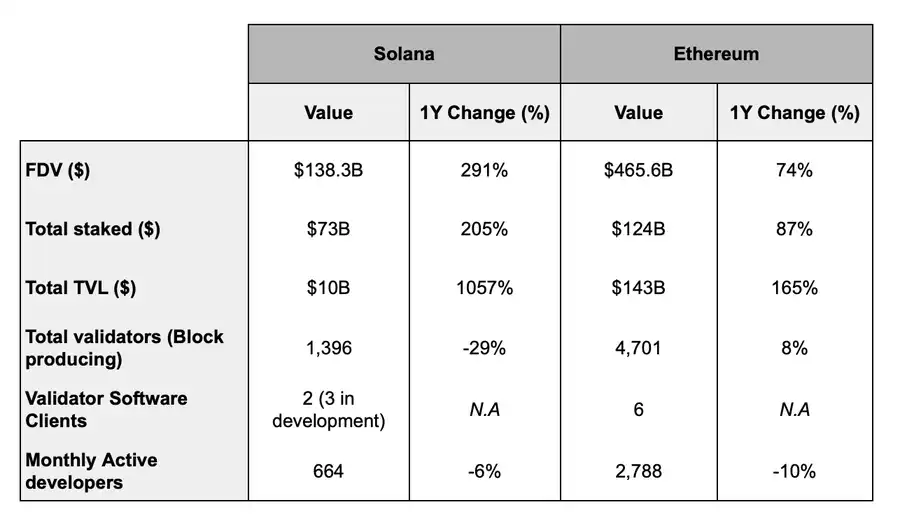
For staking to occur, the underlying blockchain must have strong economic security. This has been Ethereum's advantage all along: currently, the Ethereum mainnet has 34.3 million ETH staked (worth about $124 billion), 4,701 block producing validators, six consensus clients, and as one of the longest-standing and most reliable blockchains for application development, it has a high industry reputation. Therefore, Ethereum has become the preferred platform for staking.
However, humans tend to extrapolate the present into the future, assuming that Ethereum will always maintain its dominant position. Yet history tells us that technological disruptions are often driven by creative destruction. For example, there was a time when Yahoo was considered the dominant player in the search engine space, only to be surpassed by Google later on. Similarly, IBM was once thought to be the ultimate winner in the personal computing space, but eventually, Apple took over.
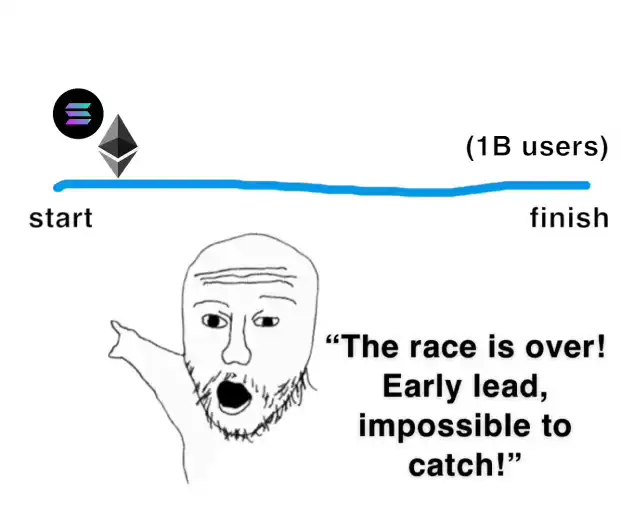
So, are we witnessing a similar moment in Ethereum's history? Is it still necessary to have the entire staking stack rely entirely on Ethereum? Especially as trends show new asset issuance on the Ethereum mainnet shifting towards L1s like Solana or L2s like Base, and with increased uncertainty about Ethereum's development direction, we need to reconsider this issue.
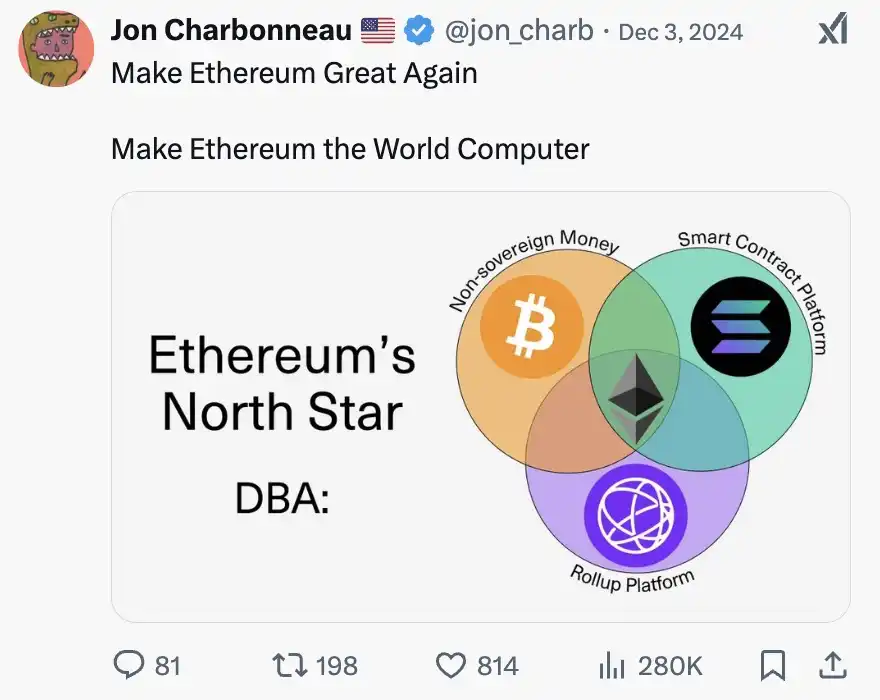
If we consider staking to be indeed a game-changing technology, then we should consider expanding it to other L1s, not just limiting it to Ethereum. This would allow developers to freely choose from which consensus layer to derive trust.
In this context, Solana is undoubtedly a strong candidate for staking. Since this bull market, Solana has become the fastest-growing L1 and has significantly improved its economic security and ecosystem maturity. Currently, about 65% of SOL's circulating supply is staked, with a total value of around $73 billion (compared to $24 billion just a year ago). Additionally, Solana has close to 1,400 block producing validator nodes and supports two existing client validators, with future additions like Firedancer, Sig, and Agave.
More importantly, Solana is known for its extremely low transaction costs and fast transaction speeds, with increasing adoption among users and developer communities. Solana is currently the fastest public chain in the crypto industry for application development, achieving true organic growth and successfully overcoming the cold start problem, establishing a strong network effect. All of this indicates that Solana's ecosystem is mature enough, making staking on Solana a practical possibility.
Re-Staking on Solana Holds Greater Potential than Ethereum
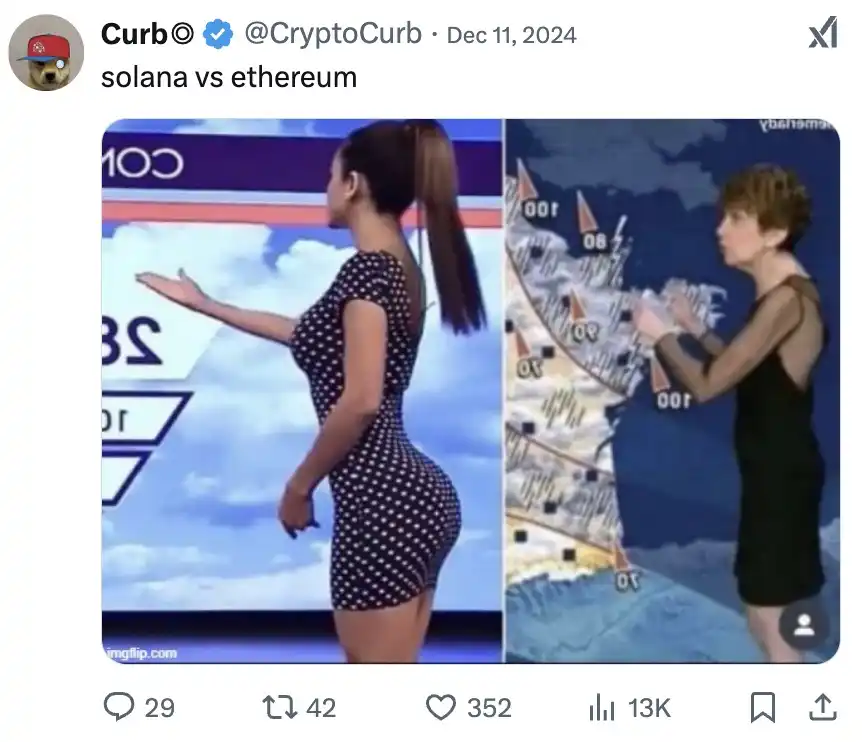
Ethereum is a smart contract pioneer, but its high Gas fees have limited the development scope of on-chain applications. Solana's architecture, on the other hand, allows developers to create richer application forms at the L1 level. Therefore, it can be argued that the design space for re-staking on Solana is larger than that of Ethereum.
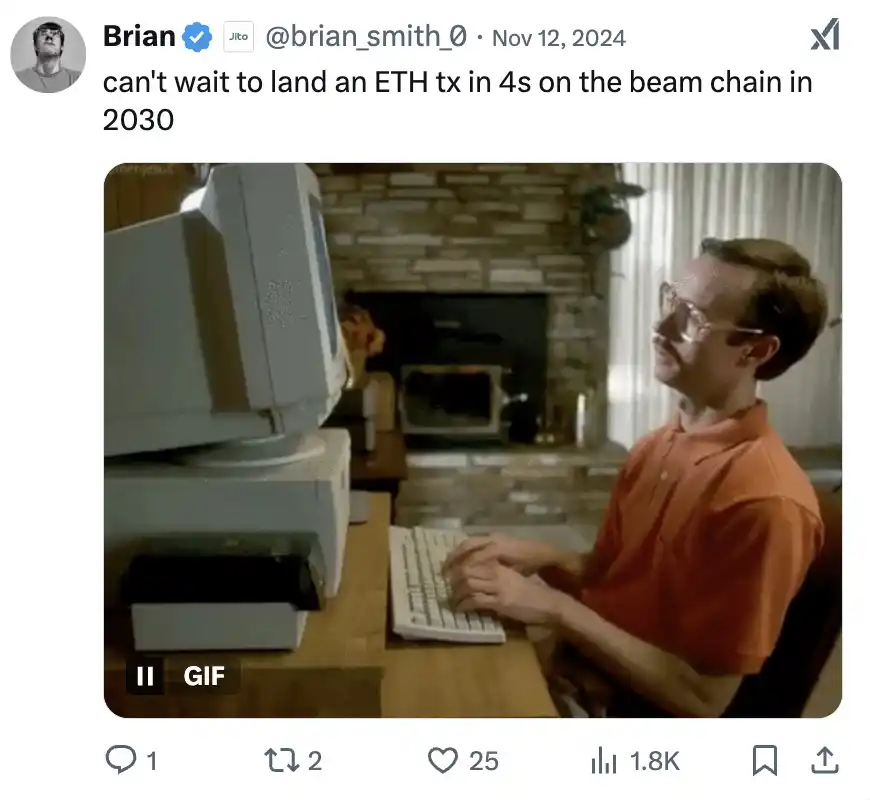
Firstly, Solana's low transaction costs and computational costs have lowered the entry barrier for Node Consensus Networks (NCNs). Unlike Ethereum, where a high fixed cost restricts participation, Solana supports smaller-scale, cost-effective, and more efficient NCNs deployments, allowing optimization for specific use cases. This not only enables more services to be outsourced, reducing reliance on direct on-chain applications, but also enhances the ecosystem's interoperability.
Secondly, NCNs on Solana can handle more complex operations, and code can be deployed more densely without impacting on-chain computing capability—unlike Ethereum's EigenLayer design. This enables on-chain verifiability, on-chain reward distribution, and on-chain data publication, enhancing the overall flexibility and robustness of re-staking. While Ethereum has served as a testing ground for re-staking, in the long run, Solana's re-staking potential in real-world applications seems greater.
Furthermore, in terms of Valuable Re-Staking Tokens (VRTs), Solana also has significant advantages over Ethereum. On one hand, Solana's low costs can significantly reduce the operational costs of liquidity VRT providers. In a business model where every basis point is crucial, this cost optimization not only increases profitability but also promotes market competition, creating a more vibrant ecosystem where different VRTs can offer diversified re-staking strategies and more flexible slashing conditions.
On the other hand, liquidity re-staking on Solana is more affordable for users because low transaction costs lower the entry barrier, allowing them to more conveniently use liquidity VRTs in various DeFi applications without constantly worrying about high fees. This is crucial for driving long-term capital inflows.
Re-Staking Can Drive Innovation on the Solana Network
The vision of Solana has always been to become a global computing interface that allows everyone to build applications on top of it. To achieve this goal, Solana has been focused on increasing the underlying chain's throughput and reducing latency.
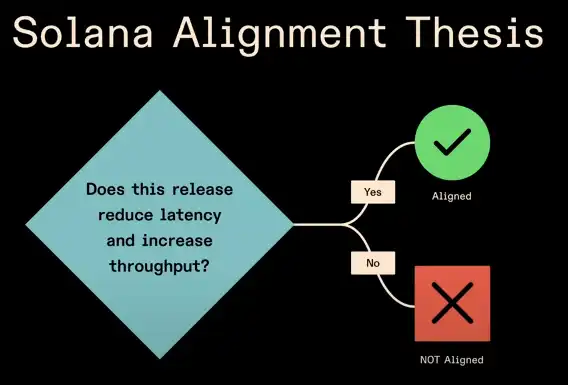
This is a strong and reasonable vision. However, physical laws cannot be defied, and we cannot increase throughput by 10x or reduce latency by 10x in a short period of time. Achieving an order of magnitude improvement requires significant resources and long-term efforts. Therefore, although it may not be achievable in the short term, people have gradually realized that not all computation needs to happen on L1. This point is also reflected in recent discussions about "network extensions."
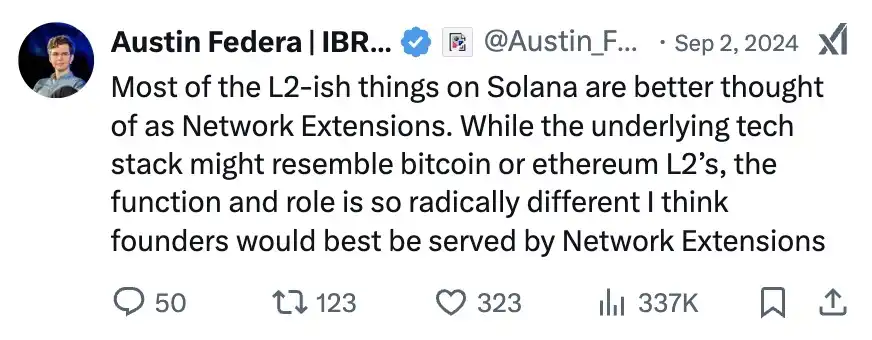
From this perspective, re-staking can bring new design possibilities for the extension of the Solana network and the "network extensions" plan. The design space is vast, and although it is currently unclear how this mechanism will be specifically implemented, it is likely to evolve into a powerful infrastructure-level extension tool. For example, the @SonicSVM project claims to be the first Layer 2 specifically designed for sovereign games in the Solana ecosystem, built on HyperGrid, the horizontal scaling framework for the Solana virtual machine. The project plans to leverage Jito (Re)staking to enhance the security and operational efficiency of its SVM, supporting multi-functional applications in the Solana ecosystem, including gaming, DeFi, and other use cases.
In addition, the strong security provided by the re-staking mechanism can effectively enhance the reliability of the Solana network. For example, Jito TipRouter NCN is currently under development, aiming to decentralize MEV tip distribution and enhance its security. Another example is Nozomi, a protocol launched by @temporal_xyz, which will use Jito (Re)staking to reshape Solana's transaction microstructure and address issues such as sandwich attacks, slippage, and transaction timeouts. These innovations align with Solana's long-term vision and can significantly optimize user experience, making Solana not only fast and cost-effective but also more secure, stable, and user-friendly.
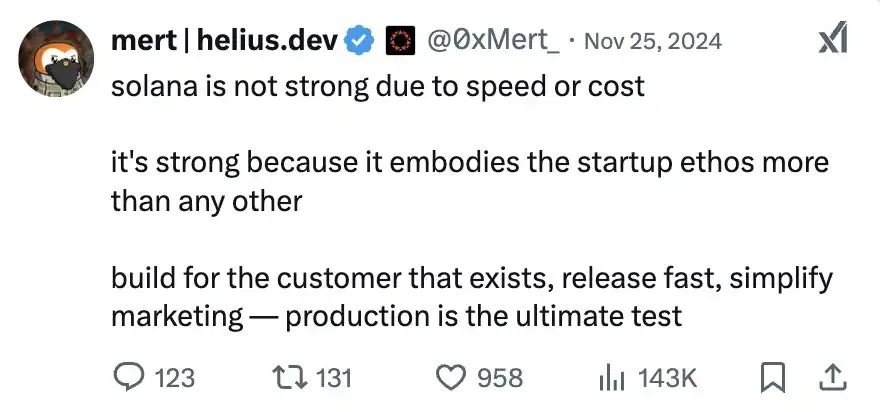
In addition to high performance and robust on-chain data metrics, Solana also embodies an entrepreneurial spirit. Over the past few years, we have witnessed the rise of a series of successful projects such as Jito, Kamino, Jupiter, and Helium. But this is just the beginning, as the number of projects choosing to build in the Solana ecosystem continues to grow.
If Solana is becoming the preferred public chain for developers, then Once staking will undoubtedly have a place in it. It can extend Solana's economic security to a range of key services in its ecosystem, such as oracles, cross-chain bridges, and sorters, even though these components usually do not run directly on L1 but are still crucial parts of the ecosystem.
While smart contracts and their interactions benefit from Solana's security, these peripheral components often still require independent economic security guarantees. This means that either they need to raise a significant amount of capital to incentivize validators or compromise on security. This can lead to a paradox: the smart contract layer may be secure, and the computational results correct, but if the oracle provides incorrect data, the entire system is still at risk. From a security perspective, the security of the entire system ultimately depends on its weakest link.
Therefore, some key services in the Solana ecosystem can leverage Once staking to enhance their security. For example, @switchboardxyz, a permissionless oracle network on Solana, is collaborating with Jito (Re)staking to ensure the reliability of its data sources. If this pattern successfully takes hold, it will simultaneously enhance the security and stability of the Solana network.
Once Staking Optimizes DeFi Users' Capital Efficiency
Once staking offers a higher annualized return compared to regular staking on Solana. Since one of the core goals of DeFi users is to optimize capital efficiency, Once staking has become a highly attractive option. It allows DeFi users on Solana to unlock new yield opportunities without additional capital injection. For example, instead of purchasing liquidity staking tokens to earn SOL staking rewards and use them in the DeFi ecosystem, users can opt to buy liquidity once staking tokens, not only achieving a higher APY but also continuing to operate freely within the DeFi ecosystem.
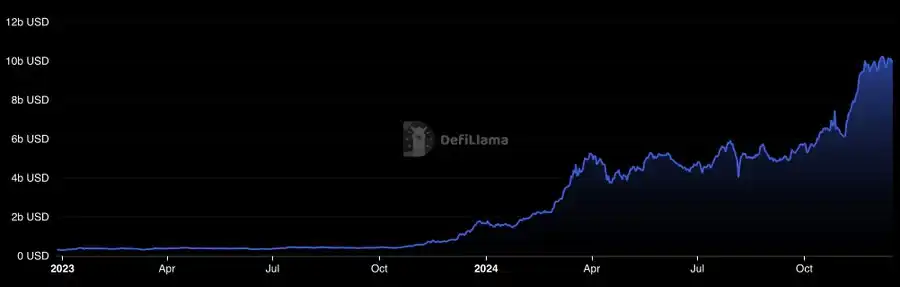
Considering the rapid growth of DeFi in the Solana ecosystem, we can assume that a mechanism that optimizes capital efficiency will help attract significant liquidity in the long term. In fact, DeFi activity on Solana is surging, with the total value locked in Solana DeFi growing from $1 billion to $10 billion in the past year, and the growth trend remains strong, further demonstrating the market potential of Solana's Once staking.
Summary
Re-staking on Solana is still in the early experimental stage, but it has already shown tremendous potential, and many interesting use cases are gradually emerging. Assuming that, in the long run, Solana can capture a market share comparable to Ethereum's staking market, its market opportunity will be significant.
Currently, Solana's re-staking infrastructure is mainly dominated by two core protocols: Solayer and Jito (Re)staking. As a pioneer, Solayer has already built a complete re-staking stack and achieved over $3.5 billion TVL. However, in the long term, Jito is more likely to become the dominant player in this narrative. With a strong technical foundation, the highest TVL in the Solana ecosystem, and a clear vision, Jito has established its leadership position in the Solana ecosystem. Furthermore, Jito's re-staking stack is designed to be highly flexible and has built-in liquidity re-staking token integration from the start, while supporting multiple assets, further enhancing its future growth potential.
Nevertheless, I would like to conclude with a quote from Freeman Dyson:
“When a great innovation appears, it will almost always be in a chaotic, incomplete, and confusing form. Even its discoverers can only understand half of it, and for others, it is a mystery. If an idea does not seem crazy at first, it has no hope.”
This quote perfectly describes the current state of Solana re-staking: early-stage, full of potential, and nurturing brand new DeFi opportunities.
You may also like

In the name of charity, for the benefit of the family: How the Trump family turned charity into profit?

Will Gold Break $4,500 After Tonight's Fed Decision? What XAUT and PAXG Traders Need to Know

Cursor, why did you get on Musk's spaceship?

Morning Report | DeepSeek completes over $7 billion in financing, with a valuation exceeding $50 billion; Musk's personal wealth has surpassed the total market value of Bitcoin

SharpLink CEO: How to understand that Ethereum developers have just surpassed 1 million?

Morning Report | MiCA grace period expires on July 1; Kalshi's trading volume in the first week of the World Cup breaks $5.1 billion, setting a record

The foundation of SpaceX's trillion-dollar valuation: Who is dividing Musk's annual capital expenditure of tens of billions?

How to exit after asset tokenization?

The stablecoin positioning battle escalates: When compliance is just a ticket to entry, will USD1 become the biggest winner?

A16Z: The sun bears witness, SpaceX is worth 7.5 trillion
Mergers and acquisitions in the cryptocurrency market are exceptionally active

Concerns Behind the Binance Customer Service Controversy

SpaceX Stock Prediction After the IPO: Can SPCX Reach $200 Before QQQ Inclusion?

Congratulations to Carl Moon on His Historic Ferrari Challenge Le Mans Podium Triumph
Crypto influencer and racing enthusiast Carl Moon finished third in the Ferrari Challenge Le Mans Coppa Shell class, marking his best result of the year. As his racing partner and sponsor, WEEX celebrates this remarkable achievement and continues to lead crypto’s journey beyond boundaries, uniting the innovation of digital assets with the passion of motorsport.
Can the CLARITY Act Become Law by July 4? Everything You Need to Know About the Final Battle

France vs Senegal World Cup 2026: Mbappe’s New Era Begins Against a Historic Rival
What is the connection between Huang Zheng of Pinduoduo and blockchain?

Morning Report | Prediction market platforms like Kalshi and Polymarket jointly sue Kentucky over 14.25% trading tax; Bridgewater founder discusses decision-making in the AI era: principled thinking should run parallel to AI, human insight remains irre...
In the name of charity, for the benefit of the family: How the Trump family turned charity into profit?
Will Gold Break $4,500 After Tonight's Fed Decision? What XAUT and PAXG Traders Need to Know
Cursor, why did you get on Musk's spaceship?
Morning Report | DeepSeek completes over $7 billion in financing, with a valuation exceeding $50 billion; Musk's personal wealth has surpassed the total market value of Bitcoin
SharpLink CEO: How to understand that Ethereum developers have just surpassed 1 million?
Morning Report | MiCA grace period expires on July 1; Kalshi's trading volume in the first week of the World Cup breaks $5.1 billion, setting a record


