
Anthropic's IPO Gamble: At the Most Unlikely Moment, It Chose to Say No


Imagine this scenario.
You're three months behind on your utility bills, you went to the hospital last month, you file your taxes diligently every year. These things seem unrelated.
But in a certain AI system, these three pieces of information are aggregated, generating a red dot on a map. That red dot represents your location and a law enforcement directive targeted at you.
This is not science fiction. In early 2026, the U.S. Federal Immigration Agency carried out a large-scale sweep operation in Minneapolis, powered by this logic. The relevant AI system comes from a data company called Palantir, which integrates immigrants' medical records, utility bills, and tax information into an algorithm, coldly marking out pursuit targets one by one.
AI is being weaponized. Not a future tense, but a present one.
The question is no longer whether it will happen, but who has the right to decide what it can and cannot do.
On February 27, 2026, that question received a disturbing answer.
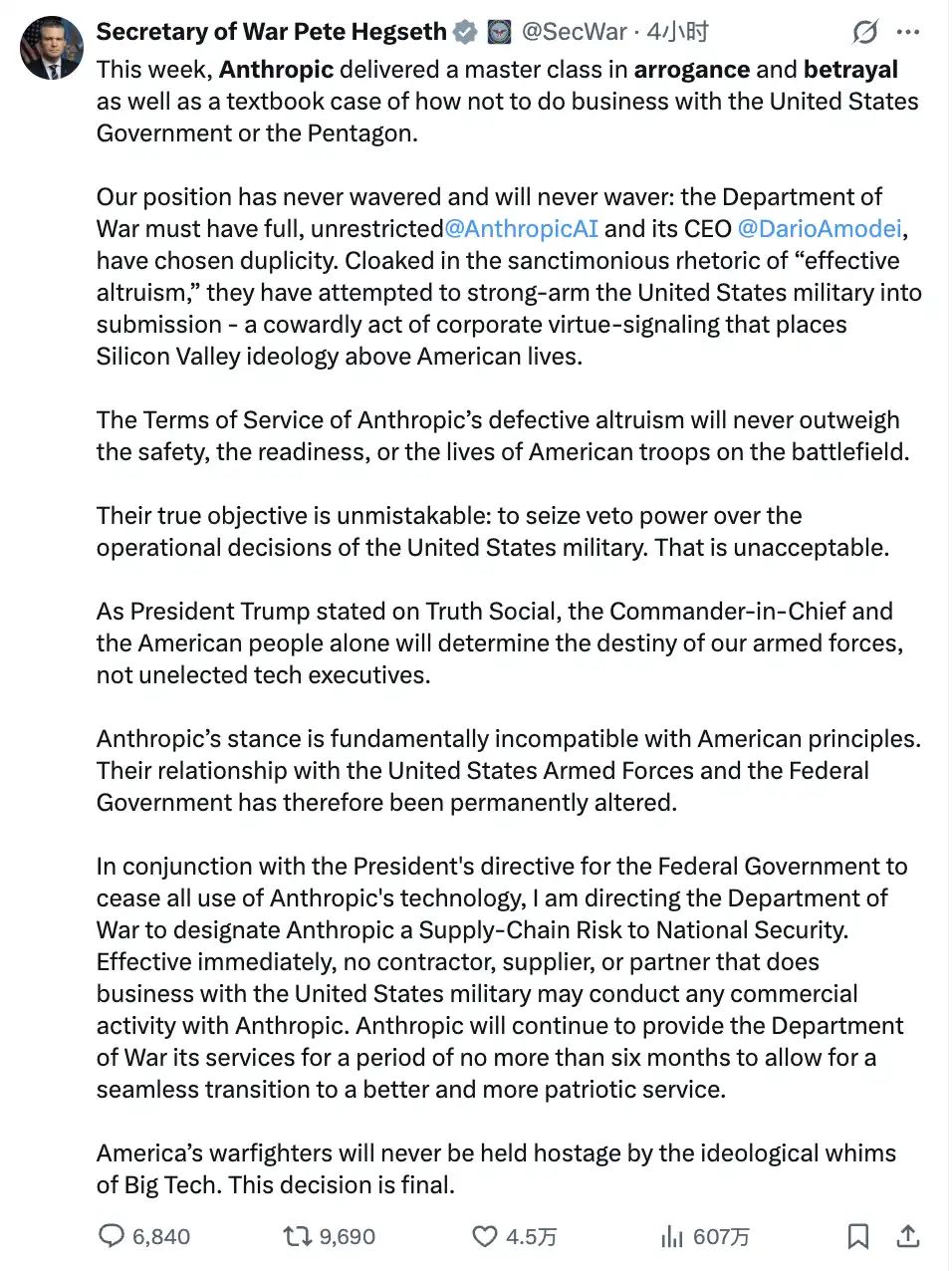
On that day, a company called Anthropic—an AI company, the developer of the conversational AI product Claude, a competitor on the level of ChatGPT—was formally banned by the U.S. government. The reason for the ban was its refusal to allow its AI to be used to monitor U.S. citizens and autonomously decide on targets for elimination.
It was classified as a "national security risk" because it said, "It can't be used this way."
What a Company Preparing for an IPO Needs Most
Before answering "Why Anthropic wouldn't compromise," it is necessary to understand where it stands now.
Anthropic is one of the world's most highly valued AI companies, valued at $380 billion, with a full-year revenue of $14 billion in 2025. Its biggest shareholder is Amazon, with a stake exceeding any other shareholder. Its AI model Claude is one of the fastest-growing AI products in the enterprise market currently.
By any standard, this is a company ready to go public. In fact, Anthropic is indeed preparing for an IPO this year, allowing everyday people to buy its stock.
What does a company preparing for an IPO need most? The answer requires little thought: stability, predictability, and no regulatory troubles. Any negative event could affect investor confidence in the company and thereby depress the IPO pricing.
Then, things took a turn in the completely opposite direction.
In July 2025, the Pentagon simultaneously awarded a contract of up to $200 million to Anthropic, OpenAI (developer of ChatGPT), Google, and Musk's xAI, with the goal of integrating cutting-edge AI into the U.S. military system. This was the largest government procurement in AI history.
Notably, Anthropic's contract contained a detail that the other three companies did not have. It explicitly stated two usage restrictions: Claude could not be used for mass surveillance of American citizens or for autonomous weapons systems without human oversight.
OpenAI, Google, xAI, all agreed that the military could use AI for all legal purposes without any additional limitations. Only Anthropic drew two red lines in the contract.
These two red lines later became the starting point of all troubles.
Ultimatum
In February 2026, the Pentagon decided to pressure Anthropic.
Secretary of Defense Pete Hegseth issued an ultimatum to Anthropic's CEO Dario Amodei: remove the usage restrictions from the contract, allowing Claude to be used for all legal purposes. Otherwise, the Pentagon would cancel the contract and designate Anthropic as a "supply chain risk." The deadline was February 27th.
Dario's response was: No.
In a public statement, he wrote, "We understand that military decisions are made by the government, not private enterprises. But in very few cases, we believe AI may undermine rather than uphold democratic values. We have a clear conscience and cannot accept their demands."
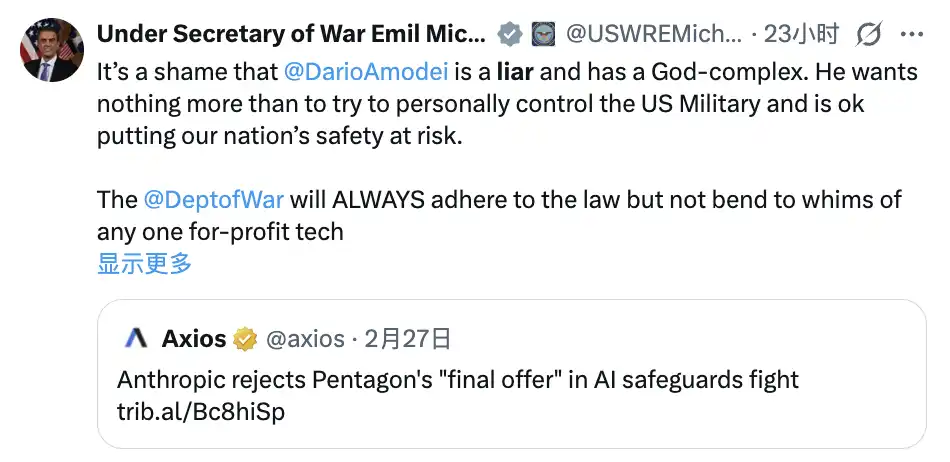
Emil Michael, the Pentagon's technology lead, then posted on social media, calling Dario a fraud, accusing him of having a god complex, and trying to personally control the U.S. military, risking national security.
Then came Trump himself. He wrote on his own social platform, Truth Social, that Anthropic was a "radical left awakening company," had "made a catastrophic mistake," and ordered: all federal government agencies to immediately cease using all of Anthropic's products, with a transition to be completed within 6 months.
The Pentagon promptly classified Anthropic as a "supply chain risk."
This label was previously only used to mark companies related to foreign adversaries such as China. It has been used for Huawei and SMIC. Now it's the turn of a US AI company headquartered in San Francisco with a valuation of $380 billion.
$200 million is a minor issue, the real trouble is here
Many people's initial reaction was: losing a $200 million government contract is just a small fraction for Anthropic with $14 billion in annual revenue.
This assessment is correct, but the focus is wrong.
The real impact comes from the "supply chain risk" label itself. It means that any company collaborating with the US military must prove that their business has not involved Anthropic. This is not a soft ethical pressure but a strict compliance requirement.
Following this line of thought downward, the scope of the impact begins to look less optimistic.
Amazon Web Services is Claude's primary operational infrastructure and also the largest cloud provider for the US government, with deep integration between the two. Data analytics company Palantir, while serving the US military and intelligence agencies, incorporates Claude. Defense tech company Anduril processes data using Claude in Pentagon-related projects.
These clients now have to make a choice: continue using Claude, facing the pressure of collaborating with a "supply chain risk" company, or replace Claude, a tool deeply integrated into their workflows.
Both options are losses for Anthropic. This is the real risk that needs to be managed, far more concerning than the $200 million contract amount.
All this trouble is happening before the IPO.
Why the rejection still happened
The situation is becoming intriguing.
A company racing towards an IPO, the last thing it needs at this critical moment is trouble, yet it chose to confront the government's pressure head-on. Is this a business judgment error or a calculated gamble?
Putting the two options side by side makes the logic clearer.
If they compromise, the contract is saved, government relations are maintained, and the immediate trouble disappears. But Anthropic's most core brand narrative of the past three years — "the most responsible AI company," "safety-first" — will develop a crack at this moment.
The greater risk is not immediate. Once Claude is actually used for large-scale surveillance or autonomous weapon decisions, once any mishap occurs, the loss will not be just a contract, but the entire company's valuation thesis. The premium that investors initially paid for the "Responsible AI" story will evaporate overnight.
If refused, lose $200 million, trigger a supply chain risk label, and have the government market essentially closed off. But the "Safety First" brand narrative has received the most expensive public endorsement in history. No PR budget could buy this effect, being banned by the government for refusing to let AI monitor the country's citizens.
There is a sentence in Dario's statement that is worth highlighting: "Our valuation and revenue only increase after this stance."
Is this sentence a PR statement or a business judgment? It could be both, but they are not contradictory.
There is a counterexample to consider. Palantir, the data company mentioned earlier that used AI to help the federal immigration agency track targets, took a completely opposite path. It deeply accommodated every government demand, being open to immigration tracking, intelligence analysis, and military targeting. As a result, it was shunned by the socially responsible mainstream capital circle for almost twenty years, unable to raise money for a long time, and shut out by major funds.
Then, in 2024, when the AI military narrative became the mainstream story of the market, its stock price rose 150% in a year, and its market value exceeded $400 billion.
Two paths, two fates, each with its own logic. Palantir exchanged twenty years of patience for today's explosion. Anthropic is betting on a different valuation logic—in today's increasingly fierce homogeneous competition among AI companies, the "safest AI" is not just an ethical stance but a real-world business moat.
Which bet is bigger is still unknown. But Anthropic clearly believes that the cost of compromise is higher than rejection.
Can Dario's Bet Pay Off?
The answer to this question depends on several variables that have not yet materialized.
First, it's the real response of enterprise customers. Will Amazon, Palantir, and Anduril actively cut off Claude due to the "supply chain risk" label or choose to stand still and wait for the situation to change? Currently, these companies have not made a public statement. If they choose to wait and see, Anthropic's actual loss will indeed be just the $200 million government contract.
Next is the practical difficulty of government replacement. Even the Pentagon's own department using Claude internally acknowledges: Claude is currently one of the most powerful AI models available, with Musk's Grok still lagging behind it technically. Replacement means downgrading use. Who will bear this cost?
Lastly, there is the unexpectedly far-reaching impact of this matter. On the very day Anthropic was banned, Sam Altman, CEO of OpenAI, the developer of ChatGPT, publicly took a stand: OpenAI and Anthropic share the "same red line" regarding the boundary of military AI use, with both companies taking a unified stance.
In other words—if the government is looking for an alternative that is willing to fully comply without any restrictions, the options are much fewer than imagined.
The process of AI weaponization will not slow down because of this. Musk's Grok has already penetrated the Pentagon's classified network, other AI companies have not missed out on military contracts, and AI-assisted weapon systems continue to iterate.
Anthropic's choice does not change this trajectory. What changes is where it stands on this trajectory.
But one thing is certain: this is the first time in the history of the AI industry that a mainstream company has openly resisted government pressure on explicit principles—even if it ultimately paid the price of being banned. Regardless of the outcome of this gamble, this precedent now exists.
The final arithmetic problem left to the reader: a $380 billion-valued company, for the sake of two principles written in a contract, gave up the entire government market and was then classified as a national security risk.
In today's AI-accelerated weaponization era, how you calculate this equation depends on what you consider the most valuable thing in the future.
You may also like

The survival dilemma of small and medium exchanges behind the withdrawal anomalies exposed by AscendEX

Why Is Bitcoin Falling Below $60K? 5 Key Market Drivers Explained
Bitcoin has dropped sharply amid ETF outflows, Strategy stock weakness, AI stock rallies, and changing Fed expectations. Explore the key forces driving BTC’s latest correction and what traders should watch next.

The shift in the cloud of the air: from despising stablecoins a year ago to the high-profile entry of capital today

ETH has entered a non-consensus phase, and the turning point is approaching!

Bitcoin vs. Gold in 2026: Which Asset Performs Better in Different Markets?

What is your view on Binance's competitive advantages?
I never expected that the first application of AI x Crypto would be in security auditing

Global Launch: As predictions become the most scarce asset in the AI era, Manadia is defining the next generation of the value internet

Who is footing the bill for the $64 billion accounting frenzy?

Morning Report | CoinEx becomes a key hub for Iran to evade sanctions, involving over $3.8 billion in funds; Kalshi seeks a new round of financing, with a valuation potentially rising to $40 billion

Why do cryptocurrency projects always like to change their names?

From the white-haired stock god to the billionaire fund mogul, the smart people shorting Nvidia are all getting rich using the same framework

Morning News | The draft amendment to the People's Bank of China Law aims to clarify the legal status of digital renminbi; South Korea will transfer about 40 unregistered virtual asset service providers to law enforcement agencies

The cryptocurrency industry has entered the "Show Me" era: merely relying on vision is no longer enough

Interpreting the Ethereum Foundation's new structure: Reaffirming self-sovereignty amid institutional trends

Former SpaceX engineer reconstructs the financial execution system using first principles
Standard Chartered Bank sings a 50x rhapsody again, aiming for AAVE to reach 3500 USD
Tidal Investment: We still have a positive outlook on the AI industry chain, but the reasons have changed
The survival dilemma of small and medium exchanges behind the withdrawal anomalies exposed by AscendEX
Why Is Bitcoin Falling Below $60K? 5 Key Market Drivers Explained
Bitcoin has dropped sharply amid ETF outflows, Strategy stock weakness, AI stock rallies, and changing Fed expectations. Explore the key forces driving BTC’s latest correction and what traders should watch next.
The shift in the cloud of the air: from despising stablecoins a year ago to the high-profile entry of capital today
ETH has entered a non-consensus phase, and the turning point is approaching!
Bitcoin vs. Gold in 2026: Which Asset Performs Better in Different Markets?
What is your view on Binance's competitive advantages?


