
Binance Insider Trading: Why Does Front-Running Persist Even After Employee Caught Red-Handed?


Original Article Title: "Binance Employee Caught Insider Trading: Why Does Insider Trading Persist?"
Original Article Author: ChandlerZ, Foresight News
On March 24, according to an official announcement by Binance, its internal audit team received a report on March 23, 2025, accusing an employee of conducting front-running trades using insider information to gain undue profits. Binance has initiated a comprehensive internal investigation.
At the time of the alleged incident, the individual was working within Binance's Wallet team, which had no business relationship or cooperation with the project in question. However, it is alleged that the individual abused prior position information for personal gain. Before joining the Wallet team a month ago, the employee held a business development role at BNB Chain. By leveraging information obtained during their previous role and familiarity with the on-chain project, the employee knew about the project's Token Generation Event (TGE) and purchased a significant amount of project tokens through multiple linked wallet addresses before the project publicly announced the token.
Following the announcement, the employee quickly sold a portion of the held tokens, realizing substantial profits, while retaining a considerable unrealized gain in the remaining tokens. Based on non-public information obtained from their previous position, this conduct constitutes front-running, a clear violation of company policy.
The preliminary investigation has concluded, and the individual involved has been suspended pending legal action. Additionally, Binance has completed report verification and deduplication work and distributed a $100,000 reward evenly among reporters.
Blockchain Evidence Captures the "Rat's Tail"
According to user X, exposed by BroLeon, Binance employee Freddie Ng has been accused of involvement in illegal insider trading, participating in a UUU token manipulation arbitrage worth $110,000. After publicly sharing on-chain evidence, he demanded that Binance provide a reasonable explanation for the matter.
BroLeon stated, "UUU token insider trading has been confirmed! I have just verified this report, and the entire theft process has been exposed on-chain. I wonder how this time the Binance Wallet BD and Growth employee Freddie Ng, caught in this insider trading, will be dealt with."
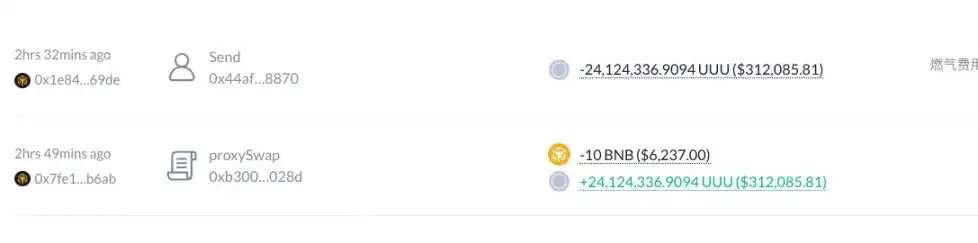
Based on the detailed crime process, a Binance employee named Freddie Ng was undoubtedly aware in advance that the UUU token was going to pump. Using their pseudonymous wallet address starting with 0xEDb0, they spent 10 BNB at an average price of $0.00026 to buy 24.1 million tokens worth $31,200 and transferred them all to a wallet starting with 0x44a.
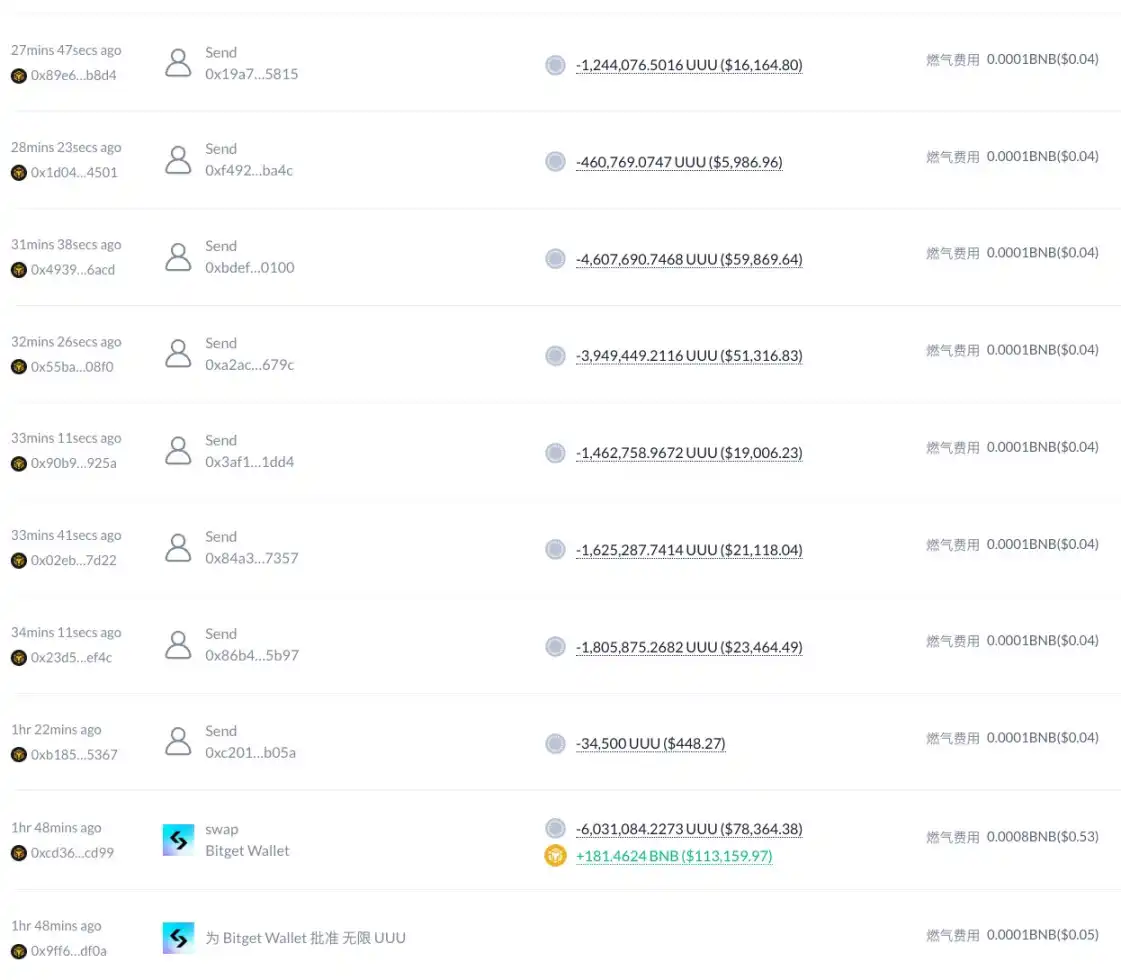
Subsequently, Freddie sold 6.02 million UUU at an average price of $0.0188 through the Bitget wallet, receiving $113,600, and distributed the remaining UUU tokens to 8 different addresses, each receiving tens of thousands of dollars.
BroLeon said, "The slip-up this guy made was that the wallet he used for the rug pull was funded 121 days ago from his identified wallet freddieng.bnb (starting with 0x77C)."
On March 23, the BNB Chain exchange platform uDex officially listed the official token UUU on four.meme. uDex is one of the members of the BNBChain MVB Season 8, providing on-chain information to users and allowing direct trading from social networks. Currently, the token has a market capitalization of $8.22 million.
Industry Chronic Issues
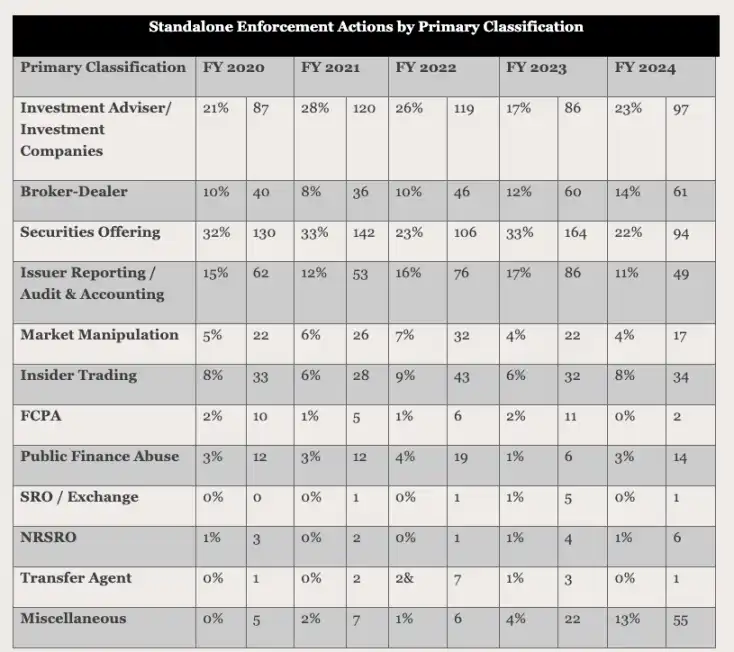
Insider trading is not a unique issue to the cryptocurrency market. For example, based on historical data from the U.S. Securities and Exchange Commission (SEC), insider trading enforcement cases on average represent 8-9% of the annual enforcement total, a proportion that already exists in traditional financial markets.
This is not the first time Binance has faced allegations of insider trading, although there have been few instances of employees being investigated in the past. Since 2018, the cryptocurrency industry has consistently faced systematic questions regarding insider trading within exchanges. Several exchanges have been accused at different times of similar rug pull issues, becoming chronic issues in the industry.
The transparency and decentralization features of the cryptocurrency market have not completely eliminated the risk of insider trading. Instead, due to a lack of unified regulation and imperfect internal controls, exchanges are prone to such activities. Despite major exchanges enhancing compliance and risk control systems, the anonymity of cryptocurrencies, technological complexity, and global operational models make traditional regulatory measures challenging to enforce.
Industry giants like Binance often exert strong deterrence measures when facing internal trading abuse issues but also frequently experience similar incidents due to a lack of effective preventive and monitoring measures. Externally, Binance's swift investigation results and actions in this case demonstrate its determination to rectify the situation. However, whether they can completely eliminate rug pull issues requires the industry to strengthen compliance management and transparency from the source.
You may also like

The impossible triangle is simply a pseudo problem

Stablecoins Finally Find Real Returns: On-Chain Reinsurance Re Explained | Interview with Re Founder Karan Saroya

The AI gamble of mining companies: Valuations enter a phase of differentiation, and it's hard to turn the tide

A letter from Alliance to entrepreneurs: Written on the occasion of Cursor selling for 60 billion dollars

Will MicroStrategy fall into a death spiral? What will the macro trend be in the second half of the year?

Blockchain Capital Partner: The Core Secret of Arbitrage

STRC unanchored by 11%, can the perpetual motion machine of Strategy still operate?

Bitcoin Market Analysis 2026: Can BTC Reach $150K by Year-End?

Bitcoin ETF Outflows Hit a Record $4.4 Billion: What Are Traders Doing With Their Cash?

WEEX App Just Got Smarter – New Tabs for Faster Trades & Easy Asset Management

WEEX All-New Search Features: Find, Trade & Earn Faster Than Ever

Morning Report | Illinois signs the strictest digital asset tax law in the U.S.; RWA tokenization market size surpasses $43 billion, institutions accelerate the migration of on-chain assets

Full version of the debut Q&A! Federal Reserve Chairman Waller: Sticking to the 2% inflation target, establishing five special working groups, individual did not submit the dot plot

From Disruptor to Shadow Market: The Crypto Market is Becoming a Colony of Traditional Finance
Dalio's important long article: How to position in the current market environment?
OKX Star analyzes Binance's competitive advantages: when regulation levels the playing field, competition has just begun

New gameplay for participating in initial offerings on cryptocurrency exchanges
Why Is Bitcoin Down Today? What the Hawkish FOMC Means for SpaceX, Gold and Nasdaq
The impossible triangle is simply a pseudo problem
Stablecoins Finally Find Real Returns: On-Chain Reinsurance Re Explained | Interview with Re Founder Karan Saroya
The AI gamble of mining companies: Valuations enter a phase of differentiation, and it's hard to turn the tide
A letter from Alliance to entrepreneurs: Written on the occasion of Cursor selling for 60 billion dollars
Will MicroStrategy fall into a death spiral? What will the macro trend be in the second half of the year?
Blockchain Capital Partner: The Core Secret of Arbitrage


