
Can AI Make $200 a Day with Weather Forecasting?

![EverRise [old]](https://s2.coinmarketcap.com/static/img/coins/64x64/10548.png)


Original Article Title: "Using AI to Play Weather Prediction and Earn $200 Passively in a Day"
Original Article Authors: Changan, Biteye
Weather is unlike elections, it has no stance; unlike the NBA, it has no home team. Yet it is this very market that has drawn in domestic users. The reason is simple—everyone has a perception, everyone thinks they understand Shanghai's weather.
But "feeling knowledgeable" and "making money" are two different things.
Biteye shares three things today:
1. Understand the settlement rules
2. Establish a weather prediction method
3. Use a system to find trading opportunities that others can't see
I. First, Understand: How Does This Weather Market Settle?
1. The settlement temperature is not what you think it is
Many people, when participating for the first time, have a misconception: they compare the highest temperature on their phone's weather app, but the app shows the temperature for the Shanghai urban area, while Polymarket's settlement uses the actual data from Shanghai Pudong Airport (ZSPD weather station). This data is publicly available through the American weather platform Wunderground, and PM directly reads the records on WU as the settlement basis.
Two different locations, two different numbers. Pudong Airport is located on the east side of the city, near the mouth of the Yangtze River, influenced by sea breezes, and temperatures are usually lower than in the urban area. This difference is usually not noticeable, but at the boundary of a prediction bracket, it could be the difference between being correct and incorrect.
So in the weather market's comment section, you may see this kind of confusion: "Even though today feels warmer than yesterday, why is the displayed high temperature lower?"
2. The number is correct, but the unit is not what you think
WU's data comes directly from the airport's hourly reported METAR message (a globally used aviation weather report format).
There is a detail hidden here: METAR records integers in Fahrenheit, and WU directly displays this number without conversion or correction.
Most weather forecast systems and meteorological model outputs have temperatures with decimal points. The more precise your model calculation is, the easier it is to overlook this coarsest aspect.
3. Shanghai Temperature Patterns
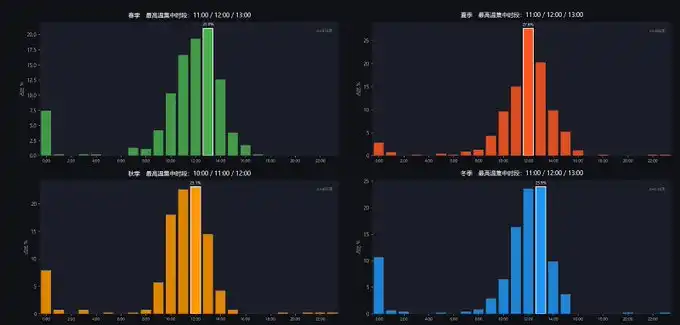
After scraping nearly 1900 days of data from ZSPD station, it turns out that the peak times for Shanghai's highest temperatures are more concentrated than imagined:
· The peak hours for all four seasons are highly concentrated around 11:00-13:00,
· The concentration in summer is highest at 12:00, accounting for 27.6% of the entire season in a single hour.
· The peak period in autumn is slightly earlier, with 10:00 also being one of the high-frequency periods.
Understanding the pattern is the first step, but the pattern won't monitor itself. Knowing when the highest temperature occurs each day, whether it's being updated, and how far it is from the threshold.
So, the author set up this system: before the daily settlement, accurately predict as much as possible which Celsius level the day's highest temperature will fall into.
II. Five Methods, Three Validated
After understanding the market rules, the next question is: how to predict the day's highest temperature?
As a meteorological newbie, the first step is to ask ChatGPT: how does the meteorological industry actually calculate the day's highest temperature and what are the mature methods available. ChatGPT provided a theoretical framework, which Claude translated into code. With two AIs working together, the system was set up over a weekend.
A total of five methods were tried, and ultimately only three were successful.
Validated:
1. WC + ECMWF Integrated Forecast
To forecast the highest temperature, data is needed. Two sources were used:
· The Weather Company (WC) is a commercial weather API that provides hourly forecast data with high accuracy;
· ECMWF is the European Centre for Medium-Range Weather Forecasts' global weather model, more sensitive to large-scale weather systems.
Each source has its pros and cons, so they are weighted by voting. The weights are dynamically adjusted based on the weather type of the day: WC is more trusted on sunny days, while ECMWF is more trusted on cloudy and windy days.
2. Real-time Correction: Using Temperature Rise Data to Estimate Peaks
The forecast was calculated last night, but today's weather has been changing. So what this module does is: using actual measured data from this morning, it calculates how high today's temperature can reach.
The logic is not complicated. The editor found that the temperature rises fastest in Shanghai between 8-9 a.m. The system, after receiving the temperature measured at this time, looks at historical data: for the same season, at the same time, how much more could the temperature rise on average.
Then two adjustments are made:
· If there are many clouds, it applies a discount because thicker clouds impede warming.
· If it's windy, it also applies a discount because strong winds accelerate heat loss. This calculates an "extrapolation estimate."
Pressure, dew point, and humidity are also considered in the calculation, but due to backtesting revealing their minimal impact and low relevance, they have been removed.
But relying solely on extrapolation is not stable enough. Here, a concept called Kalman gain is used, which essentially takes a weighted average between the "extrapolated result" and the "original forecast," with this weight automatically changing over time.
· At 6 a.m., extrapolation only accounts for 20%, with most trust placed on the forecast
· By noon at 12 p.m., extrapolation constitutes 72%
· After 1 p.m., nearly full trust is on the actual measurement, accounting for 85%
The later it gets, the more important current events are; the earlier it is, the greater the reference value of historical forecasts.
After 2 p.m., the system judges that the peak temperature is most likely already reached, and it locks in today's highest temperature directly from historical records, without further calculation.
3. Is today a warming day?
This is the most satisfying module in the whole system, making a daily predawn assessment: Will today's highest temperature be higher than yesterday's?
Between 2-4 a.m. every day, the system collects a batch of meteorological data to feed into this model:
· Pressure changes in the past 3 hours and 12 hours
· Predawn wind direction, wind speed, cloud conditions
· Yesterday's temperature fluctuations, temperature trends over the past three days, whether yesterday's temperature was higher or lower
· Plus the month, season, day in the year, whether it rained yesterday
The model's output is divided into five levels: Warming Day, Slight Warming, Stable, Slight Cooling, Cooling Day, while also providing a confidence level.
However, this method has a significant variance in accuracy across different seasons.
Most accurate in winter: When the cold air arrives, the air pressure rises sharply, the north wind strengthens, and the signal is very clear, so the model can easily identify it at a glance.
Least accurate in autumn: When warm and cold air masses tug of war, with temperatures rising one day and falling back the next, the historical patterns become invalid most quickly in this season.
Eliminated methods:
1. Fourier Numeric Forecast
Initially attempted to use Fourier analysis to fit the historical temperature data's cyclical patterns to see if it could directly predict the day's highest temperature.
The result was that it could only tell you "what the average temperature has been in this season historically." The randomness of Shanghai's weather is too high, and the Fourier fit produces a smooth average curve, not the actual daily fluctuations. With a 3.6°C error and a 100% systematic underestimation, this method was directly scrapped.
2. ERA5 Peak Moment Prediction
ERA5 is the European Centre for Medium-Range Weather Forecasts' global historical reanalysis dataset, used to predict the time of the day when the highest temperature occurs.
After backtesting,
· Accuracy within ≤1 hour is 59.6%
· Accuracy within ≤2 hours is 81.3%
Although this sounds good, the PM's precision is higher, and the time window left for traders to make judgments is very short. If peak value prediction within half an hour cannot be achieved, it is better to look at Polymarket's data. Therefore, this method was eliminated.
III. System Actual Combat: Two Cases and Shortcomings Reflection
Polymarket's weather market opens for trading four days in advance, with popular temperature ranges usually being fully priced early in the market. Buying directly at high-probability levels results in a poor risk-reward ratio.
Therefore, the strategy the author adopts is: wait for the signal, wait for the warming time window before entering the market.
Subsequently, based on the self-developed weather system, the following two operations were performed:
Case 1:
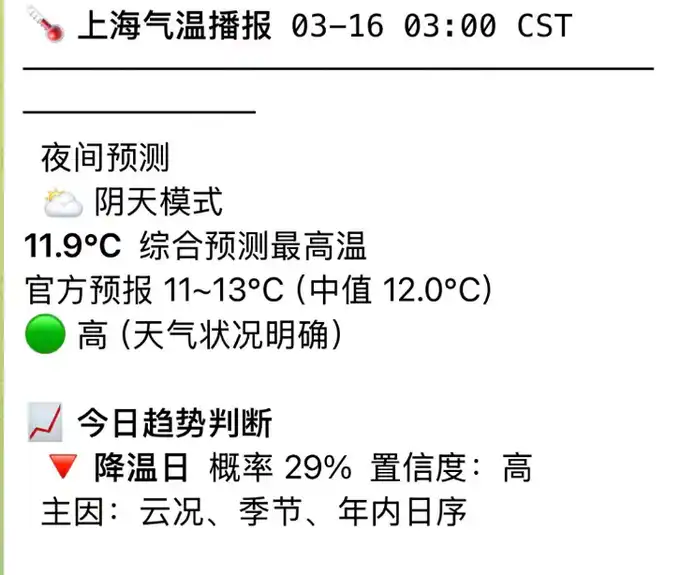
On the morning of the 16th, the Telegram channel released a nighttime mode report: Tomorrow is a cooling day. The reason is that the night had thick clouds, and both the season and the day count of the year pointed to a cooling trend.
At that time, the editor did not place an immediate bet. The early morning signal was only the first reference point.
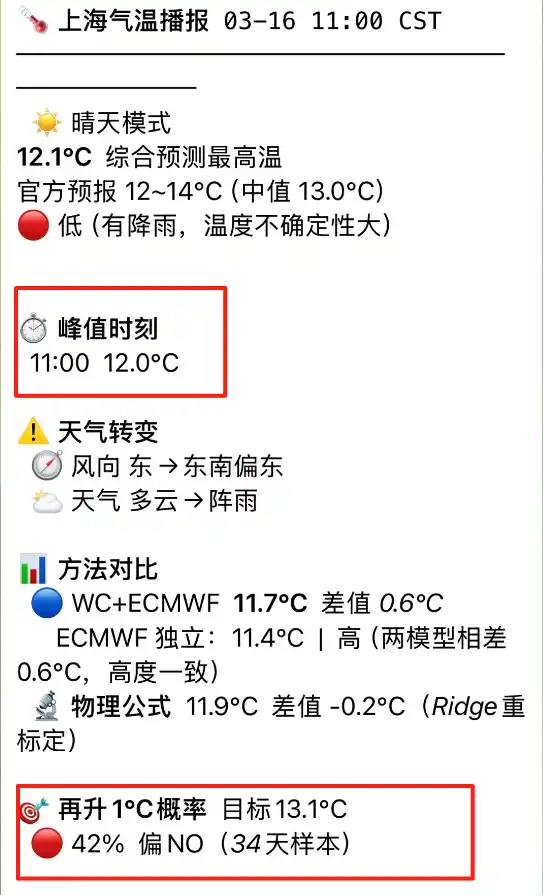
By 11 a.m., the system sent a real-time report on a warming period. At that time, the highest measured temperature was already 12°C, with a +1°C probability score result: a 42% chance of another 1°C increase today, leaning towards no further warming.
Combining the early morning logistic regression signal indicating cooling, both modules aligned in the same direction. The signal was much clearer than in the early morning. Therefore, a bet was placed that the maximum temperature on the 16th would not exceed 13°C.
Settlement that day: 12°C. The temperature on the previous day, the 15th, was 15°C, a full 3-degree drop.
Case 2:
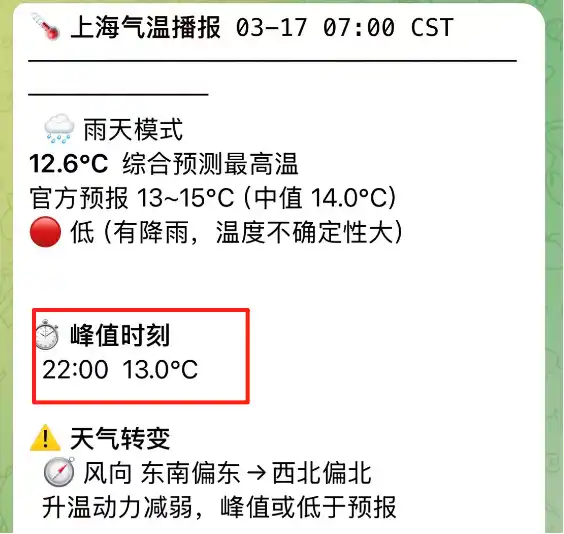
For example, looking at today's weather in Shanghai on the 17th, the weather system can still provide a warning function: a push received at 7 a.m. showed an unusual peak time: 22:00.
In a normal sunny day, the highest temperature occurs in the afternoon between 1-3 p.m. However, today's peak is at 10 p.m., indicating this is not sunlight-induced warming but the nighttime transport of warm and humid air currents. It rained all day, with cloud cover at 97-100% and almost zero sunshine.
Opening Polymarket at this point, seeing the pricing of 12°C still at 53%. Some in the community are confused: It's already afternoon, and the temperature is only 11°C. The usual peak time has passed, so why are people still buying at 12°C?
Behind this confusion is that people are still using sunny day logic to assess a rainy day market.
The system is not confused. It correctly identified today's weather type in the morning, with an unusual peak time, showing a clear deviation between the current temperature and the market's expectation. This difference in information is a trading opportunity.
This is the significance of having this system: It makes it easier to identify opportunities in the face of opportunity and warns faster in the face of risk.
What are some limitations of the system?
Implemented a system over the weekend, impossible to be without flaws:
· The accuracy in autumn is only 63.7%, close to a coin toss.
· Cold and warm air masses tug-of-war repeatedly during this season, with today's temperature rise followed by a drop tomorrow, the historical patterns are least reliable in autumn.
· The pressure characteristics are not available in live trading. Pressure changes were used as a feature when training the model, and the backtesting results were good.
· The signal of cold air passage is very clear. However, during live trading, the current interface does not provide real-time pressure data.
· Coastal correction is still awaiting data activation. The sea breeze effect at Pudong Airport is indeed real, and the system has built a corresponding correction module, but the backtest samples are not sufficient.
A system that has just run for a weekend can already identify these issues, which is considered a gain. Next steps involve debugging during running.
IV. Conclusion
Meteorology has developed for hundreds of years, incorporating satellites, supercomputers, global models, yet weather forecasts still dare not guarantee 100% accuracy for tomorrow. It's not that scientists are not working hard enough, but the atmosphere itself is chaotic. A slight difference in initial conditions can lead to completely different outcomes.
This system that ran over a weekend will, of course, make mistakes. The accuracy rate in autumn is close to a coin toss, if cold air arrives early, the system may not respond in time, and the sea breeze effect has not been fully captured even now.
But this is not important. Predicting the market does not require being right every time, only needing to have an advantage in odds, seeing one more layer of information than the market.
You may also like

Dan Bin's latest speech: Don't miss out on a great era
Robinhood launches its own blockchain, no longer wanting to be a tenant on others' chains
Why Tokenized Stocks Are Booming in 2026 While Crypto Is Still Struggling
From Pump.fun to Collector Crypt: Has Solana's income throne changed hands?
Looking at Stripe's ambitions and the future of stablecoins from OUSD
Do you want to buy CRCL?
Wosh: Inflation has cooled in recent weeks, AI is reshaping the economy, and forward guidance has lost its necessity
The most secretive AI winner
Former ByteDance employee's account: How I started with two Pinduoduo hard drives and made six times the profit with Seagate to achieve financial freedom?
MiCA reshuffle begins, Binance temporarily bids farewell to the EU
How does Gate redo "buying and selling stocks" from the cryptocurrency world to the stock market?
Visa and Mastercard join 140 giants to launch a new stablecoin, but the impact on the market landscape may still be limited
Circle CEO responds to OUSD's challenge: Stablecoins are a winner-takes-all business, and we will not slow down
Argentina vs Cape Verde: When a Record-Breaking Legend Meets an Unbreakable Underdog
WEEX exclusive pre-match analysis of Argentina vs Cape Verde, exploring Messi-led Argentina’s dominance and Cape Verde’s historic defensive breakout, with a breakdown of volatility, structure, and match dynamics.
WEEX Launches Depth Chart for Spot Trading
Raising interest rates to protect STRC and selling coins to maintain credit, this time the strategy has chosen the two most expensive paths
Morning Report | Samsung announces a 265.5 trillion won investment plan, focusing on semiconductor and AI computing power data centers; Vitalik publishes an article detailing the entire technology tree behind the confusion protocol (iO) mainline
In the era of AI, what is left of Bitcoin?
Dan Bin's latest speech: Don't miss out on a great era
Robinhood launches its own blockchain, no longer wanting to be a tenant on others' chains
Why Tokenized Stocks Are Booming in 2026 While Crypto Is Still Struggling
From Pump.fun to Collector Crypt: Has Solana's income throne changed hands?
Looking at Stripe's ambitions and the future of stablecoins from OUSD
Do you want to buy CRCL?


