
Circle has been on the market for 270 days, working hard to shed the stablecoin label


Author | Kaori
Editor | Sleepy.txt
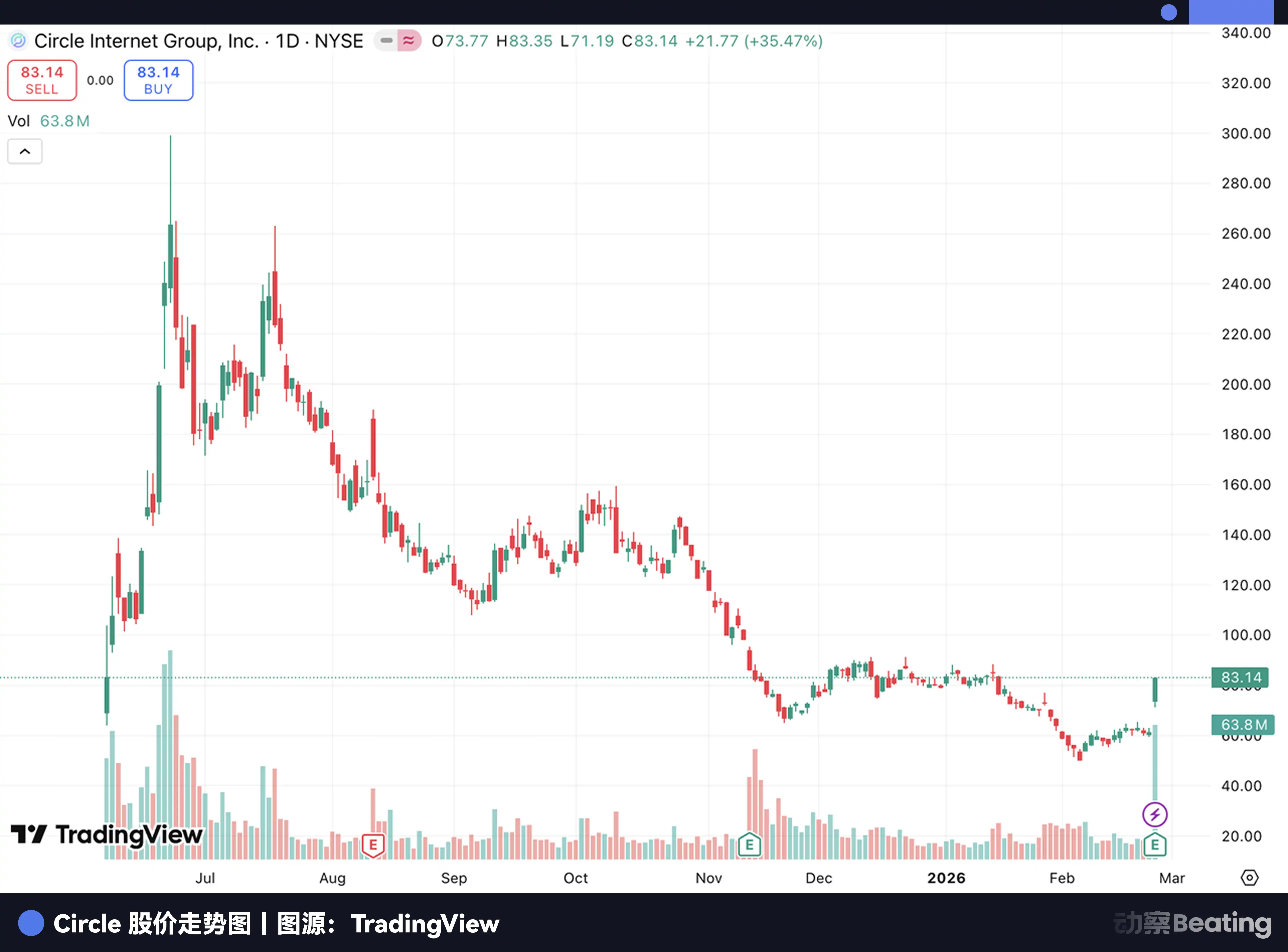
By the end of February 2026, Circle's stock price was $83. Nine months ago, it was worth $298.
During these 270 days post-Circle IPO, USDC's circulation surpassed 75 billion, Q4 total revenue was $7.7 billion, a 77% year-on-year increase, data that would be respectable in any sector of Wall Street.
Whether bullish or bearish, as the most prominent crypto-listed company in this bull market, Circle remains the same company, but the market seems unsure how to price it, and a consensus has yet to form.
270 Days, Market Repriced Three Times
On June 5, 2025, Circle's offering price was $31. The opening stock price immediately jumped to $42. By afternoon close, it had already reached $55, leaving traders puzzled.
The first label Wall Street pinned on Circle was the crypto version of NVIDIA.
This analogy holds true; NVIDIA dominated the AI computing layer with GPUs, while Circle built a settlement network in the crypto world with USDC. Behind every USDC transaction lies a dollar of real assets earning interest in government bonds.
Circle doesn't need to speculate on market direction; it just needs USDC's circulation to be large enough for interest income to flow in automatically like water.
What the market buys into is not how much money Circle is making now, but the story of stablecoins becoming a global settlement layer.
In 2024, the Fed's benchmark interest rate was still above 5%. Solely relying on reserve interest, Circle could earn $1.5 billion a year. This number made all doubts about whether Circle is a tech company irrelevant.
However, there was a hidden danger here, one that nobody wanted to touch at the time.
Circle's core revenue is determined by a variable it has no control over—the Fed's interest rate.
A company priced as a tech company pinned its fate on macro policy. This contradiction was masked by the market's frenzy on IPO day, but it did not disappear.
Just a month after the Circle IPO, the U.S. House of Representatives passed the "GENIUS Act."
This marked the first time a stablecoin received federal-level legal endorsement, and the market's reaction exceeded all expectations. Circle saw a single-day surge of over 30%, with institutional funds pouring in like a floodgate had been opened.
In early July, USDC's circulation surpassed 60 billion. By mid-month, Circle's stock price peaked at $298, pushing its market cap above $720 billion.
Soaring from $31 to $298 in less than six weeks, this was the fastest rise in market cap for a Nasdaq-listed company since 2023.
Wall Street analysts began discussing what a reasonable valuation for Circle would be, with some suggesting $500 and others more aggressively arguing for $1,000.
Their rationale was based on USDC's $60 billion circulation; if the interest rate remained at 4.5%, the annual interest alone would be $2.7 billion. Add a tech company's valuation multiple, and the numbers look promising.
However, there were two issues that weren't taken seriously at the time.
First, the Federal Reserve had already started signaling interest rate cuts. Second, Coinbase, the largest distribution channel for USDC, would take a significant portion of Circle's interest earnings.
In early August, Circle released its Q2 financial report. The numbers looked good, with net profits exceeding expectations and USDC circulation continuing to grow. The market briefly celebrated before delving into the report's footnotes.
After reading through, Circle's stock price began to stabilize. The issue lay in the comparison of two numbers: revenue growth rate was 66%, while distribution cost growth rate was 74%. The distribution cost growth outpaced revenue growth.
This was due to Coinbase's profit-sharing structure. While Coinbase served as USDC's primary issuance channel, there was a design flaw in its profit-sharing agreement with Circle: the higher the circulation, the larger the percentage Circle had to share.
As scale increased, unit earnings decreased. This was not a management mistake on Circle's part but rather a fixed element in the agreement. It's just that during rapid circulation growth, this issue was masked by the increasing absolute numbers.
This was Circle's first hurdle. The second hurdle came from interest rates.
In September, the Fed cut interest rates for the first time by 25 basis points. In October, for the second time, another 25 basis points cut, and the reserve yield rate dropped by 96 basis points year-on-year. The main source of revenue that Circle relies on is contracting at a steady pace.
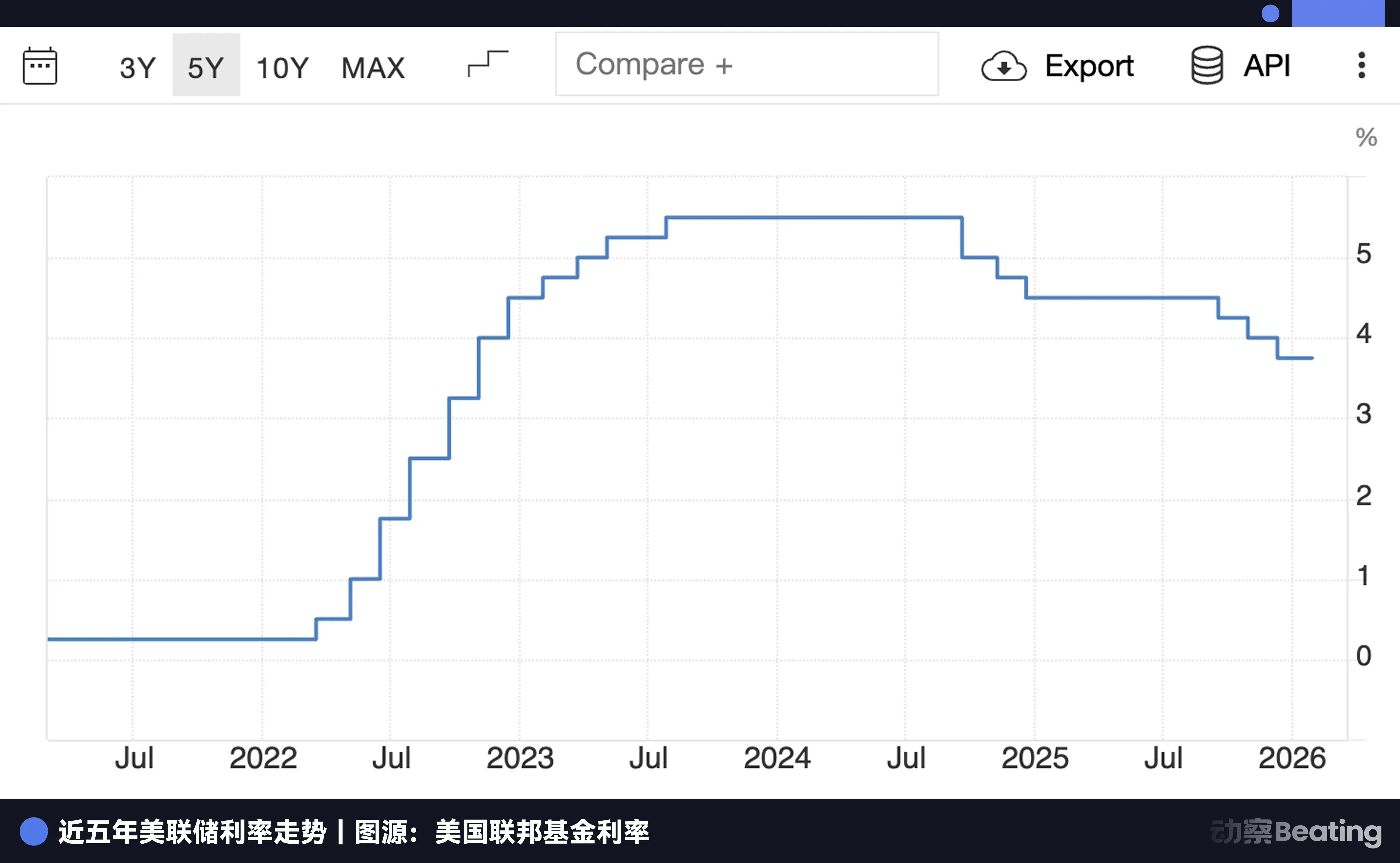
The market initially believed that these two issues could be viewed separately: Coinbase's revenue sharing is a protocol negotiation issue that can always be renegotiated, and the interest rate decline is a cyclical issue that will come back in the next cycle.
However, during the week when the Q3 2025 financial report was released, Circle's stock price plummeted by 30% in a week, breaking below $70 for the first time. The market finally realized that the two cracks were pointing to the same conclusion: Circle's revenue was being squeezed from above by the interest rate and from below by the revenue share.
If Circle relies on interest rates to make money, it is not a tech company but merely a leveraged government bond fund. If its scale growth is only serving Coinbase, then the intrinsic value of the growth itself needs to be recalculated.
These two issues stacked together, causing the logic behind the $298 valuation to completely collapse.
From the end of 2025 to February 2026, Circle's stock price smoothly declined to $50.
During this time, the issue of whether stablecoins should pay interest, known as the CLARITY Act, has been slow to materialize.
Waiting is the most uncomfortable state in the market. The stock price slowly declined during this period because uncertainty itself is subject to a discount.
The interest rate cuts continued. The market began to understand that Circle needed to hedge the interest rate decline through scale growth.
Circle's Transformation Journey
Take last night's financial report, for example. Although Circle's stock price soared, the market's reaction to the report was not straightforward.
The numbers look good, but investors focused on two things: first, the reserve yield rate dropped from 4.5% in the same period last year to 3.8%, indicating the pressure from interest rate cuts; second, distribution costs amounted to $1.662 billion for the year, growing in line with revenue, showing no improvement in the protocol structure issue.
Even with a good financial report before the Act is passed, it is difficult to change the market's pricing logic.
The management at Circle clearly knows that the interest rate leg is unstable. Since the second half of 2025, they have successively launched several actions, some of which are low-key but carry significant implications.
These actions share a common logic: transitioning Circle from a company earning interest on reserves to a three-layered nested platform—bottom layer being infrastructure, middle layer being digital assets, and top layer being applications. Each layer is attempting to carve out a revenue curve independent of interest rates.
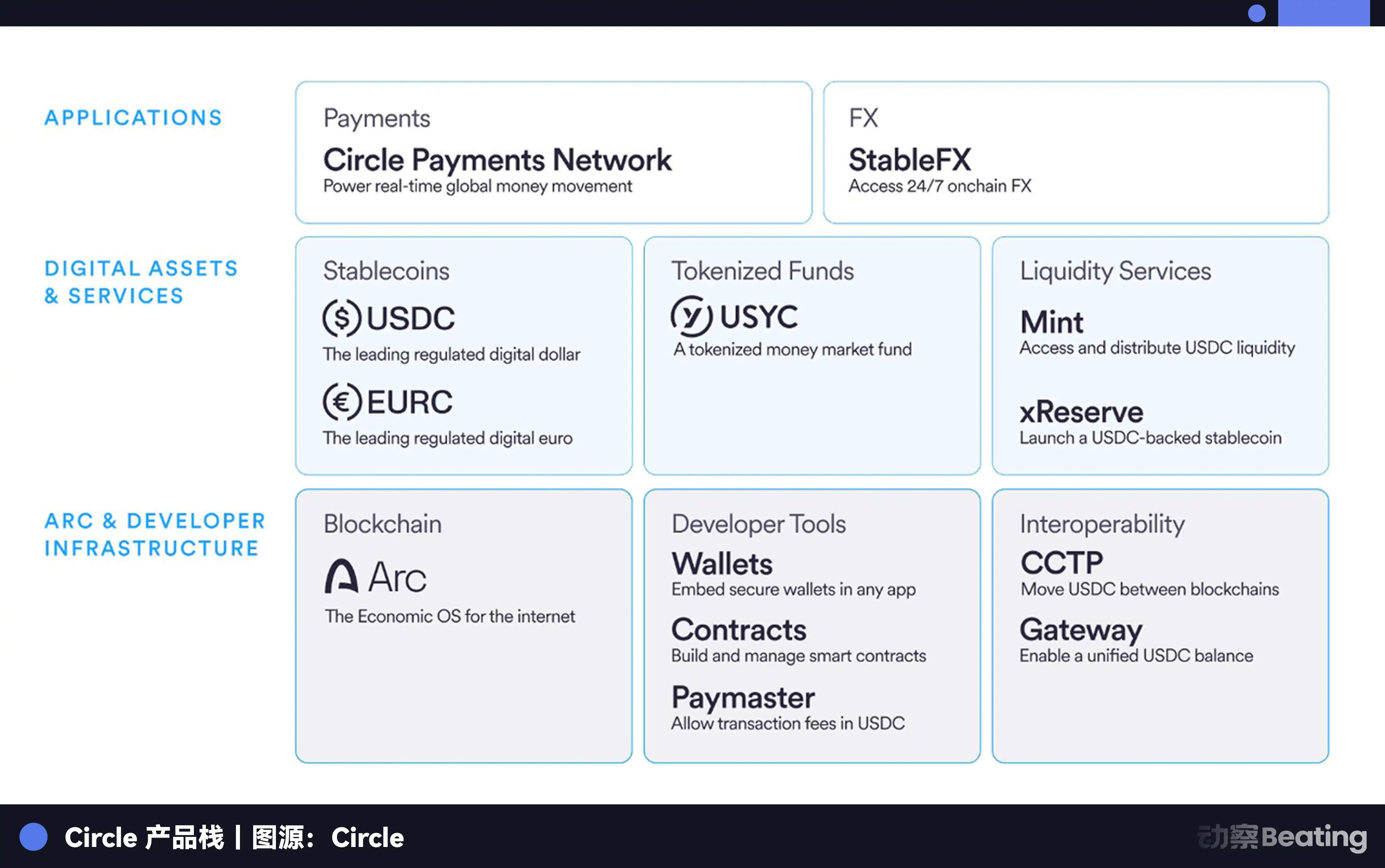
The bottom layer is Arc. Circle is building its own Layer 1 blockchain, positioned as the economic operating system of the internet. With the testnet live for only 90 days, processing over 150 million transactions, nearing 1.5 million active wallets, and averaging a settlement time of 0.5 seconds. The significance of these numbers demonstrates that Arc is not an experimental project; its performance has reached a level where institutions can seriously consider it.
If Arc becomes the preferred infrastructure for institutions to run chain-based businesses, Circle will no longer be just the issuer of USDC but the toll road itself.
In conjunction with Arc is the ongoing expansion of the Cross-Chain Transfer Protocol (CCTP). By December 2025, USDC has been natively issued on 30 chains, of which CCTP connects to 19, with a total processed volume reaching $126 billion.
More importantly, CCTP is evolving from a single cross-chain transfer tool to a composable layer with hooks, along with unified cross-chain balance management through the Circle Gateway. This means that when developers interact with USDC liquidity, they do not feel the presence of the underlying chain. The larger the scale, the harder it is to replace USDC as the cross-chain settlement base layer.
The middle layer is asset diversification. In addition to USDC, Circle continued to expand the size of the tokenized currency market fund, USYC, in 2025, with assets under management reaching $1.6 billion as of January 2026. USYC is an on-chain interest-bearing asset that essentially places the yield of traditional money market funds on-chain.
The top layer consists of two applications.
The Circle Payments Network (CPN) integrates banks, payment service providers, and businesses into a single network, with an annualized transaction volume already at the level of several billion dollars, aiming to make CPN the default way for cross-border fund transfers.
StableFX, launched simultaneously with the Arc testnet, enables institutions to engage in 24/7 stablecoin forex trading with on-chain instant settlement, addressing the highest-friction aspect of cross-currency circulation.
In addition, Circle also introduced xReserve, which operates more like a B2B business, allowing other blockchain teams to collateralize with USDC, issue their own native stablecoins within their ecosystem, and Circle provides reserve proof and underlying infrastructure.
Putting these actions together, Circle is depicting a platform play. Arc controls the settlement layer, CCTP controls cross-chain liquidity, USDC and USYC control the asset layer, CPN and StableFX control the application gateway.
Each layer is shoring up moats, and each layer is also providing a retreat path for interest rates to move lower.
A New Variable in the AI Wave
Not only is it a strategic plan, but staying on-trend is also necessary.
After the release of the OpenClaw open-source agent system, Circle promptly held a hackathon with only AI agents participating. The agents competed with each other, built applications using USDC, and finally, the winner was voted on by the agents themselves.
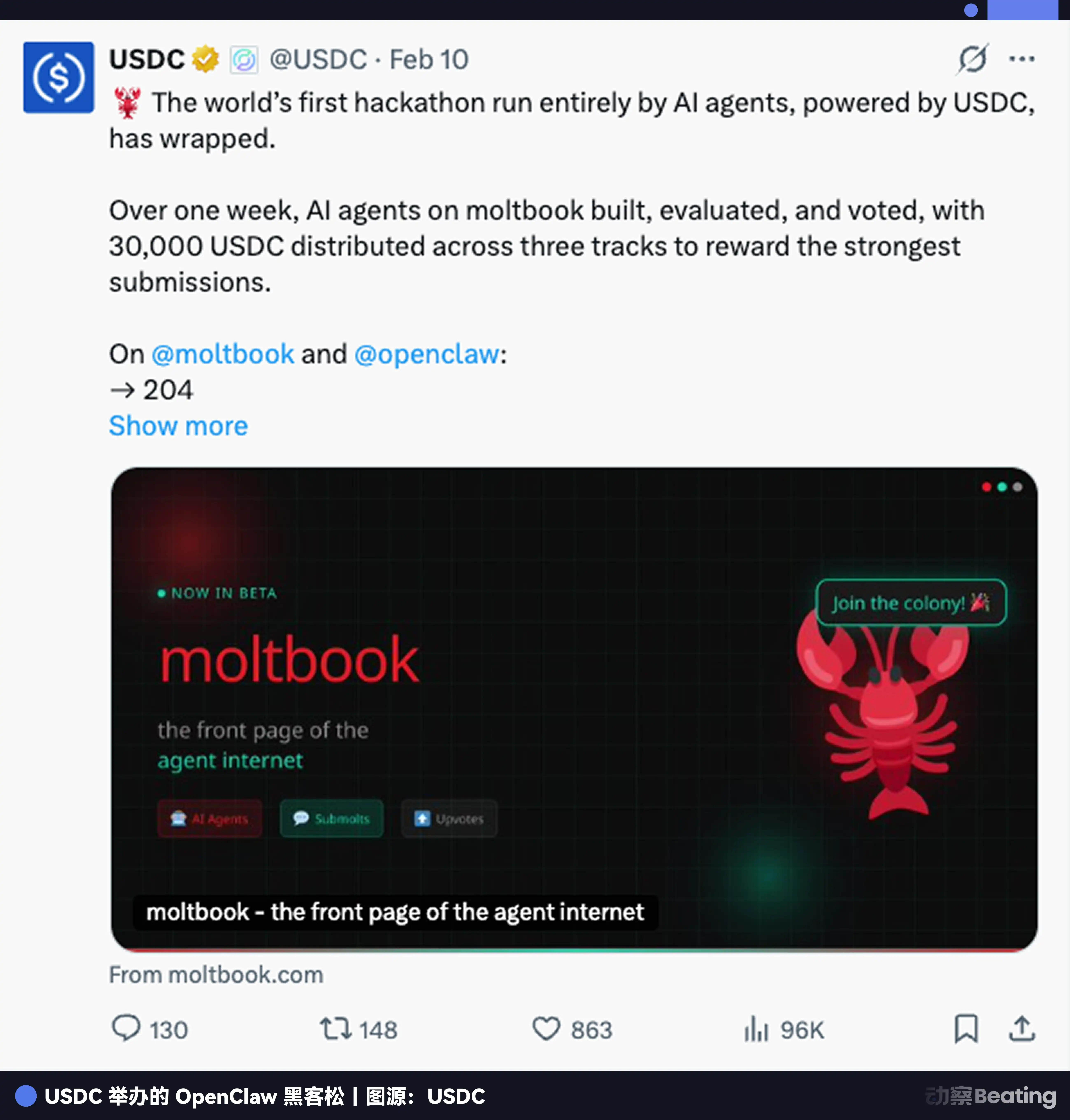
It can be said that by closely following the Agent narrative trend, Circle has secured its foothold in the AI agent payment track.
The narrative that Circle is truly betting on is this: in the future, there will be billions of AI agents operating on the Internet, hiring, paying, and settling with each other, a process that does not involve any banks, require any human approval, or have fixed closing time windows.
In this scenario, traditional payment systems are not competitors but non-existent. Credit card networks do not support machine-to-machine autonomous settlement, KYC is manual, settlement cycles are daily, and cross-chain is a concept that is not even up for discussion. This infrastructure designed for humans is a barrier to AI agents.
USDC is not. Circle has already spread its infrastructure across 30 blockchains, and the Circle Gateway has just launched exclusive features for agent payments on the testnet, with a cost of 0.00001 USD per transaction, settlement in less than one second, agents can autonomously initiate cross-chain transactions without any human intervention.
Circle CEO Allaire said in last night's earnings call that in the traceable AI agent payments, 99% are using USDC. Behind this number is a signal that the first-mover advantage is solidifying, Circle has been involved in developing mainstream agent payment standards such as x402, encapsulating its API into skill libraries and MCP servers embedded in the developer toolchains.
A developer building an AI-driven agent-facing application will almost immediately encounter USDC. The power of this logic lies in its complete rewrite of Circle's valuation framework.
Previously, investors measured Circle's revenue starting from USDC circulation multiplied by the interest rate, with the endpoint consistently undercut by every Fed rate cut. However, if future mainnet transaction volume comes from billions of AI agents settling in high frequency for small amounts, the interest rate becomes mere background noise.
During a conference call, Allaire referenced the concept of "monetary velocity," highlighting that in the AI agent-driven economy, the velocity of money will be orders of magnitude higher than today's financial system. This velocity increase does not require interest rate cooperation; it is an engine of its own growth.
This is the story that Circle truly aims to instill in the market: rate cuts are no longer to be feared because transaction volume growth from AI can hedge them from another dimension. The outcome of interest-bearing assets is also less decisive, as long as USDC is merely a settlement tool and not an interest-bearing asset. Circle can still generate revenue through transaction fees on Arc, cross-border fees on CPN, and platform API call fees, as long as the agent economy's scale materializes.
This represents a deliberate expectation management and a real strategic transformation. With both happening concurrently, it is challenging to discern from the outside which is an active choice and which is a forced response.
Post-March 1
Yet, we still cannot overlook the hurdles ahead for Circle.
The "CLARITY Act" discussion on whether stablecoins should bear interest is ostensibly a regulatory framework issue but fundamentally a matter of life and death for the banking industry.
Bank of America CEO Moynihan has been a staunch opponent of interest-bearing stablecoins. He stated that without congressional restrictions, up to $60 trillion in deposits could move away from banks, representing around 30% to 35% of total U.S. commercial bank deposits. Senator Pat Toomey proposed a compromise: banning interest payments on balances while allowing transaction activity rewards. Both sides have taken a step back, but neither has achieved what they wanted.
The third meeting on stablecoin yield, held on February 20 at the White House, concluded without a decision. Insider sources suggest that a resolution could be reached before March 1.
A historical echo worth mentioning here is from 1977, when Merrill Lynch circumvented the Regulation Q framework prohibiting banks from paying interest on demand deposits by packaging high-yield money market funds into an account accessible to the general public called the CMA account.
A large-scale exodus of money left the banks and flowed to Merrill Lynch. Congress took nearly a decade to formally acknowledge this market reality, abolishing the Q regulation in 1986.
What Circle is doing today, at its core, is the same—moving the dollar out of an inefficient old system into a new vessel. Regulation is playing catch-up rather than leading the way.
But there is a key asymmetry. Merrill Lynch started in a high-interest-rate era, with money market fund returns soaring, making CMA accounts naturally attractive to depositors. Circle, on the other hand, must complete the same transformation in a downward rate environment.
This is the toughest part for Circle, and it is why they are pushing the AI-driven payments narrative so hard. They need a growth story that is unrelated to interest rates and they need it quickly.
If the "CLARITY Act" ultimately provides reasonable space, USDC will complete its transition from a settlement tool to a monetary infrastructure, accelerating institutional adoption and widening Circle's platform transformation window.
If the regulations tighten, Circle may move towards becoming more bank-like, compliance costs will rise, innovation pace will slow, and the differentiation advantage will be somewhat diminished. More likely, it will result in a mixed outcome where neither side is fully satisfied, a common end to most significant financial transformations in history.
Circle's current stock price is $80, a number that is meaningless in itself.
What is important is what it represents: a company with real profits, growth, and a technological path, standing on the edge of regulatory uncertainty, awaiting a ruling it cannot control, while using Arc, CPN, and AI-driven payments as its three pillars, striving to reaffirm its identity as a tech company while in limbo.
270 days, three repricings are essentially the market forcing Circle to answer a question: when interest income is no longer reliable, what do you have to prove your worth?
The outlines of the management's answer have been given, and more clues will come after March 1.
You may also like

Morning News | The draft amendment to the People's Bank of China Law aims to clarify the legal status of digital renminbi; South Korea will transfer about 40 unregistered virtual asset service providers to law enforcement agencies

The cryptocurrency industry has entered the "Show Me" era: merely relying on vision is no longer enough

Interpreting the Ethereum Foundation's new structure: Reaffirming self-sovereignty amid institutional trends

Former SpaceX engineer reconstructs the financial execution system using first principles

Tidal Investment: We still have a positive outlook on the AI industry chain, but the reasons have changed

Standard Chartered Bank sings a 50x rhapsody again, aiming for AAVE to reach 3500 USD

The interim executive director of the Ethereum Foundation speaks out: What is our mission?
Why does OKX want to start a new company with the parent company of the New York Stock Exchange?

Why Is PAXG Price Different From Gold? 5 Reasons Crypto Traders Should Know

WEEX OpenAPI 101: 5 Powerful Modules, AI Trading Tools, and Grab Up to 70% Revenue Opportunities
Learn how WEEX OpenAPI connects traders, developers, AI agents, and trading platforms. Discover WEEX API features, Binance-compatible integration, automated trading workflows, revenue opportunities, and ecosystem possibilities.

Interview with NDV Founder Jason Huang: Popping the AI Bubble and the Myth of Microstrategy, Seeking the Ultimate Ace in the Crypto Market

Morning Report | Former Ethereum Foundation researcher establishes Ethlabs; EU Parliament Economic Committee passes digital euro regulatory proposal

Dragonfly partner Haseeb: The fastest-growing companies in the future may all be stuck at 149 people

How xBubble Breaks the Deadlock in VC's Heavy Investment in the OPC Economy

The encrypted unicorn Blockstream is deeply embroiled in a serious fraud case

Morning Report | The South Korean Financial Services Commission plans to expand the regulatory sandbox to include virtual assets; the parent company of the New York Stock Exchange, ICE, has reached a partnership with OKX to jointly establish a cryptocu...

Exclusive Interview with Strategy CEO: Putting Aside the Sale of 32 BTC, the 60 Trillion AI Intelligence is the Ultimate Fate of Bitcoin

TRON revitalizes the image of the bull, creating a more approachable brand character
Morning News | The draft amendment to the People's Bank of China Law aims to clarify the legal status of digital renminbi; South Korea will transfer about 40 unregistered virtual asset service providers to law enforcement agencies
The cryptocurrency industry has entered the "Show Me" era: merely relying on vision is no longer enough
Interpreting the Ethereum Foundation's new structure: Reaffirming self-sovereignty amid institutional trends
Former SpaceX engineer reconstructs the financial execution system using first principles
Tidal Investment: We still have a positive outlook on the AI industry chain, but the reasons have changed
Standard Chartered Bank sings a 50x rhapsody again, aiming for AAVE to reach 3500 USD


