
CNBC Guest's Catchphrase Leads to $30 Trillion "Tariff Snafu," Becomes the Most Absurd 10 Minutes in Financial History


On April 7th, a piece of news stating that "Trump is Considering Suspending Tariffs on Some Countries for 90 Days" hit the financial markets like a bombshell. However, no one expected that this was once again a historic "fake news" story.
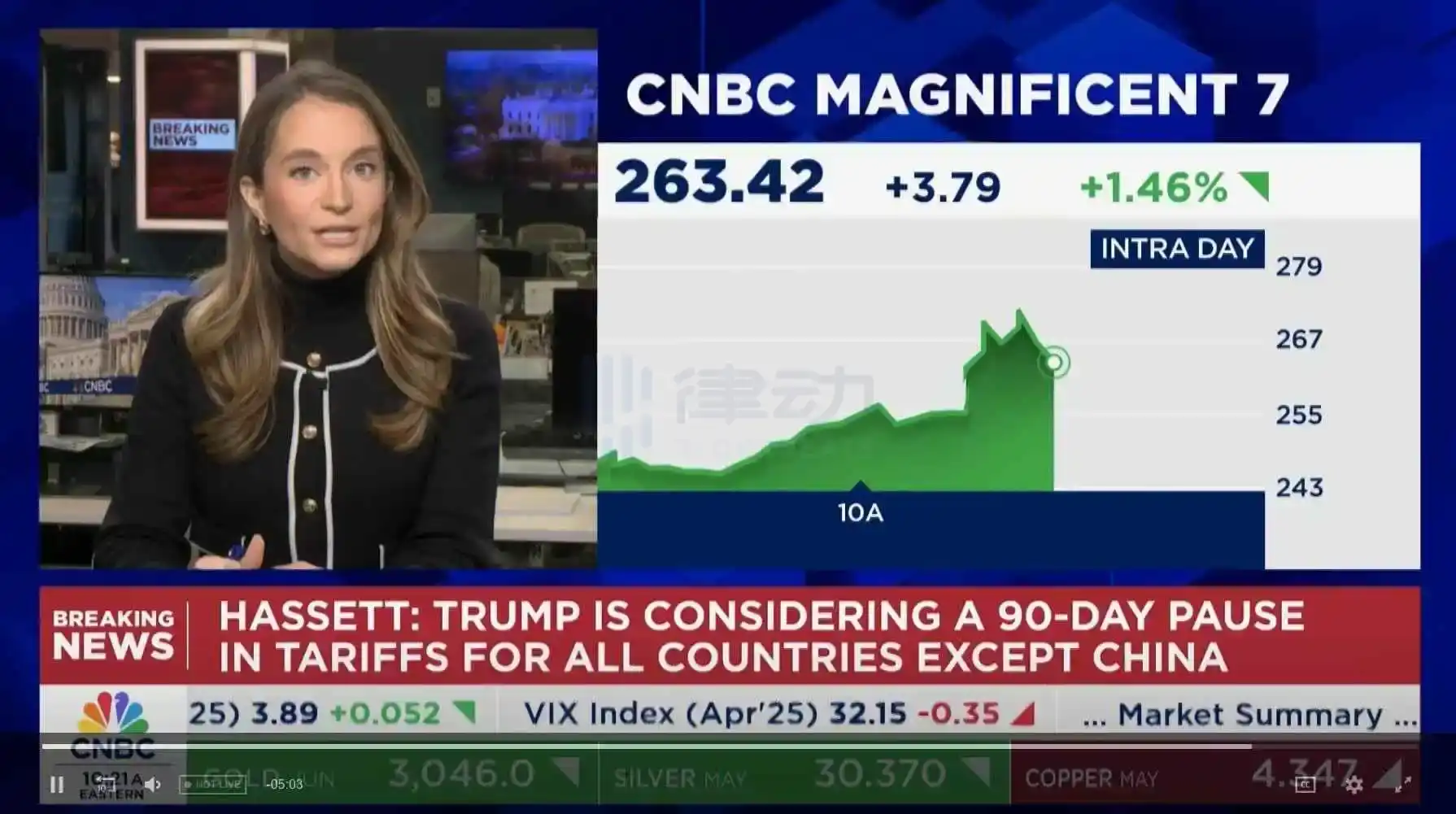
A Comedy of Errors Originating from a Simple "Yep"
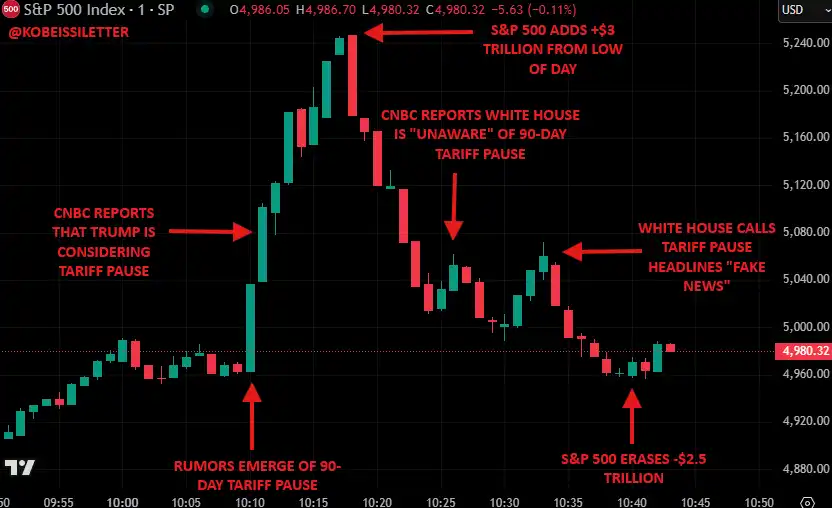
On April 7th, when the U.S. stock market was experiencing a three-day slump, chaos ensued. At 10:10 a.m. Eastern Time, a rumor suddenly surfaced: the White House was considering a "90-day tariff suspension." As soon as this news came out, the market instantly became restless. Just 5 minutes later, at 10:15 a.m., CNBC reported that Trump was considering a 90-day tariff suspension for all countries except China. This explosive news fired up investors. By 10:18 a.m., the S&P 500 index soared from its low point, adding over $3 trillion in market value. The market seemed to smell the long-lost bull market sentiment, and investors speculated that this was a signal of a policy shift by Trump. At the same time, Bitcoin surged from $76,000 to $81,000 in just 10 minutes. The market sentiment was overwhelmingly bullish, leading to over $129 million in short contracts being liquidated in just one hour.
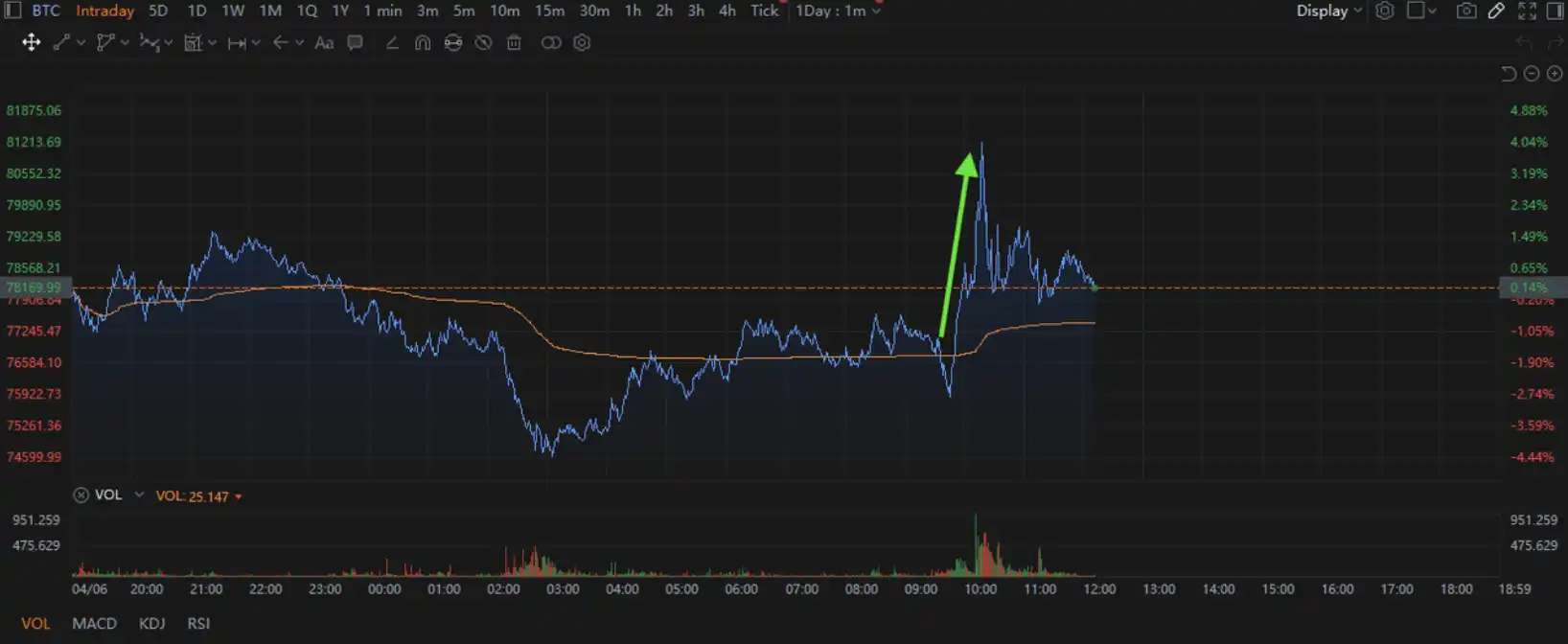
However, the plot twist came swiftly. At 10:25 a.m., reports emerged that the White House was "completely unaware" of the "Trump considering 90-day tariff suspension" matter. Shortly after, at 10:26 a.m., CNBC admitted that their earlier headline about the 90-day tariff suspension was erroneous. By 10:34 a.m., the White House officially labeled this rumor as "fake news." The market's mood plummeted like a rollercoaster in free fall. At 10:40 a.m., just 22 minutes after the soaring highs, the S&P 500 index rapidly fell back, evaporating $2.5 trillion in market value from its peak. The fervor faded away, leaving investors bewildered.
The source of this comedy of errors points to Hassett. Earlier in the day, during an interview with Fox News, host Jimmy D posed a crucial question to him: "Will Trump consider suspending tariffs for 90 days?" Hassett responded with a simple "Yep," followed by, "I think the President will make his decision... Even if you think there would be some negative impacts on the trade side, it's a very small fraction of GDP." This casual "Yep" acted as the spark. Financial blog Zerohedge analyzed that the market seemed to have misunderstood this as Hassett agreeing, when in reality, he was just acknowledging that he heard the question and did not confirm any policy.
Never before in history has such a dramatic scene unfolded: in just 30 minutes, fake news caused a trillion-dollar wave, only to quickly return everything to its original state.
Who Pays for the Tariffs
Since taking office, Trump has raised the banner of "America First," wielding the tariff stick against major trade partners such as China and the EU, attempting to protect domestic industries and reduce trade deficits. But can this "protective umbrella" really withstand the storm? The reality may not be so simple.
As the U.S. stock market opened on Monday, the market was already in turmoil. Trump's previous high tariffs against major trade partners had plunged the S&P 500 Index (SPY) into its first bear market since the COVID-19 pandemic. According to real-time data, the S&P 500 Index (SPY) opened at $489.19 on that day, but plummeted to an intraday low of $483.122. However, when the "tariff suspension" rumors spread, at 10:15 a.m., SPY soared to $512.155, dramatically increasing in value. Nevertheless, as the clarification emerged, by 10:45 a.m., SPY fell back to $504.19, with investors watching trillions of wealth evaporate before their eyes.
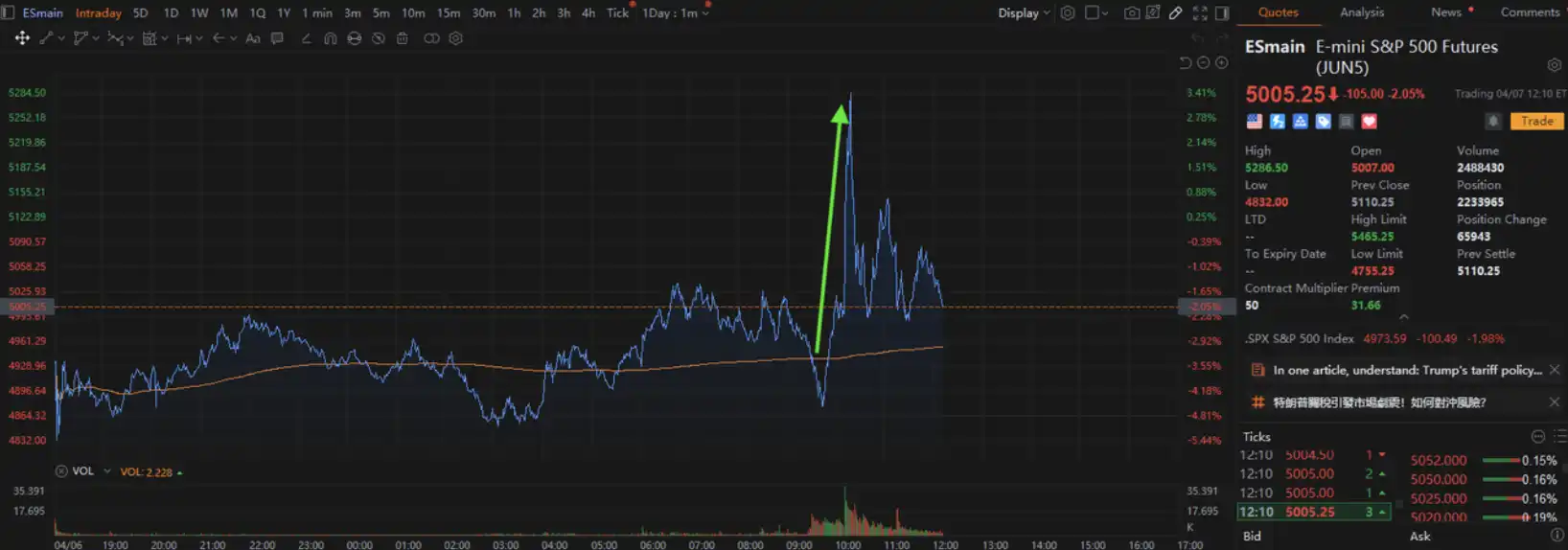
This blunder is not an isolated incident. Last week, after Trump announced the "most severe trade barrier of the century," the S&P 500 Index had already fallen by 20% from its historical high on February 19, with a market value evaporation of approximately $9.5 trillion. The speed of the decline ranks second among the 14 bear markets since 1945. The Wall Street panic index—the Chicago Board Options Exchange Volatility Index (VIX)—closed at 45 last Friday, then overnight on Monday surged to 60, far exceeding the long-term average of 20, indicating that market panic has reached its peak.
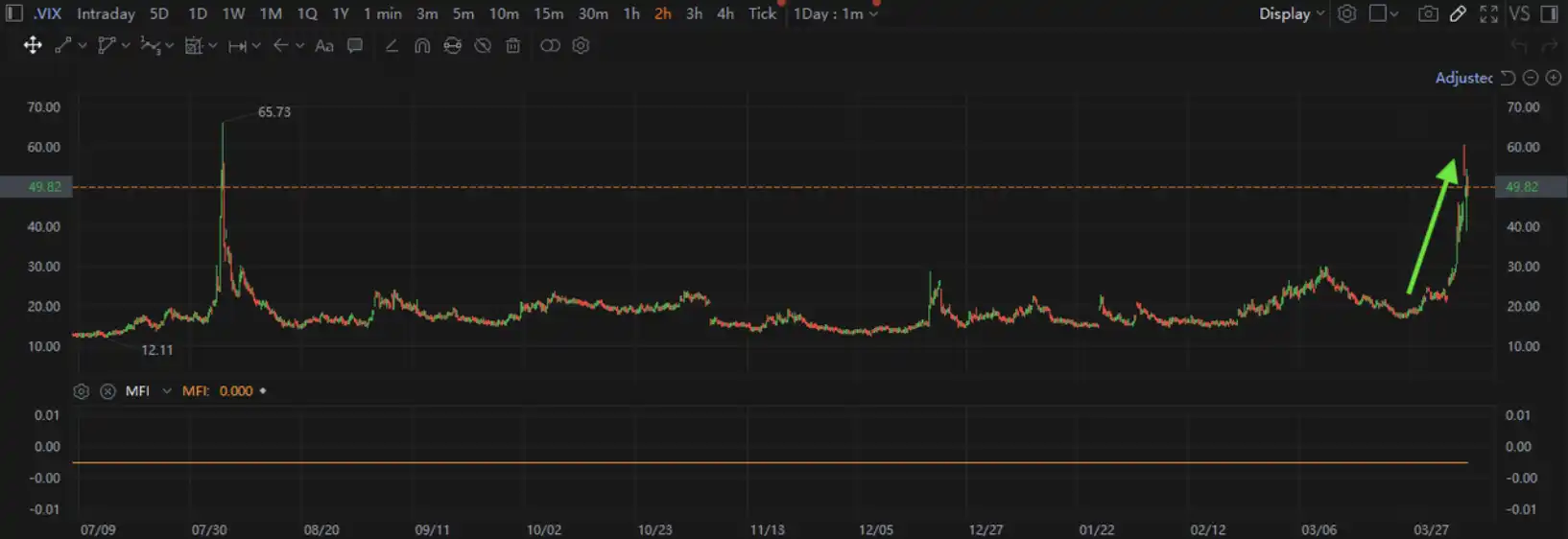
The real shadow has long been cast over the market. CFRA data shows that the S&P 500 Index plummeted 3.5% at the Monday opening, officially entering a bear market. Tech stocks were hit hard, with chip giant NVIDIA (NVDA) dropping 32% from its yearly high, Tesla (TSLA) falling by about 35%, Palantir (PLTR) experiencing an even more tragic drop, and other tech companies such as Super Micro Computer (SMCI), ON Semiconductor (ON), and Micron Technology (MU) all falling by over 37%. The travel industry is equally devastated, with stock prices of Delta Air Lines (DAL) and Norwegian Cruise Line Holdings (NCLH) plummeting over 40%.
While this fake news was a false alarm, it prompted people to reconsider the devastating impact of Trump's tariff policy. High tariffs have caused imported goods' costs to soar, with American consumers bearing the brunt. For example, a Chinese-made smartphone could see its price rise from $1000 to $1250 due to a 25% tariff. Businesses are also feeling the heat, with Tesla (TSLA) relying on a global supply chain; increased tariffs could raise production costs and put pressure on stock prices. Chip giants like NVIDIA (NVDA) are facing price hikes on imported components, squeezing profit margins.
At the international level, tariffs have triggered retaliatory actions. China and the EU might impose tariffs on American soybeans and aircraft, further hurting the export industry. Global supply chain disruptions, plummeting oil prices, and commodities prices have thrown the market into chaos. Doug Ramsey, Chief Investment Officer at Leuthold Group, warned, "This downturn could be the start of a new cyclical bear market."
Although this market turmoil sparked by a fake subtitle was short-lived, it acted as a mirror reflecting the far-reaching implications of tariff policies. While the White House's clarification dispelled the rumors, it did not soothe the market's unease. The future moves of Trump will require close attention.
You may also like

10 Counterintuitive Insights on Latin American Payments

Perp DEX: The Next Generation Exchange "War"

The AI gamble of mining companies: Valuations enter a phase of differentiation, and it's hard to turn the tide

A letter from Alliance to entrepreneurs: Written on the occasion of Cursor selling for 60 billion dollars

Stablecoins Finally Find Real Returns: On-Chain Reinsurance Re Explained | Interview with Re Founder Karan Saroya

The impossible triangle is simply a pseudo problem

Will MicroStrategy fall into a death spiral? What will the macro trend be in the second half of the year?

Blockchain Capital Partner: The Core Secret of Arbitrage
STRC unanchored by 11%, can the perpetual motion machine of Strategy still operate?

Bitcoin Market Analysis 2026: Can BTC Reach $150K by Year-End?
Bitcoin ETF Outflows Hit a Record $4.4 Billion: What Are Traders Doing With Their Cash?
WEEX App Just Got Smarter – New Tabs for Faster Trades & Easy Asset Management

WEEX All-New Search Features: Find, Trade & Earn Faster Than Ever

Morning Report | Illinois signs the strictest digital asset tax law in the U.S.; RWA tokenization market size surpasses $43 billion, institutions accelerate the migration of on-chain assets
Full version of the debut Q&A! Federal Reserve Chairman Waller: Sticking to the 2% inflation target, establishing five special working groups, individual did not submit the dot plot

From Disruptor to Shadow Market: The Crypto Market is Becoming a Colony of Traditional Finance
Dalio's important long article: How to position in the current market environment?
OKX Star analyzes Binance's competitive advantages: when regulation levels the playing field, competition has just begun
10 Counterintuitive Insights on Latin American Payments
Perp DEX: The Next Generation Exchange "War"
The AI gamble of mining companies: Valuations enter a phase of differentiation, and it's hard to turn the tide
A letter from Alliance to entrepreneurs: Written on the occasion of Cursor selling for 60 billion dollars
Stablecoins Finally Find Real Returns: On-Chain Reinsurance Re Explained | Interview with Re Founder Karan Saroya
The impossible triangle is simply a pseudo problem


