
Cursor "Shell" Kimi Controversy Reversed: From Copyright Infringement Allegations to Authorized Collaboration, China's Open Source Model Once Again Becomes a Global AI Foundation

In the early hours of March 20, AI programming tool Cursor (parent company Anysphere, latest valuation $29.3 billion) released its in-house model Composer 2, claiming performance improvements from "continuing pre-training on the base model for the first time, combined with reinforcement learning," without ever mentioning the base's source.
In less than two hours, developer @fynnso, while debugging a Cursor API request, intercepted the actual model ID of Composer 2: `kimi-k2p5-rl-0317-s515-fast`, literally meaning "Kimi K2.5 + RL." Darkside of the Moon pre-training lead Du Yulun promptly tweeted, stating that the team tested Composer 2's tokenizer and found it "completely identical to our Kimi tokenizer," almost confirming that "this is the result of our model being further trained," and directly questioned Cursor's co-founder Michael Truell: "Why not respect our license and not pay any fees."
The tweet was subsequently deleted. The controversy quickly escalated on social media, with Elon Musk replying to @fynnso's post, "Yeah, it's Kimi 2.5," further fueling the discussion.
Kimi K2.5 is released under a modified MIT License, explicitly stating that for commercial products with over 100 million monthly active users or monthly revenue exceeding $20 million, the user interface must prominently display "Kimi K2.5." Given Cursor's valuation and number of paid users, the monthly revenue threshold is almost certainly met.
Subsequently, the winds shifted. The official account of Darkside of the Moon @Kimi_Moonshot posted early this morning, changing the tone from accusation to congratulations: congratulations to the Cursor team on releasing Composer 2, stating "we are proud to see Kimi K2.5 providing the foundation." The statement also clarified that Cursor's access to Kimi K2.5 through the Fireworks AI hosted RL and inference platform is part of an authorized commercial collaboration, with license compliance ensured through Fireworks AI's commercial agreements.
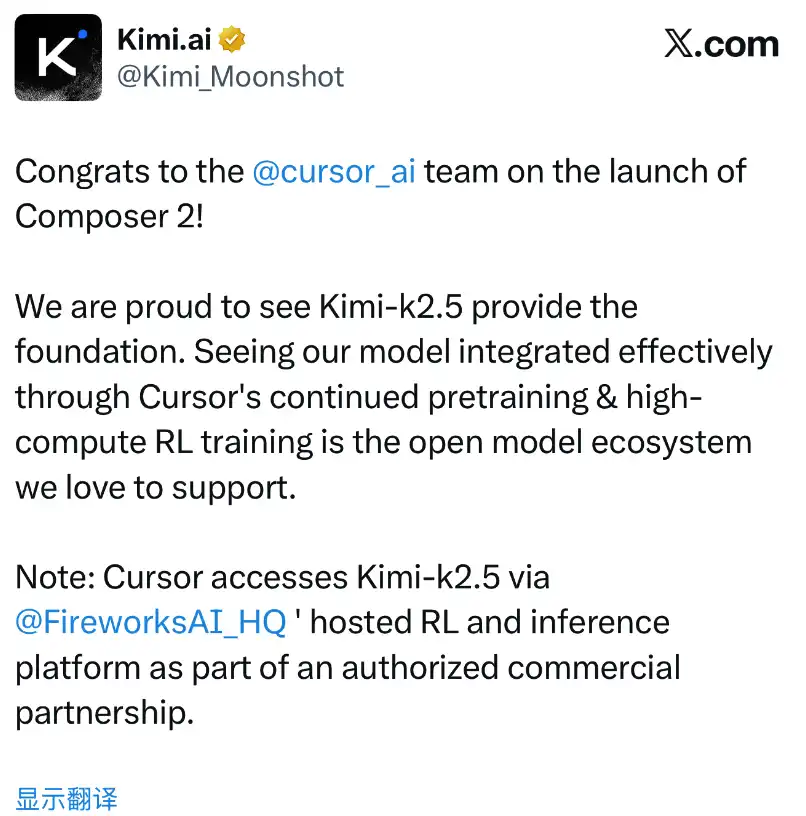
Following Kimi's official statement, Cursor co-founder Aman Sanger and VP of Developer Education Lee Robinson followed up. Sanger explained the technical choices: the team conducted confusion matrix evaluations on multiple bases, with Kimi K2.5 proving to be "the strongest," followed by additional pre-training and 4x-scale high-power reinforcement learning, deployed through Fireworks AI's inference and RL sampler.
Robinson added that the final model had about a quarter of its compute coming from Kimi, with the rest coming from Cursor's own training. Both acknowledged that not mentioning the Kimi base in the blog post was a "mistake" and stated that the next model would be upfront about it.
This is the second time Cursor has been found to use a Chinese open-source model without disclosure. In November 2025, when Composer 1 was released, the community discovered that its tokenizer was identical to DeepSeek, and the model occasionally produced Chinese output during inference, with Cursor again failing to comment.
The discussion sparked by this incident has exceeded mere license compliance. Hugging Face co-founder and CEO Clément Delangue commented that this was another validation of Chinese open source, stating that "Chinese open source is now the biggest force shaping the global AI tech stack," and that the forefront of competition is no longer just about who trains from scratch, but about who can adapt, fine-tune, and productize the fastest.
An interesting timing coincidence: On March 15, Bloomberg reported that Dark Side of the Moon was seeking up to $1 billion in new funding, with a valuation of around $18 billion, more than four times what it was three months ago, with both Alibaba and Tencent participating in the bet. Just five days later, the world's most valuable AI programming tool was found to be based on Kimi K2.5. Anysphere, valued at $29.3 billion, identified Kimi K2.5 as the "most powerful base" and built its core product on top of it, perhaps providing the most direct market endorsement of Dark Side of the Moon's technical capabilities.
At this point, with the fundraising round still ongoing, the Cursor incident effectively served as a global developer-facing showcase for Kimi. Whether the $18 billion valuation still undervalues Dark Side of the Moon remains to be seen and may need to be reassessed.
You may also like
How to choose between buying discounted ETH, Bitmine, and SharpLink?
Do you want to buy CRCL?
Wosh: Inflation has cooled in recent weeks, AI is reshaping the economy, and forward guidance has lost its necessity
The most secretive AI winner
Looking at Stripe's ambitions and the future of stablecoins from OUSD
From Pump.fun to Collector Crypt: Has Solana's income throne changed hands?
Dan Bin's latest speech: Don't miss out on a great era
Robinhood launches its own blockchain, no longer wanting to be a tenant on others' chains
Why Tokenized Stocks Are Booming in 2026 While Crypto Is Still Struggling
Former ByteDance employee's account: How I started with two Pinduoduo hard drives and made six times the profit with Seagate to achieve financial freedom?
MiCA reshuffle begins, Binance temporarily bids farewell to the EU
How does Gate redo "buying and selling stocks" from the cryptocurrency world to the stock market?
Visa and Mastercard join 140 giants to launch a new stablecoin, but the impact on the market landscape may still be limited
Circle CEO responds to OUSD's challenge: Stablecoins are a winner-takes-all business, and we will not slow down
Argentina vs Cape Verde: When a Record-Breaking Legend Meets an Unbreakable Underdog
WEEX exclusive pre-match analysis of Argentina vs Cape Verde, exploring Messi-led Argentina’s dominance and Cape Verde’s historic defensive breakout, with a breakdown of volatility, structure, and match dynamics.
WEEX Launches Depth Chart for Spot Trading
Raising interest rates to protect STRC and selling coins to maintain credit, this time the strategy has chosen the two most expensive paths
Morning Report | Samsung announces a 265.5 trillion won investment plan, focusing on semiconductor and AI computing power data centers; Vitalik publishes an article detailing the entire technology tree behind the confusion protocol (iO) mainline
How to choose between buying discounted ETH, Bitmine, and SharpLink?
Do you want to buy CRCL?
Wosh: Inflation has cooled in recent weeks, AI is reshaping the economy, and forward guidance has lost its necessity
The most secretive AI winner
Looking at Stripe's ambitions and the future of stablecoins from OUSD
From Pump.fun to Collector Crypt: Has Solana's income throne changed hands?

Popular coins
Latest Crypto News


