
December 29th Market Key Intelligence, How Much Did You Miss?

Featured News
2. ZBT Surges Over 58.5% in the Past 5 Hours, with Over $1.2 Million in Liquidations Across the Network
4. BSC-Based MSCST Project Faces Flash Loan Attack, Losing Around $130,000
5. Flow Abandons Network Rollback, Will Phased Network Recovery
Trending Topics
Source: Overheard on CT (tg: @overheardonct), Kaito
Here is the Chinese translation of the original content:
[STANDX]
STANDX currently dominates social discussions, driven by its ongoing mainnet launch trading points event and the rapid growth of its auto-yield stablecoin $DUSD, with current TVL of approximately $160 million.
Discussions focus on the platform's institutional-grade matching execution (built by the original Binance Futures founding team) and its unique "poker table-style" trading interface.
Key interactive drivers also include: a 10% points bonus for Binance Wallet users; market rumors of a potential integration with Pendle Finance on January 29; $DUSD's capital efficiency advantage: users can earn passive income while using it as collateral for high leverage perpetual contracts
[BNB]
BNB has become a focal point of discussion due to its relative resilience in 2025, being one of the few mainstream altcoins to experience an increase in value (around +19% year-to-date).
The ecosystem data is also impressive, with BNB Chain leading in daily active users among L1 blockchains, averaging around 4.32 million.
Market attention is also on: Changpeng Zhao's (CZ) year-end AMA following a presidential pardon; significant increase in trading volume; a strategic shift towards AI-driven payments and stablecoin scalability; BNB listing on Gemini; inclusion of opBNB upgrade and native privacy feature in the technical roadmap for 2026.
[TWT]
Trust Wallet (TWT) has seen a significant surge in popularity after its browser extension version 2.68 fell victim to a supply chain attack, resulting in the theft of around $6-7 million in user funds.
The attack, carried out by implanting malicious code to steal seed phrases, prompted an emergency announcement from the official team, urging users to upgrade to version 2.69.
Following CZ's statement that Trust Wallet would fully reimburse the losses and that user funds are "SAFU," market sentiment has somewhat recovered, but the community still criticizes the initial security vulnerability and delayed disclosure.
[MEGAETH]
MEGAETH has gained increased discussion momentum, primarily due to its strategic integration with Mayan Finance and Wormhole, enabling native cross-chain swaps and transfers without the need for wrapped tokens. The community is also highly interested in its financial system-level real-time execution capability, active over-the-counter pre-trading, and anticipation of its mainnet launch and TGE, rumored to potentially occur in early 2026.
[MIDEN]
MIDEN is gaining popularity due to its first offline community event in South Korea and the release of the "Miden Name" identity system, which introduces a more user-friendly "Pay-to-Name" feature.
Community discussions are focused on its ZK native architecture, particularly: client-side execution; and the Actor model for high-performance parallel processing.
As a key privacy layer in the Polygon AggLayer ecosystem, MIDEN has received praise for its programmable privacy capabilities and developer-friendly support for Rust and WebAssembly, with the mainnet expected to launch in 2026.
Featured Articles
1.《 Lighter Founder's Latest Response on Token Issuance Progress, What Did They Say》
Yesterday morning, Lighter Founder and CEO Vladimir Novakovski held a deep Q&A session on Twitter Space. As promised earlier that "TGE will be completed this year," Lighter will complete the TGE in the final 3 days countdown time. Meanwhile, in the past few days, Lighter's new round of witch account cleaning has caused some users to lose their hard-earned points, sparking intense discussions on Discord and Twitter.
2.《Who Is Creating These Ugly Memes?》
When AI, algorithmic recommendation, and crypto speculation are combined, internet memes are systematically "manufactured" to harvest attention and money. Starting from a series of offensive content that went viral on social platforms, this article reveals how these seemingly absurd trends serve the propagation logic of crypto scams. It reminds us that when popularity is no longer organically generated but designed to profit, the internet is becoming more chaotic and dangerous.
On-chain Data
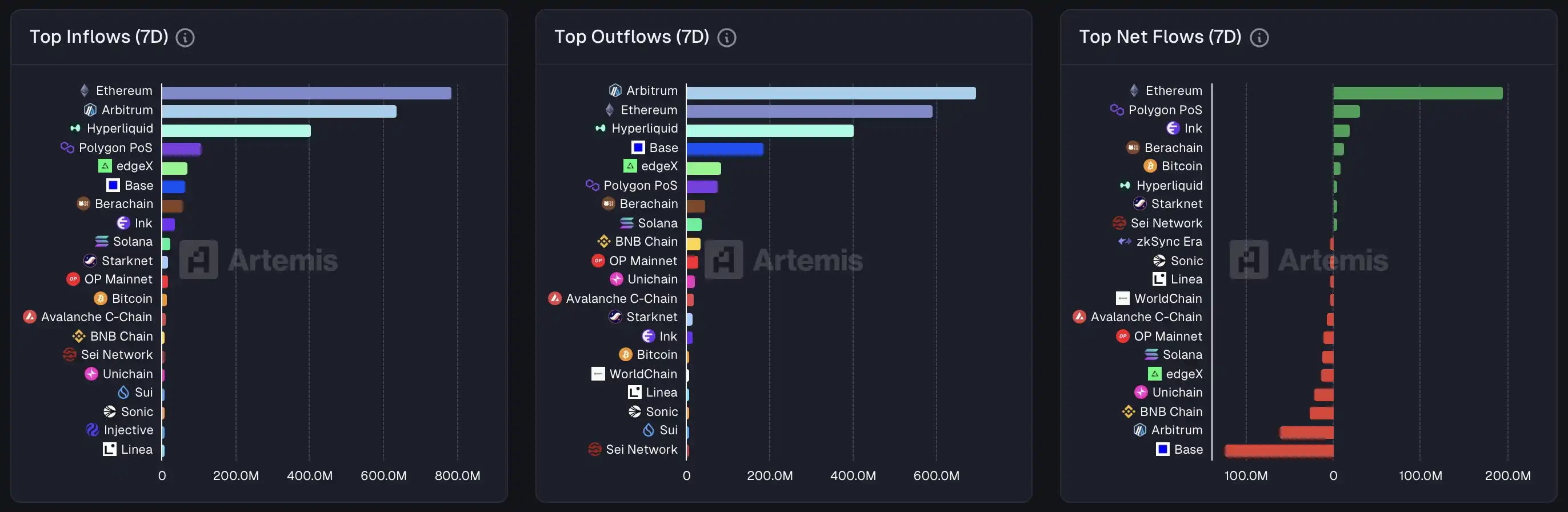
On-chain Fund Flow Last Week on December 29
You may also like

The cryptocurrency industry has become a traditional industry
Chip frenzy cooling down? Morgan Stanley's Wilson: Funds are shifting towards AI supercomputing giants like Microsoft and Amazon
$10,000 in TRUMP Token vs. $10,000 in Nasdaq: The "Trump Trade" That Actually Worked in 2026
Morning Report | Vitalik outlines Ethereum's long-term roadmap, Lean Ethereum will become the third major iteration; SK Hynix seeks to attract more AI investors by listing in the U.S
The impact of OUSD on Circle, Tether, and Paxos: not a single negative factor, but a more complex reshaping of competition
Li Feifei's latest long article: When video generation, robots, and NVIDIA all claim to be world models, we need a taxonomy
Blaming the desolation of the cryptocurrency world on the rise of AI is a form of intellectual laziness
Strategy Founder: The Next 10 Years of Bitcoin
Forbes Special Report: Stablecoin cross-border payments are faster now, but not cheaper yet
A valuation of 8 billion dollars, doubling in 8 months! What makes the crypto-friendly bank Erebor Bank stand out?
340 billion valuation: Li Yanhong's largest IPO, a seat in Kunlunxin's shares is hard to come by
Stablecoins are the "royalists" of the crypto world: Open USD brings the old currency system into play
Cape Verde 2-3 Argentina: The Underdog Team That Stunned the World in Defeat
Cape Verde's run ended in a 3-2 defeat to Argentina, but their journey — three unbeaten draws, one heroic goalkeeper, and a fight that pushed the defending champions to the brink — is the kind of story markets recognize too: small caps can rattle blue chips long before anyone expects it.
Semiconductor stocks plummet, yet Anthropic wants to create a 2nm chip
Where is Zhao Changpeng's billion-dollar investment going? YZi Labs' investment landscape fully revealed
Ethereum Foundation Report: A Basic Guide to Ethereum for Governments and Financial Institutions
A pre-announced harvesting case: After the cryptocurrency price dropped by 99%, the public chain Saga exited to transform into AI
When American giants collectively "defect" from Chinese AI models
The cryptocurrency industry has become a traditional industry
Chip frenzy cooling down? Morgan Stanley's Wilson: Funds are shifting towards AI supercomputing giants like Microsoft and Amazon
$10,000 in TRUMP Token vs. $10,000 in Nasdaq: The "Trump Trade" That Actually Worked in 2026
Morning Report | Vitalik outlines Ethereum's long-term roadmap, Lean Ethereum will become the third major iteration; SK Hynix seeks to attract more AI investors by listing in the U.S
The impact of OUSD on Circle, Tether, and Paxos: not a single negative factor, but a more complex reshaping of competition
Li Feifei's latest long article: When video generation, robots, and NVIDIA all claim to be world models, we need a taxonomy


