
Global Stablecoin Regulation Update Overview

 Prefer us on Google


Original Article Title: "WOO X Research: Stablecoins: An Overview of New Regulatory Dynamics"
Original Source: WOO
In recent years, the rapid development of stablecoins has attracted the attention of regulatory agencies worldwide. As a type of cryptocurrency pegged to fiat currency or other assets, stablecoins possess the characteristic of price stability and have been widely used in areas such as cross-border payments and DeFi. Particularly in this cycle, Real World Assets (RWAs) have performed well, with both traditional financial institutions (such as BlackRock) and web3-native institutions/organizations (such as Sky, formerly MakerDAO) entering the space. More and more investors are also paying attention to this sector, leading to a trend of ranging growth.
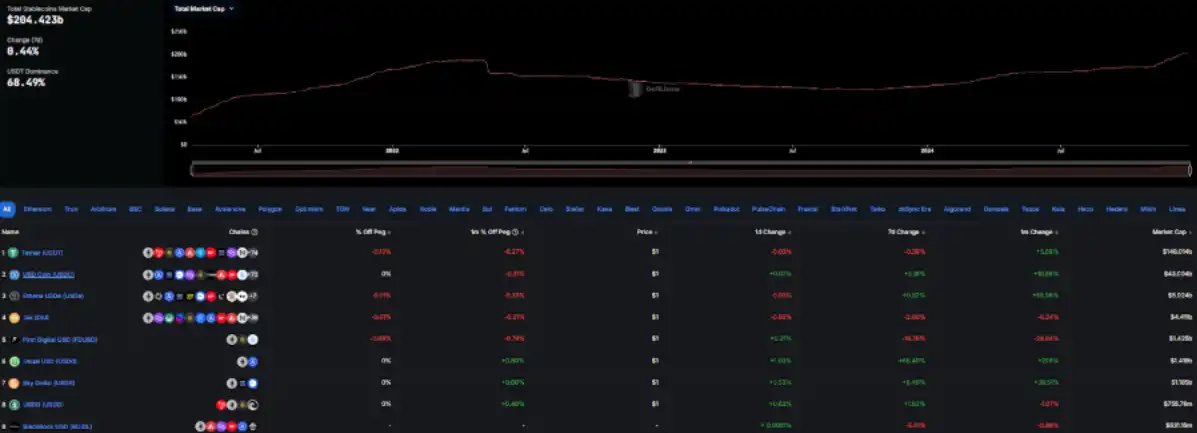
(Image Source: https://defillama.com/stablecoins)
"Regulations are necessary for orderly development," and consequently, governments and international organizations have begun to introduce policies to regulate stablecoins. This article provides a brief summary of the current regulatory landscape.
United States (North America)
The United States is one of the primary markets for stablecoin development, and its regulatory policies are relatively complex. The U.S. stablecoin regulatory framework is mainly implemented by multiple agencies, including the Treasury Department, the Securities and Exchange Commission (SEC), and the Commodity Futures Trading Commission (CFTC).
For certain stablecoins, the SEC may deem them to have securities attributes, requiring compliance with the relevant securities laws. The Office of the Comptroller of the Currency (OCC) under the Treasury Department has proposed allowing national banks and federal savings associations to provide services to stablecoin issuers, subject to anti-money laundering and compliance requirements. Recently, the U.S. Congress has been discussing legislative proposals such as the "Stablecoin Transparency Act" in an attempt to establish a unified regulatory framework for stablecoins. With the election of Donald Trump, often referred to as the "Crypto President," although the policies have not yet been implemented, cryptocurrency regulation seems to be generally trending positively.
European Union (Europe)
Stablecoin regulation in the European Union primarily relies on the Markets in Crypto-Assets Regulation (MiCA).
MiCA categorizes stablecoins into Asset-Referenced Tokens (ARTs) and Electronic Money Tokens (EMTs). Electronic Money Tokens (EMTs) refer to tokens pegged to a single fiat currency, such as stablecoins pegged to the Euro or the Dollar. Meanwhile, Asset-Referenced Tokens (ARTs) refer to tokens pegged to certain assets (such as fiat currency, commodities, or cryptocurrencies). MiCA sets out corresponding regulatory requirements for each category. Entities issuing stablecoins must obtain a license from an EU member state and meet requirements such as capital reserve and transparency disclosure.
Hong Kong (Asia)
On July 17, 2024, the Hong Kong Monetary Authority and the Financial Services and the Treasury Bureau jointly issued a consultation summary outlining the key features of the upcoming stablecoin regulatory regime. Under this regime, companies looking to issue or promote fiat-backed stablecoins to the Hong Kong public will need to obtain a license from the HKMA. The regulatory requirements include asset reserves management, corporate governance, risk controls, disclosure, and measures to combat money laundering and terrorist financing.
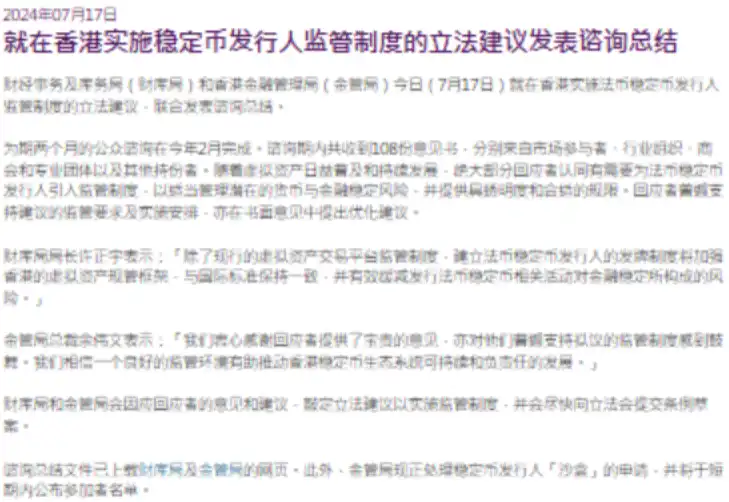
(Image Source Link: https://www.hkma.gov.hk/eng/news-and-media/press-releases/2024/07/20240717-3/?utm_source=chatgpt.com)
In addition, the HKMA has introduced a stablecoin issuer sandbox scheme to engage with the industry on the proposed regulatory requirements. The first list of participants was announced on July 18, 2024, including JD Coinchain Technology (Hong Kong) Limited, Roundcoin Innovation Technology Limited, and a consortium composed of Standard Chartered Bank (Hong Kong) Limited, Animoca Brands Limited, and Hong Kong Telecom Limited.
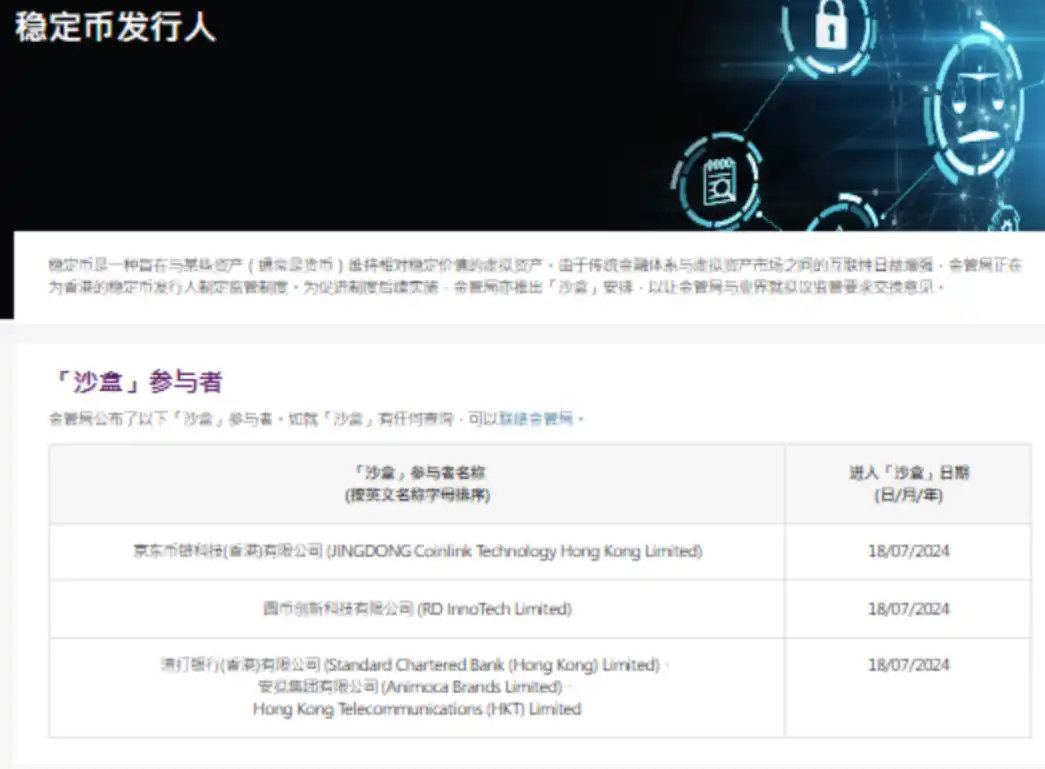
(Image Source Link: https://www.hkma.gov.hk/eng/key-functions/international-financial-centre/stablecoin-issuers/?utm_source=chatgpt.com)
Recently, on December 6, 2024, the government published the "Stablecoin Bill" in the Gazette, aiming to introduce a regulatory regime for fiat-backed stablecoin issuers in Hong Kong to enhance the oversight framework for virtual asset activities.
-- Price
Singapore (Asia)
Under Singapore's Payment Services Act, stablecoins are considered digital payment tokens, and their issuance and circulation require approval from the Monetary Authority of Singapore (MAS). MAS provides a regulatory sandbox for startups to test business models related to stablecoins.
Japan (Asia)
In June 2022, Japan revised the Payment Services Act (PSA), establishing a regulatory framework for the issuance and trading of stablecoins. Under the amended PSA, stablecoins fully backed by fiat currency are defined as "Electronic Payment Instruments" (EPI) that can be used to pay for goods and services. There are specific requirements for the issuing entities: only three types of institutions can issue stablecoins: banks, funds transfer service providers, and trust companies. Institutions wishing to engage in stablecoin-related activities must first register as Electronic Payment Instrument Service Providers (EPISP) to obtain the necessary licenses to provide services.
Brazil (South America)
In October 2024, BCB President Roberto Campos Neto announced plans to regulate stablecoins and asset tokenization in 2025. In November 2024, BCB proposed a regulatory measure suggesting a ban on users withdrawing stablecoins from centralized exchanges to self-custody wallets. Additionally, in December, BCB's Deputy Director of the Financial System stated that the central bank might lift the ban if key issues such as transaction transparency are addressed.
Conclusion
Furthermore, Russia, a BRICS country, is also considering using cryptocurrency as a settlement method for cross-border financing. Overall, whether it's creating regulatory sandboxes for crypto companies or defining categories based on stablecoins' different characteristics, more and more stablecoin regulatory policies will be introduced in the future. Cross-border payments seem to be one of the most widely applicable scenarios for stablecoins.
This article is a contributed piece and does not represent the views of BlockBeats.
This content is provided for general informational purposes only and doesn't constitute financial, investment, legal, or tax advice. Any events, rewards, online promotions, or related information mentioned herein should not be considered a recommendation, solicitation, or invitation to purchase, sell, trade, or otherwise deal in any crypto assets. Crypto assets are highly volatile and may result in loss. The availability of WEEX services, products, and related events may vary by region. You are responsible for ensuring that your participation is in accordance with applicable local laws and regulations.
You may also like

Can SKY Reach $0.10 in 2026? Standard Chartered Turns Bullish

AI and the extinction of humanity: the $2 trillion danger?

Dark energy may be changing, according to a study of 3,000 supernovae

Apple's Foldable iPhone Duo Launches at 15,999 Yuan, Available from October 23

What Are We Losing in the Age of AI? — Observations from an Ordinary Person in 2029

Crypto: Token Buybacks Reach $640 Million in 2026

On-Chain Stablecoins vs. U.S. Treasuries: Higher Risks, Are They Matched by Sufficient Yield Premiums?

Tim Cook Steps Down: Bitcoin, AI, What the New Apple CEO Must Urgently Address

Robinhood Surge: Why UNI is Rising
Bankless: On-Chain Gacha FWA is Reigniting the NFT Market

Hash Global: After BTC, Who Will Take the Baton for the Next Bull Market?

Hugging Face Launches AI Robot Microduck Priced at $399

Mantle stablecoins and tokenized assets reach $880M
Private Air Defense from 20 Million UAH: Who Protects Ukrainian Businesses from Shelling and What Will Happen to the Market After the War
Mantle Vault Expands into DeFi Space
Current Top Cryptocurrencies: The Second Ten Digital Assets Changing the Market

RWA deposits triple to $7.4B as DeFi activity falls

Fake World Assets Opens Its Gacha Pool to New NFT Collections

Reviewing 14 Years of RWA: From Colored Coins Concept to Trillion-Dollar Market
Will AI Suddenly 'Evolve'? Paradigm Uses a Game to Tell You the Answer
Exodus Reports $18.6 Million Net Loss in Q2, Monthly Active Users Down 6.7%

Blockchain Capital Partners Discuss: The Next Bull Market May Be Just Around the Corner

Sky Reports $10.735 Million in Q2 Revenue, Collateral Decreases in July
$67 Million in Forgotten Cryptos: How to Claim Them Without Getting Scammed

UEFA Dismisses Gianni Infantino's Apology Request and Maintains Its Stance Ahead of Elections

With a Market Share of Nearly 70%, How Does Upbit Manage the Wealth Anxiety of Korea's 'Ants'?

How cross-chain bridges work and why $4 billion has been stolen from them
Important: MakerDAO Adjusts Governance During Transition to Sky! Fine-Tuning Continues Towards Endgame

Sky Protocol Achieves Remarkable Milestone with Annual Revenue Approaching $419 Million! Demand for USDS Boosts DeFi Earnings!
SKY Financial Corporation SDEV Reports $2.2 Million Staking Revenue in Q2, Holdings Increase to 10%
Can SKY Reach $0.10 in 2026? Standard Chartered Turns Bullish
AI and the extinction of humanity: the $2 trillion danger?
Dark energy may be changing, according to a study of 3,000 supernovae
Apple's Foldable iPhone Duo Launches at 15,999 Yuan, Available from October 23
What Are We Losing in the Age of AI? — Observations from an Ordinary Person in 2029
Crypto: Token Buybacks Reach $640 Million in 2026


