
Messari: Trading US Stocks on Perp DEX, the Next New Frontier

Original Article Title: Equity Perps: Tall Orders and Slow Beginnings
Original Article Author: Sam, Messari Research
Original Article Translation: Deep Tide TechFlow
Key Insights:
Equity perpetual contracts still belong to a high-potential but unproven area, with limited appeal in the on-chain market mainly due to misaligned audience, weak demand, and more popular alternatives (such as 0DTE options).
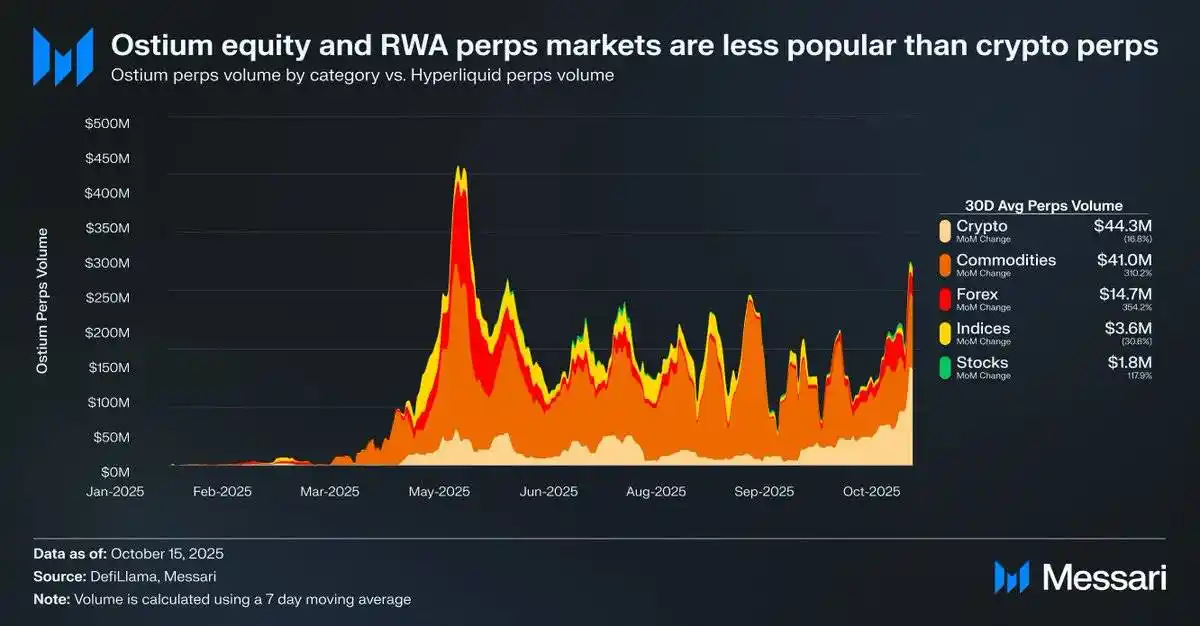
For example, the daily average trading volume of equity perpetual contracts on the Ostium platform is only $1.8 million, while cryptocurrency perpetual contracts reach as high as $44.3 million, demonstrating a weak market demand.
This may imply that due to infrastructure and regulatory constraints, market demand has not been fully unleashed. Hyperliquid's recent HIP-3 upgrade has provided the best opportunity for equity perpetual contracts, but the adoption process is expected to be gradual.
Source: Messari (@0xCryptoSam)
Equity perpetual contracts are considered the inevitable next blue ocean in the on-chain market, but current data suggests that this area is still challenging to break through in the short term. Ostium, as a decentralized exchange focusing on real-world assets (RWAs), has a daily average trading volume of equity perpetual contracts of only $1.8 million, while cryptocurrency perpetual contracts reach $44.3 million, reflecting weak demand.
This adoption gap is mainly due to misaligned audience. On-chain traders have little interest in stocks, while off-chain platforms (such as Robinhood) allow traders to easily trade stocks and options but not perpetual contracts. International investors may be a potential target audience as they cannot directly access the US stock market. However, these investors may prefer to hold stocks directly to gain shareholder rights while avoiding funding costs and settlement risks.
Compared to tokens, stocks have fewer interoperability challenges, benefiting from the convenience of synthetic wrapping. For the average investor, almost every stock in the global market has already been abstracted through the search bar's individual stock code. Therefore, even though perpetual contracts add permissionless and censorship-resistant features to stocks, ordinary stock investors are either unaware of this or simply not interested.
Source: fow
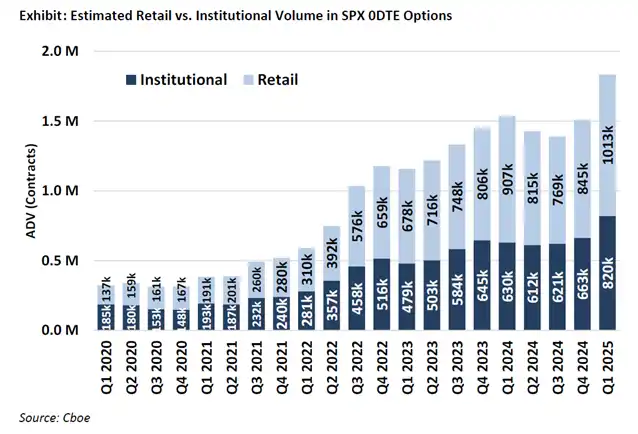
The most likely users of stock perpetual contracts are retail options traders (who drive 50%-60% of 0DTE trades on the Robinhood platform). However, traditional exchanges relying on banking services will only adopt stock perpetual contracts when the law is clear. The U.S. Commodity Futures Trading Commission (CFTC) has approved perpetual contract trading for BTC and ETH, but these two have been deemed non-securities. While perpetual contracts are more intuitive than options, the popularization of stock perpetual contracts may be slower than expected due to the close link between retail adoption paths and legal clarity.
Source: @Kaleb0x
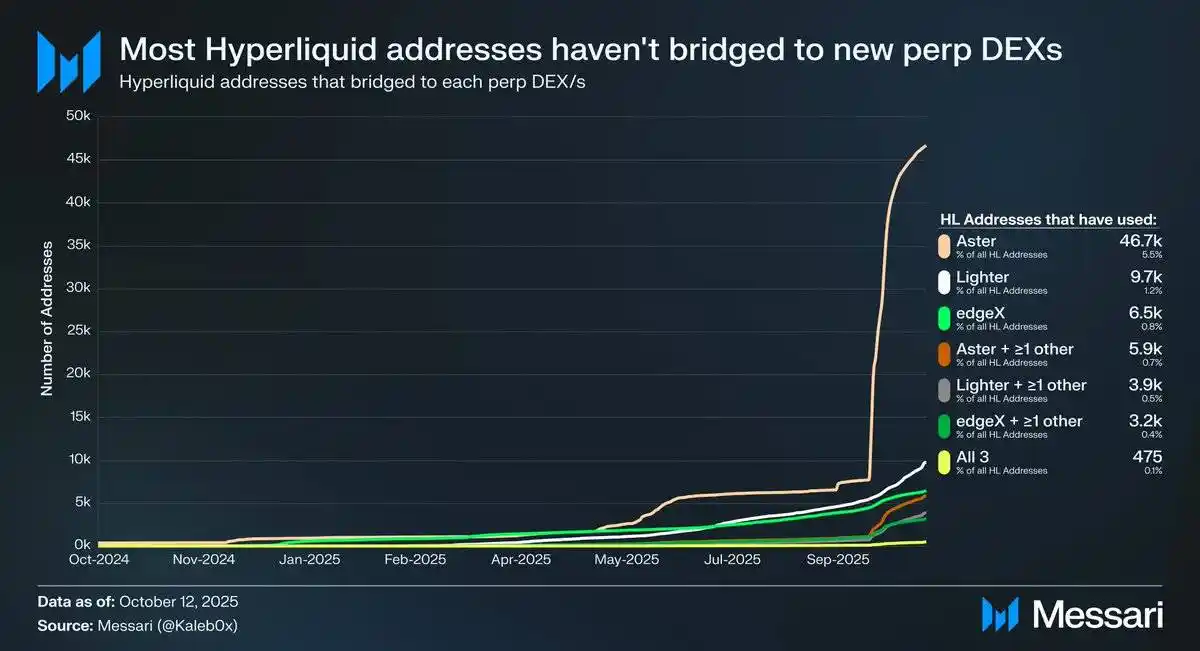
Let's discuss the potential development direction of stock perpetual contracts under the background of the HIP-3 upgrade on Hyperliquid. HIP-3 introduces a permissionless perpetual contract market, and data shows that less than 10% of Hyperliquid addresses have bridged to Aster, Lighter, and edgeX, with even fewer users opting for multiple perpetual contract decentralized exchange (DEX) platforms. This indicates that funds on Hyperliquid are sticky and of higher quality. Based on this data, the future of stock perpetual contracts can be predicted from two perspectives:
Hyperliquid users are loyal to the platform and, regardless of asset listings or features, they are more likely to choose Hyperliquid over other perpetual contract DEXs.
Hyperliquid users are satisfied with the current perpetual contract market products.
I believe both of these viewpoints make sense. Considering that Hyperliquid users have not massively shifted funds in the face of incentives, they may be loyal to Hyperliquid. However, as most of the trading volume and open interest on Hyperliquid are concentrated in mainstream assets, similar to other perpetual contract DEXs, it is currently difficult to determine whether Hyperliquid users care about market diversity and whether stock perpetual contracts are attractive to regular users (more importantly, to the whales holding 70% of Hyperliquid's open interest).
In addition, these traders may also have accounts on both traditional trading platforms and brokerage platforms, further limiting the potential market size of stock perpetual contracts on Hyperliquid.
It is worth noting that stock perpetual contracts may not bring new open interest or trading volume to Hyperliquid but may instead divert existing trading volume.
Although Ostium (with an annual average perpetual contract trading volume of $220 billion) and stock tokenization tools (such as xStocks, with a spot trading volume of $2.79 billion) have not yet experienced explosive growth, this may reflect infrastructure limitations rather than a lack of underlying demand. This pattern mirrors the early growth trajectory of perpetual contracts. GMX demonstrated the demand for on-chain perpetual contract markets, but the infrastructure at the time could not support sustained trading volume. Hyperliquid overcame this bottleneck, unleashing latent demand. By the same logic, after stock perpetual contracts receive the necessary performance and liquidity enhancements under HIP-3, they may find their first scalable product-market fit on Hyperliquid. While current data cannot confirm this outcome, this precedent is worth noting.
Compared to 0DTE options, the long-term potential of stock perpetual contracts remains evident. Projects like Trade[XYZ] can leverage regulatory arbitrage to build an early user base before entering the market on traditional exchanges. However, the real challenge lies in attracting off-chain retail traders, which has always been difficult for crypto applications.
You may also like

Circle CEO responds to OUSD's challenge: Stablecoins are a winner-takes-all business, and we will not slow down
Argentina vs Cape Verde: When a Record-Breaking Legend Meets an Unbreakable Underdog
WEEX exclusive pre-match analysis of Argentina vs Cape Verde, exploring Messi-led Argentina’s dominance and Cape Verde’s historic defensive breakout, with a breakdown of volatility, structure, and match dynamics.
How does Gate redo "buying and selling stocks" from the cryptocurrency world to the stock market?
Former ByteDance employee's account: How I started with two Pinduoduo hard drives and made six times the profit with Seagate to achieve financial freedom?
Visa and Mastercard join 140 giants to launch a new stablecoin, but the impact on the market landscape may still be limited
WEEX Launches Depth Chart for Spot Trading
MiCA reshuffle begins, Binance temporarily bids farewell to the EU
Raising interest rates to protect STRC and selling coins to maintain credit, this time the strategy has chosen the two most expensive paths
Morning Report | Samsung announces a 265.5 trillion won investment plan, focusing on semiconductor and AI computing power data centers; Vitalik publishes an article detailing the entire technology tree behind the confusion protocol (iO) mainline
In the era of AI, what is left of Bitcoin?
NeoSoul announced plans to integrate with the OKX Agentic Wallet, promoting AI agents' participation in the on-chain economy
Why Is Bitcoin Lagging Stocks in 2026? AI Stocks, ETF Outflows, and the Nasdaq Rally Explained
What you bought on CEX is really not US stocks: Analyzing the 94% liquidation monopoly and the evaporation of equity under a five-layer pipeline
In such a crowded cross-border payment arena, where is the next stop for the future?
Why Is Bitcoin Down in 2026? What We Can Learn From 2022
The large models in the United States are moving towards closure in the name of security
From the white-haired stock god to the billionaire fund mogul, the smart people shorting Nvidia are all getting rich using the same framework
Morning Report | CoinEx becomes a key hub for Iran to evade sanctions, involving over $3.8 billion in funds; Kalshi seeks a new round of financing, with a valuation potentially rising to $40 billion
Circle CEO responds to OUSD's challenge: Stablecoins are a winner-takes-all business, and we will not slow down
Argentina vs Cape Verde: When a Record-Breaking Legend Meets an Unbreakable Underdog
WEEX exclusive pre-match analysis of Argentina vs Cape Verde, exploring Messi-led Argentina’s dominance and Cape Verde’s historic defensive breakout, with a breakdown of volatility, structure, and match dynamics.
How does Gate redo "buying and selling stocks" from the cryptocurrency world to the stock market?
Former ByteDance employee's account: How I started with two Pinduoduo hard drives and made six times the profit with Seagate to achieve financial freedom?
Visa and Mastercard join 140 giants to launch a new stablecoin, but the impact on the market landscape may still be limited
WEEX Launches Depth Chart for Spot Trading


