
Meteora TGE Imminent: What Is the Fair Value of MET?

Original Article Title: Meteora's TGE: What is fair value for MET?
Original Article Authors: Luke Leasure & Carlos
Original Article Translators: AididiaoJP, Foresight News
This week, Meteora is about to launch its MET token: where could its fair value be?
Index
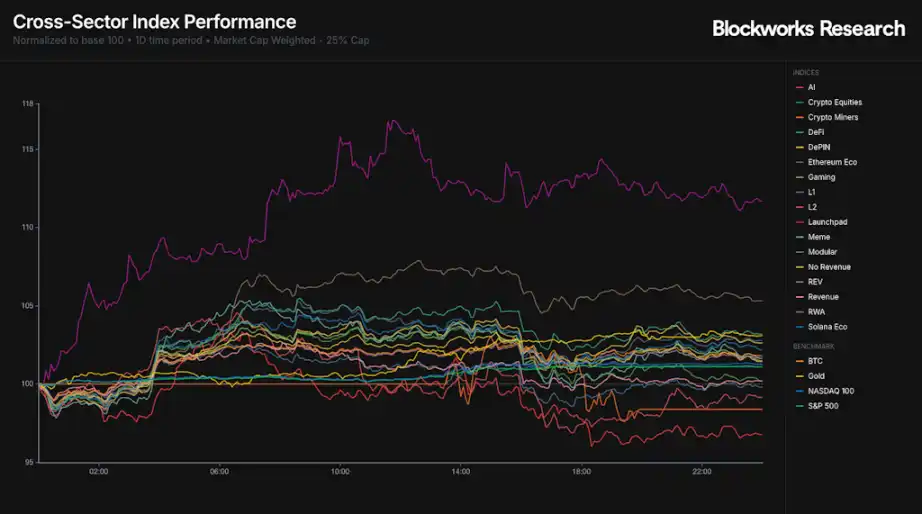
The week started strong, with BTC rising 7% from last Friday's low. During Monday's trading session, the Launchpad sector performed the best, while the AI sector saw the biggest decline, reversing their relative strength and weakness shown over the past week.
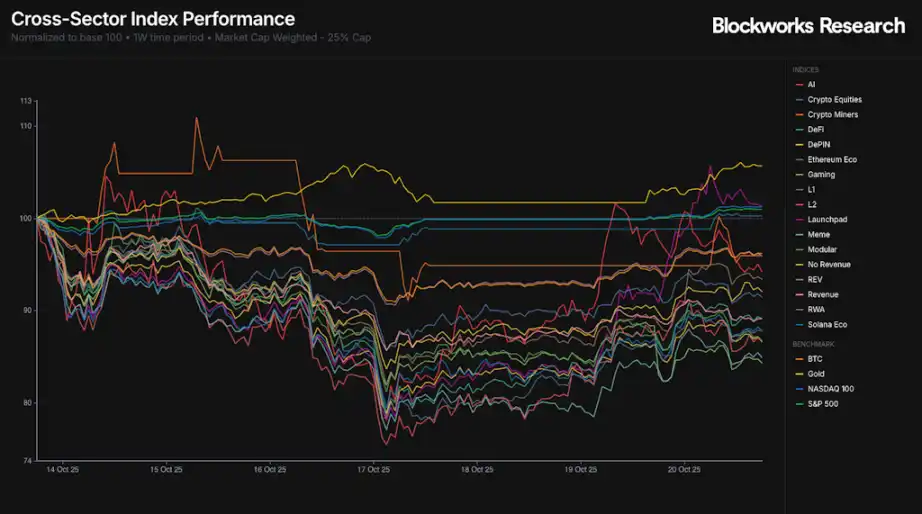
Looking at the weekly chart, the recent strength of the Launchpad sector has made it a relative winner, second only to gold, which once again approached its historical high by Monday's close. Overall, most indices remain negative on a weekly basis after the historic liquidation event. Within the Launchpad index, the BSC-based Launchpad project AUCTION was the only asset showing a positive return on the weekly chart, rising by 46%.
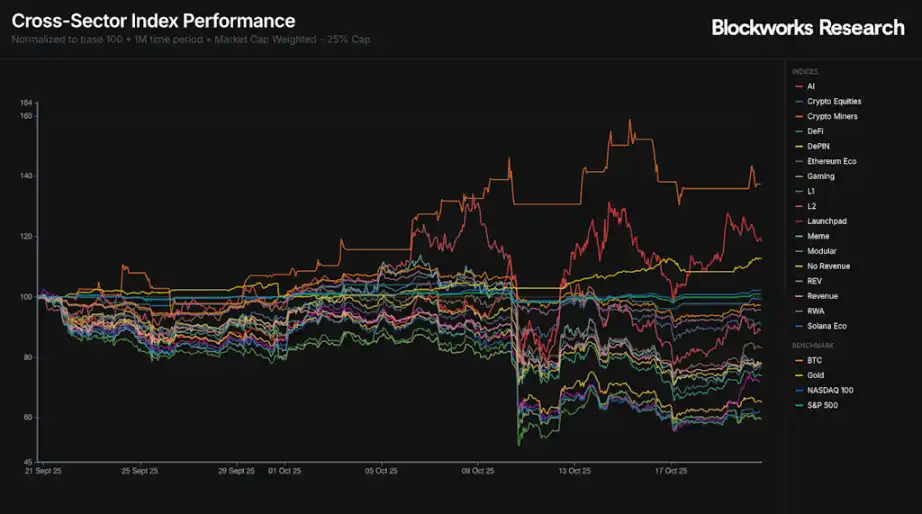
While there is some short-term upside, the monthly chart shows that almost all cryptocurrency indices have been falling over the past 30 days. The October 10 liquidation event resulted in widespread weakness, with only gold, cryptocurrency miners, AI, and stock indices performing strongly.
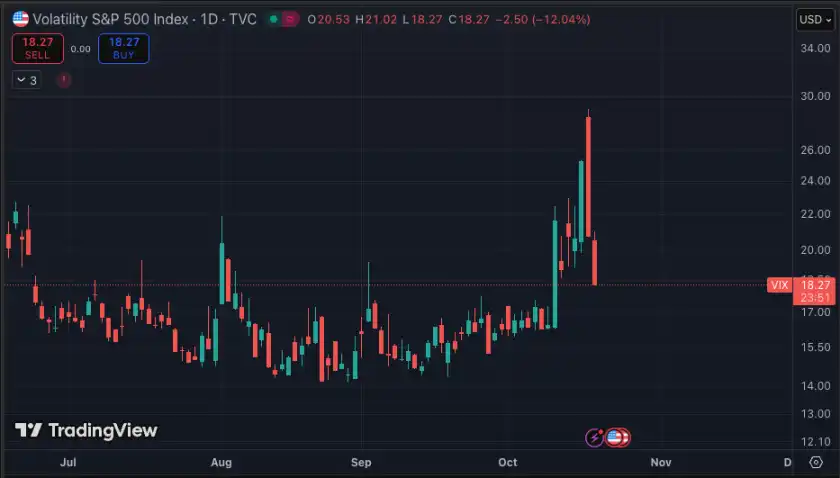
The VIX index has significantly retreated, rising to 29 on Friday morning and now falling to 18. The S&P 500 index and the Nasdaq index both rose during Monday's trading session, coming close to historical highs in the closing price.
Market Update
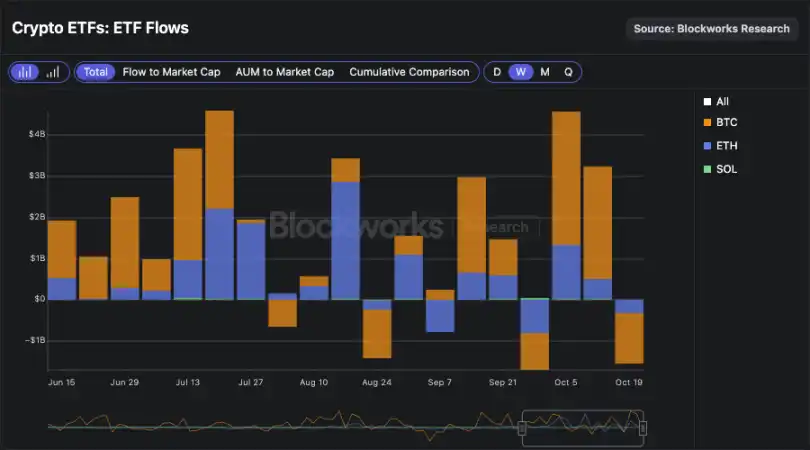
ETF fund flows remain subdued and negative. Monday's data shows BTC ETF outflows of $40 million, ETH ETF outflows of $145 million, and a $27 million inflow into SOL ETF. Looking at the weekly data, the total net outflows from ETFs last week amounted to $1.5 billion, reversing some of the funds accumulated at the strong start of October. SOL ETF is the only product showing net inflows, increasing by $14 million.
In DATCOs, BMNR is far ahead. The entity currently holds 3,236,014 ETH, surpassing the total held by all other ETH DATCOs, representing 2.67% of the total ETH supply. It is worth noting that since the end of August, BMNR has continuously increased its ETH holdings by nearly 70%, while the holdings of most other ETH DATCOs have remained stable. During this process, BMNR's market share of ETH held by DATCOs has grown from 50% to close to 65%.
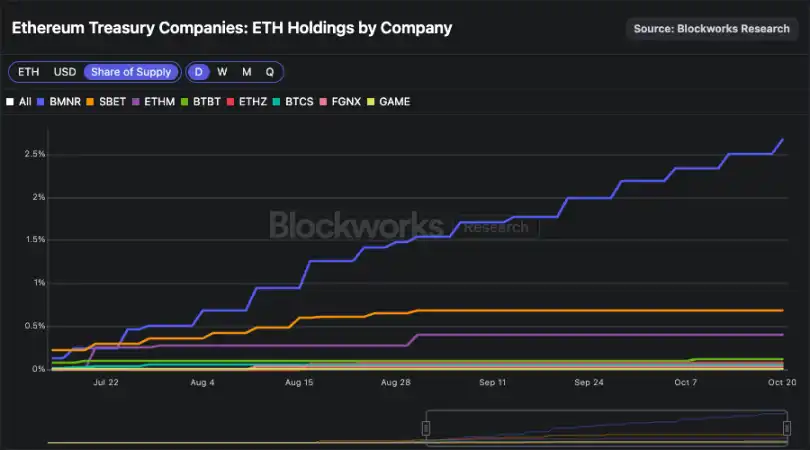
This situation is also reflected in the trading volume of ETH DATCOs. BMNR accounts for 60-85% of ETH DATCOs' trading volume, making its stock the most liquid. This liquidity feature has attracted significant allocators to the entity and reduced the marginal impact of ATM issuance on price. BMNR seems to be the clear winner in the ETH treasury company space.
In SOL DATCOs, the situation is less clear. FORD remains the largest holder, with almost all of its scale obtained through PIPE issuance earnings. Despite authorizing a $40 billion ATM issuance plan, the entity has not significantly increased its holdings through ATM issuance.
Growth in holdings remains soft, with HSDT recently rising to the second position.
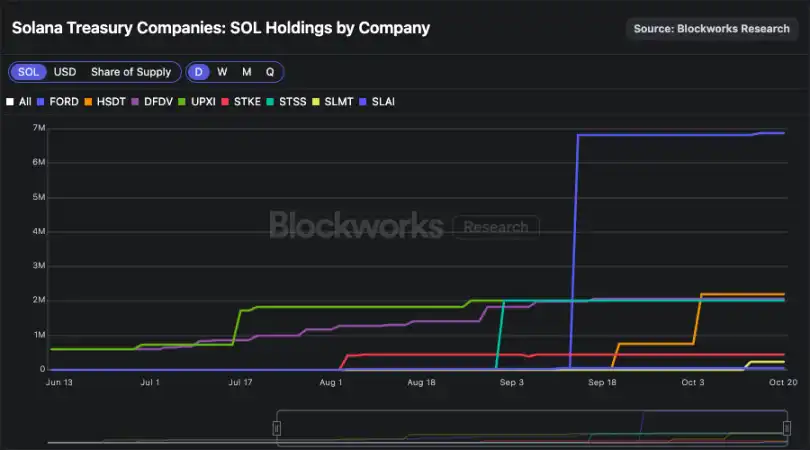
The trading volume of SOL DATCOs also tells a similar story. While DFDV once dominated much of the trading volume in this space, the situation has now shifted to a more even distribution among top names. Although FORD holds around 43% of the SOL held by DATCOs, it accounts for only about 10% of the trading volume in this space, indicating a relatively low turnover rate of its stock. These data may well explain why there is very little SOL accumulated through ATM issuance by FORD.
While BMNR is emerging as the clear winner in the ETH space, the leader in the SOL space may still be undecided. Over the next month, it is expected that trading volume will increasingly concentrate on top companies.
Meteora's TGE: What Is the Fair Value of MET?
The highly anticipated Meteora TGE will take place on Thursday, October 23. Unlike recent projects following the ICO trend, Meteora will not conduct any fundraising before the TGE. Instead, it will airdrop to eligible recipients, including Mercurial stakeholders, Meteora liquidity providers, JUP stakers, and Launchpad partners. Airdrop recipients will receive unlocked MET by default, or they can choose to provide liquidity at launch to earn trading fees.
Meteora was launched by the Solana ecosystem's largest DEX aggregator and perpetual contract trading platform Jupiter team in February 2023. Upon Meteora's launch, the protocol's previous iteration, Mercurial Finance, was sunsetted. The decision to close Mercurial and its governance token was made due to a significant amount of MER being involved with FTX/Alameda, leading the team to decide that the best course of action was to rebuild the platform using a new token.
Back in 2023, the team announced that 20% of the MET tokens would be distributed to Mercurial stakeholders at the TGE. As shown below, the team has honored the initial commitment, with 15% allocated to Mercurial stakeholders and 5% allocated to the Mercurial reserve. Additionally, the DEX has been running a rewards program since January 31, 2024, distributing a total of 15% of MET to the program. At launch, 48% of the MET supply will be in circulation, which is a high circulating supply ratio compared to other prominent tokens in the Solana ecosystem.
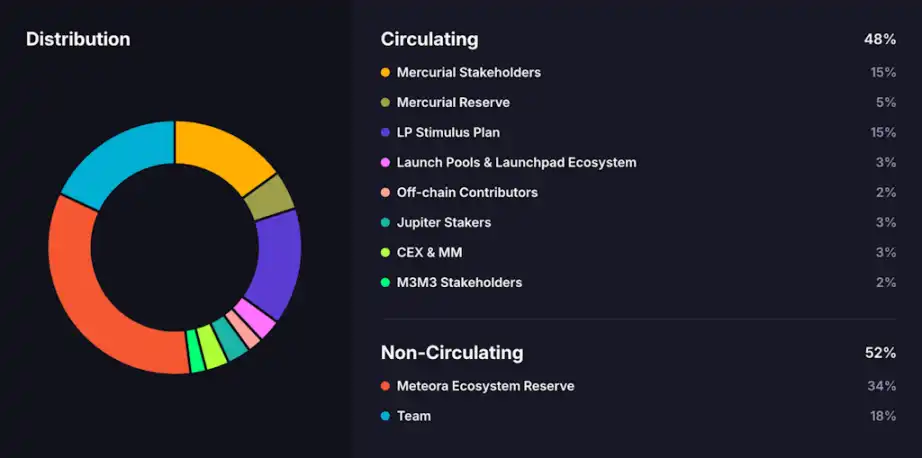
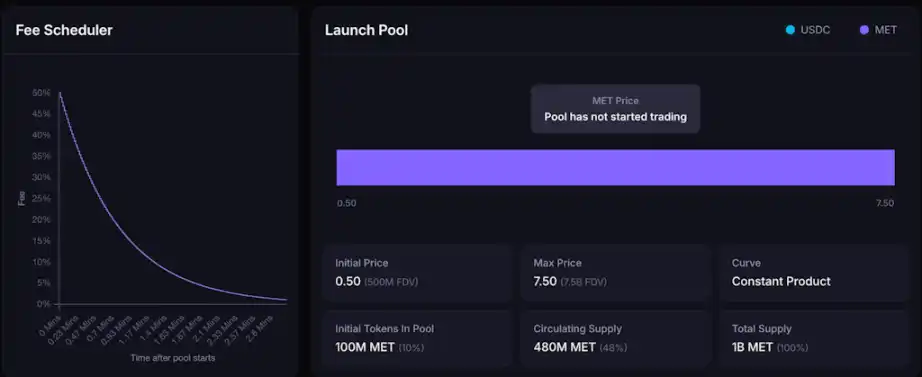
As mentioned earlier, 10% of the total supply will be used to seed initial liquidity through a dynamic AMM pool, with a starting price of $0.5 and liquidity distribution up to a $7.5 billion valuation. The early liquidity pool is one-sided, with early buyers exchanging their USDC for MET. It is important to note that the pool fees start high and sharply decrease over time through a fee schedule.
Valuation Calculation
DEXs, especially on Solana, lack significant moats as they do not have a front end. A prime example of this dynamic is when Raydium suffered significant trading volume and revenue losses after PumpSwap decided to route graduated tokens to its own AMM. Meteora aims to address this issue by vertical integration, expanding its distribution capabilities through Jupiter and selected Launchpad partners.
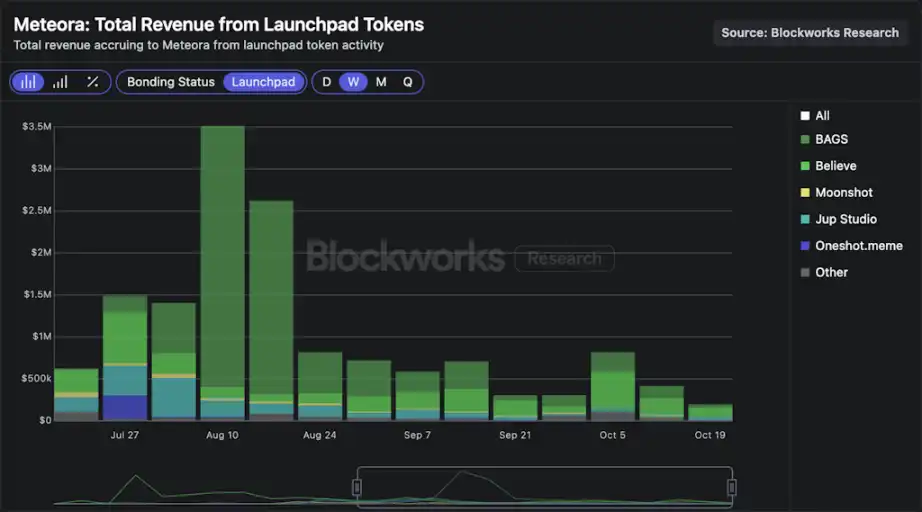
As mentioned earlier, this DEX collaborates closely with the Jupiter team, with Jupiter having become a popular gateway for retail users to conduct on-chain transactions. Additionally, in August 2024, Meteora partnered with Moonshot to launch a Launchpad and over time introduced new partners, including Believe, BAGS, and Jup Studio. The chart below shows that in recent weeks, Launchpad activities have contributed weekly revenues ranging from $200,000 to $800,000 to Meteora, with the majority of the traffic coming from Believe and BAGS.
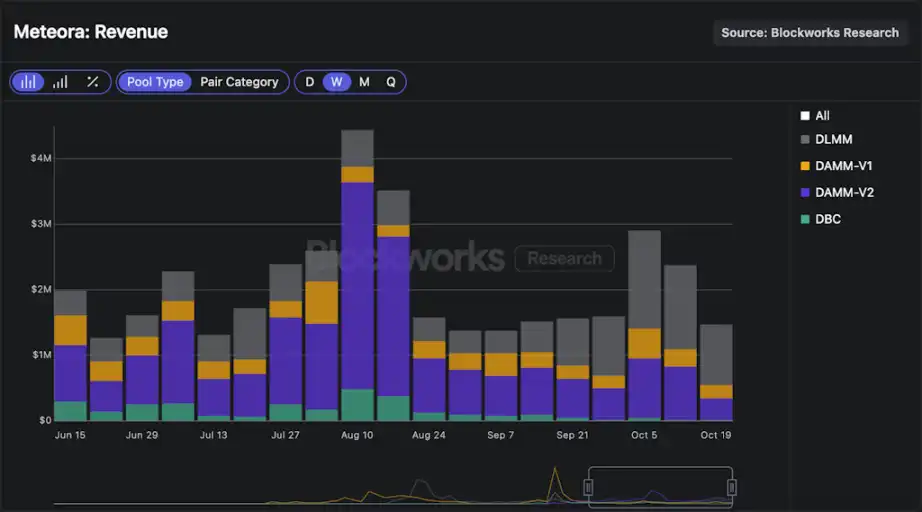
Looking at the overall financial data, Meteora generated $8.8 million in revenue over the past 30 days from all its liquidity pools, maintaining a weekly revenue close to $1.5 million even during periods of relatively low on-chain activity. It is noteworthy that over 90% of Meteora's revenue comes from Memecoin pools, which typically have higher fee levels compared to SOL-stablecoin, project token, LST, and stablecoin-stablecoin pools.
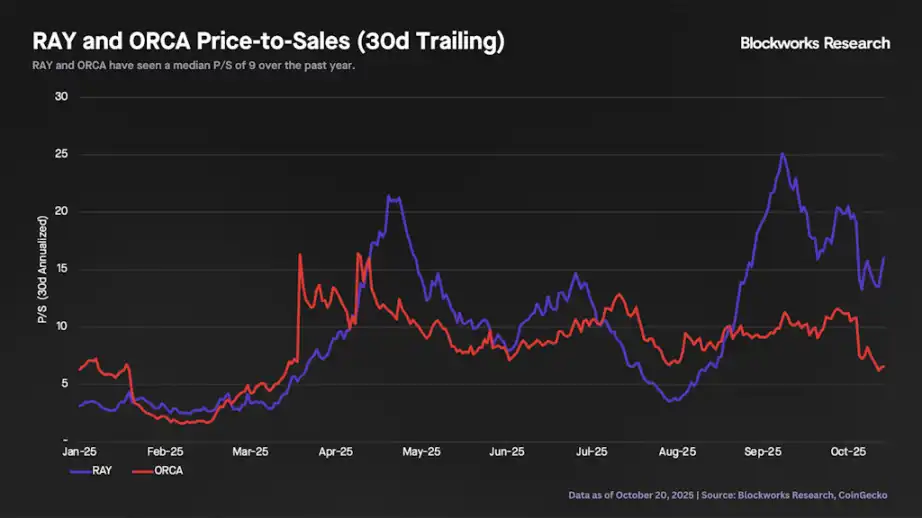
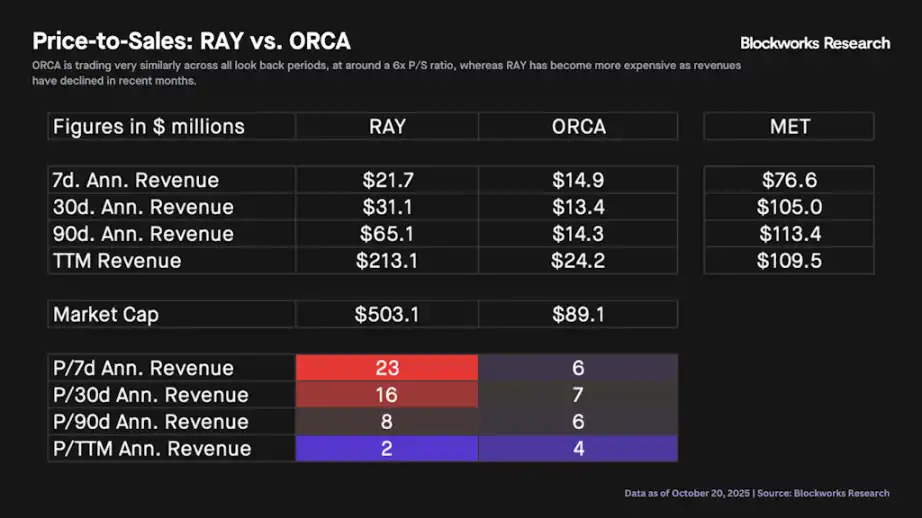
Regarding valuation, we can consider Raydium and Orca as comparable companies. The chart below shows the Price-to-Sales ratios of RAY and ORCA year-to-date based on 30-day annualized data. We observe that until September, the pricing ratios of these two assets were relatively similar, after which RAY began trading at a premium. Taking a broader view, the median Price-to-Sales ratio for these two assets in 2025 is 9x.
The table below compares the Price-to-Sales ratios of RAY and ORCA over various lookback periods. We notice that ORCA's trading behavior across all annualized time frames is very consistent, with a Price-to-Sales ratio of around 6x. On the other hand, as revenue declines, RAY has become more expensive over the past few months. For Meteora, we see its annualized revenue ranging from around $75 million to around $115 million based on the lookback period.
Finally, the chart below illustrates the potential valuation of MET across different revenue and Price-to-Sales ratio ranges. Based on the historical pricing behavior of RAY and ORCA, a Price-to-Sales ratio between 6x and 10x is the most likely. Therefore, it can be reasonably expected that post-launch, MET's trading valuation would fall between $4.5 billion and $11 billion. Please note that based on the numbers below, a valuation exceeding $10 billion starts to seem somewhat expensive relative to comparable companies, and a valuation surpassing $20 billion would almost certainly indicate MET is overvalued unless it can improve its revenue operating rate.
You may also like

Morning Report | BitMine increased its holdings by 126,971 ETH last week; trader Eugene announced his exit from the crypto market

Wang Chuan: How can one not feel anxious after the neighbor Old Wang made thirty times profit by investing in storage stocks? (Seven) - A quarter-century cycle

Cryptocurrency CEXs are flocking to sell US stocks, and traditional brokerages are facing an "uninvited guest."

$75 billion in foreign capital has fled, and South Korean retail investors have absorbed it all using leverage

Japan’s Three Megabanks Plan Joint Stablecoin Issuance in Fiscal 2026
MUFG, SMBC, and Mizuho reportedly plan to jointly issue fiat-pegged stablecoins in fiscal 2026, signaling Japan’s growing push into bank-led digital payment infrastructure.

Humanity Discloses H Token Dual-Chain Attack Details, With Losses on Ethereum and BSC Exceeding $36 Million
Humanity said the H token attack across Ethereum and BSC caused more than $36 million in losses after leaked ProxyAdmin keys enabled malicious contract upgrades and token minting.
White House Discusses CLARITY Act With Law Enforcement Ahead of Senate Vote
The White House discussed the CLARITY Act with law enforcement ahead of a Senate vote, focusing on illicit finance risks and developer protections.

Bitcoin Trading Guide 2026: Strategies for Experienced Traders

What Is XAUT and PAXG? Why Tokenized Gold Is Booming in 2026

Will the SpaceX IPO Hurt Bitcoin? Here's What Traders Are Watching

Foreign selling in the South Korean stock market accelerates, with cumulative net sales reportedly reaching $75 billion this year
On June 9, The Kobeissi Letter, citing Goldman Sachs data, reported that global investors are selling South Korean stocks at an unusually rapid pace. In the latest trading session, foreign investors sold about $801 million worth of Kospi constituent stocks again; total foreign outflows last week reached about $10 billion, and the market has been in net foreign selling on nearly every trading day over the past month. According to the data cited in the report, foreign investors have sold about $75 billion worth of South Korean stocks so far this year. Meanwhile, South Korean retail and institutional investors together recorded roughly $69 billion in net buying over the same period, suggesting that the market’s main buying support has come from domestic capital rather than returning overseas funds. The information currently disclosed still mainly comes from The Kobeissi Letter’s retelling and Goldman Sachs data summaries, while public details on the statistical period and the specific definition of “selling” remain relatively limited.

Fortune Warns of Strategy’s Financing Structure Risks as Bitcoin Premium Narrows
Fortune warned that Strategy’s Bitcoin treasury model faces growing financing risks as MSTR’s net asset premium narrows and preferred stock dividend pressure increases.

Ferrari Challenge Le Mans: Carl Moon to Dominate in WEEX Livery

Sahara AI Responds to SAHARA’s Sharp Drop: No Contract or Product Security Issues Found, Internal Investigation Underway
Sahara AI responded to SAHARA’s 60% price drop, saying no token contract or product security issues have been found and an internal investigation is underway.

WEEX Deposit/Withdrawal Dynamic Island: Your Asset Status, Always in Sight
Scaling Crypto Derivatives: The Digital Asset Infrastructure Behind High-Volume Trading
In the fast-moving digital asset ecosystem, derivatives platforms face an extreme architectural test. High-leverage futures markets demand more than just standard security—they require absolute operational precision, zero-latency matching engines, and ironclad structural scalability, all while navigating intense market volatility.
As global platforms scale to meet these demands, the industry is shifting away from rigid, monolithic setups toward a more agile, "decoupled" infrastructure philosophy.
The Blueprint for High-Volume Copy TradingFor elite global exchanges like WEEX (founded in 2018), this architectural choice becomes critical when scaling high-volume retail features like social copy trading. When thousands of users automatically mirror the real-time strategies of elite traders simultaneously, it triggers sudden, monumental spikes in concurrent transactional volume.
To prevent execution latency or settlement bottlenecks during these peak volatility events, a platform's primary engine must remain entirely dedicated to risk management, copy-trade synchronization, and order matching.
The Architectural Rule: New-generation platforms must separate front-end user execution engines from heavy backend infrastructural overhead to eliminate operational friction.
By separating these layers, platforms can maintain complete sovereignty over their trading environments and user experiences while strategically aligning with institutional-grade infrastructure ecosystems. This strategic framework allows modern exchanges to leverage advanced Digital Asset Custody infrastructure such as Cobo’s behind the scenes, ensuring that backend wallet management scales elastically alongside trading spikes.
Capitalizing on Market Momentum and 400× LeverageIn a derivatives arena where platforms offer up to 400× leverage on perpetual contracts, capital efficiency and market agility are core business metrics. To capture market momentum, an exchange needs the ability to rapidly expand its asset offerings, supporting everything from legacy crypto assets to sudden, trending altcoins across a massive library of trading pairs.
Adopting a flexible, scalable Wallet-as-a-Service (WaaS) solution such as Cobo’s could completely rewrite the development timeline for high-growth exchanges. Instead of spending months of engineering capital building out custom backend wallet architectures for every new blockchain network, platforms can deploy localized infrastructure in days.
This agility allows platforms to instantly scale their listings to over a thousand trading pairs without compromising security or delaying time-to-market. It mirrors the exact operational advantages seen during high-velocity market events, similar to how advanced wallet infrastructure empowers platforms during sudden asset surges; allowing exchanges to pass that speed and liquidity directly to their global user base.
A Mature Foundation for GrowthThe synergy between trusted infrastructure ecosystems and global trading platforms represents the natural evolution of a maturing crypto market. As WEEX continues to scale its global spot and derivatives offerings for over 6 million users, adopting robust backend paradigms proves that platforms no longer have to compromise between cutting-edge trading velocity and uncompromised structural security.

Get Paid to Onboard? Try WEEX’s New Homepage with Rewards for Registration, Deposit & Trade
WEEX Custom Layout: Build Your Perfect Trading Workspace in Seconds
Morning Report | BitMine increased its holdings by 126,971 ETH last week; trader Eugene announced his exit from the crypto market
Wang Chuan: How can one not feel anxious after the neighbor Old Wang made thirty times profit by investing in storage stocks? (Seven) - A quarter-century cycle
Cryptocurrency CEXs are flocking to sell US stocks, and traditional brokerages are facing an "uninvited guest."
$75 billion in foreign capital has fled, and South Korean retail investors have absorbed it all using leverage
Japan’s Three Megabanks Plan Joint Stablecoin Issuance in Fiscal 2026
MUFG, SMBC, and Mizuho reportedly plan to jointly issue fiat-pegged stablecoins in fiscal 2026, signaling Japan’s growing push into bank-led digital payment infrastructure.
Humanity Discloses H Token Dual-Chain Attack Details, With Losses on Ethereum and BSC Exceeding $36 Million
Humanity said the H token attack across Ethereum and BSC caused more than $36 million in losses after leaked ProxyAdmin keys enabled malicious contract upgrades and token minting.


