
OKX Exchange Launches 'Built-in DEX': What Exactly Did They Do?




Source: OKX
In this extreme world, users are often divided into two camps. One camp consists of users of centralized exchanges, who enjoy a smooth trading experience, mature risk control systems, and stable liquidity, but at the cost of limited choice — they can only trade what the platform offers, and most importantly, they do not ultimately control their assets.
The other camp consists of explorers of decentralized exchanges, who embrace the limitless possibilities on-chain, where the earliest new assets emerged, the wildest returns are found, and the highest level of freedom exists. However, the other side of this freedom includes complex cross-chain processes, expensive gas fees, burdensome private key management, and the risk of accidentally having your wallet hacked and drained.
For a long time, this has been the "binary dilemma" of the crypto world — the tug-of-war between security and freedom. But now, it seems like someone wants to flip the table. OKX has officially launched an integrated DEX within its trading platform, and this is not just another centralized platform integrating a decentralized platform as a gimmick, but a genuine attempt to bridge the two ends, redefine player boundaries, with the key point being that at this stage, the product is completely gas-free and subsidized by OKX!
Trading Platform Integrated DEX: Becoming a "Gateway" to the Chain
So, what did OKX's trading platform integrated DEX actually do? Simply put, OKX allows you to buy any on-chain token supported on Solana, X Layer, Base, etc., directly within the trading platform using tokens like USDT, USDC held in your account. The tokens you purchase will be deposited into your own self-custodial wallet, with full control of the assets in your hands.
This might sound like a "CEX integrated DEX" or just bringing the OKX Wallet DEX aggregator over? But in essence, it's completely different.
In the past, when using the DEX aggregator in the OKX wallet, you needed to manage your own seed phrases, perform your own cross-chain transfers, and bear the operational risks yourself. However, the integrated DEX in this release is essentially an on-chain gateway tailored for centralized users — all you need to do is facial recognition to open a wallet, with no need for seed phrases; directly pay gas with USDT/USDC, without the need to exchange for the native tokens of networks like SOL. In other words, this is not about "making you adapt to the chain," but about "making the chain adapt to you."
In translation, what does this mean?
You now have the experience of a CEX: no need to register a Web3 wallet, calculate gas fees, or perform cross-chain transfers. The entire trading process is as smooth as buying/selling BTC, ETH on a centralized exchange. Your USDT is the universal bullet. At the same time, you have control over your assets. Your assets are not held by OKX but are in a self-custodial wallet generated by the system for you. OKX has once again actualized the slogan that has been shouted for many years — "Not your keys, not your coins."
From a user experience perspective, this is more like opening a "portal" within a CEX. When you see the potential of a token on-chain, you simply place an order with one click, and the OKX DEX trading system will execute the trade for you at a better price, faster speed, and directly deposit the token into your self-custody wallet. Moreover, the entire system also includes token discovery, market intelligence, and asset tracking features, allowing ordinary users to easily "understand on-chain" for the first time.
After activating this feature, users can create a wallet in seconds, supporting Passkey and facial recognition, without the need for a mnemonic phrase, and can easily exchange potential coins with one click. With familiar operations, a smooth experience, and self-custody of assets, OKX is attempting to break down the "wall" that separates CEX and DEX, allowing more people to truly enter the on-chain world.
OKX is attempting to break the industry's long-standing "impossible triangle": security, convenience, and opportunity—can't you really have all three? In a sense, OKX's answer is: "you can." It is trying to play the role of that long-lost figure—the shuttle diplomat between the centralized and decentralized worlds.
Three Types of "Shuttle Diplomats": Exchange with Built-in DEX, One-stop Solution for Various Needs
OKX Exchange's Built-in DEX is trying to "shuttle" for these different types of users.
The first type is Web3 newcomers or casual users. They are curious about the on-chain world and have heard that "early adopters of the chain have all gotten rich," but when it comes to actual operations, they are often blocked at the door—complex and hard-to-remember mnemonic phrases, opaque gas fees, cumbersome cross-chain operations, and they have to manage their wallets themselves. Most of these users have experience trading on centralized platforms but rarely actually go on-chain; they occasionally buy things like metadata, NFTs, or meme coins for the hype, go through some trouble, and then return to familiar trading platforms.
The OKX Exchange's Built-in DEX provides them with a brand-new solution: in a familiar trading interface, they can directly purchase on-chain tokens such as Solana, X Layer, and Base with USDT or USDC, without mnemonic phrases, gas changes, or leaving the trading platform. In the past, to chase after trending coins, they had to go to second-tier platforms to deposit funds, manually cross-chain on a DEX, and pray the transaction wouldn't fail; now, with just one click, the on-chain token is immediately in their hands, and USDT in the trading account can continue to earn interest. For them, this is not just a new product but more like a boarding pass, allowing them to easily step into the on-chain world.
The second type is cautious high-value users. They may have been hacked on-chain or have seen cases of leaked mnemonic phrases or hacked wallets, so they are wary. Although they also want to participate in on-chain opportunities, security always comes first. They prefer to keep their funds on the exchange and do not want to manage private keys alone.
The OKX exchange platform's built-in DEX provides a "middle-ground solution" for such users: the wallet remains in self-custody mode, with assets fully controlled by the user, and OKX cannot access the private key. However, the trading process still takes place within the exchange platform's security system. Funds can be withdrawn for independent management at any time or can continue to be held within the OKX environment. Users need not worry about losing assets due to phishing or operational errors. In short, these users have obtained the ideal combination: funds are on the exchange platform, the sense of security is on the chain, and they can explore on-chain opportunities without sacrificing security.
The third type is the seasoned on-chain player, also known as on-chain "nomads." Today, they may be ape-ing into BSC, tomorrow rushing to participate in a Solana IDO, the day after moving to Base. However, their long-standing pain points are: slow cross-chain transfers, chaotic Gas fees, frequent wallet switches, and extremely low efficiency.
The OKX exchange platform's built-in DEX allows them to experience a "trading platform-level" experience for the first time: directly search and purchase multi-chain tokens within the exchange platform using USDT. The initial phase already supports X Layer, Solana, and Base, and will expand in the future to include ETH, SUI, Aptos, and more public chains. With no need to withdraw, no Gas fees, no cross-chain transfers, and no waiting, the ability to "see and buy" not only saves operational time but also enables them to seize market opportunities.
Whether they are beginners, cautious large-volume users, or seasoned on-chain players, within the familiar exchange platform interface, they can enjoy the convenience of a CEX experience while retaining the asset sovereignty of a DEX, no longer needing to choose between the two.
Tutorial Guide: How to Perform DEX Trading on the OKX Exchange Platform
In order to experience the built-in DEX on the OKX exchange platform, you first need to meet some basic requirements: for a better experience, it is recommended to upgrade the OKX APP to the latest version before activating this feature, then complete OKX registration and undergo KYC authentication, etc.
Step One: Find the DEX Trading Entrance
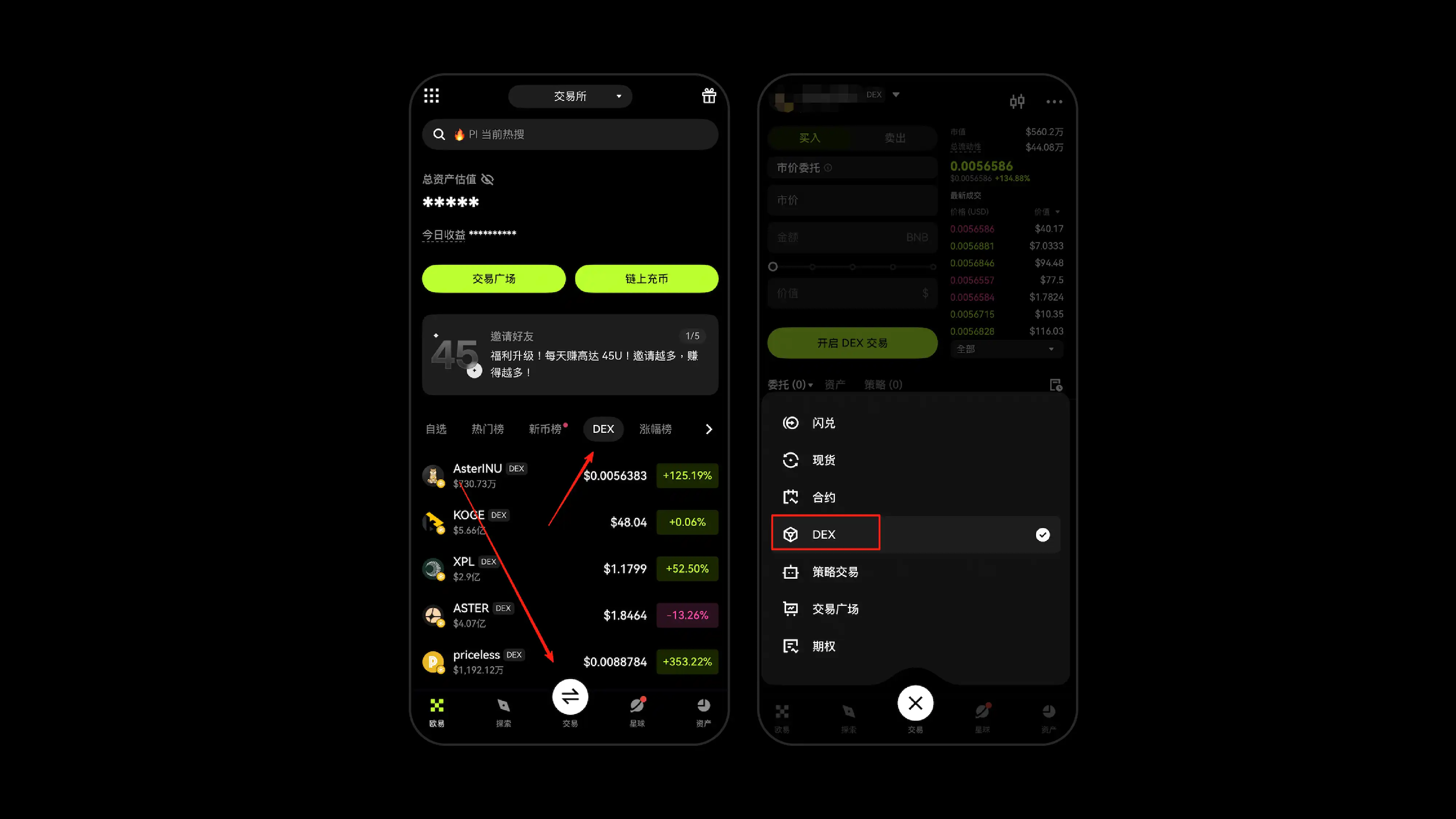
Open the OKX App, click "Trading" at the bottom of the exchange platform's homepage, and you will see the "DEX" option; or enter the DEX trading interface through paths such as the homepage leaderboard, markets, search, etc. Once you find the entrance, you are ready to step into the world of on-chain trading.
Step Two: Create a Self-Custodial Wallet (One-Time Only)
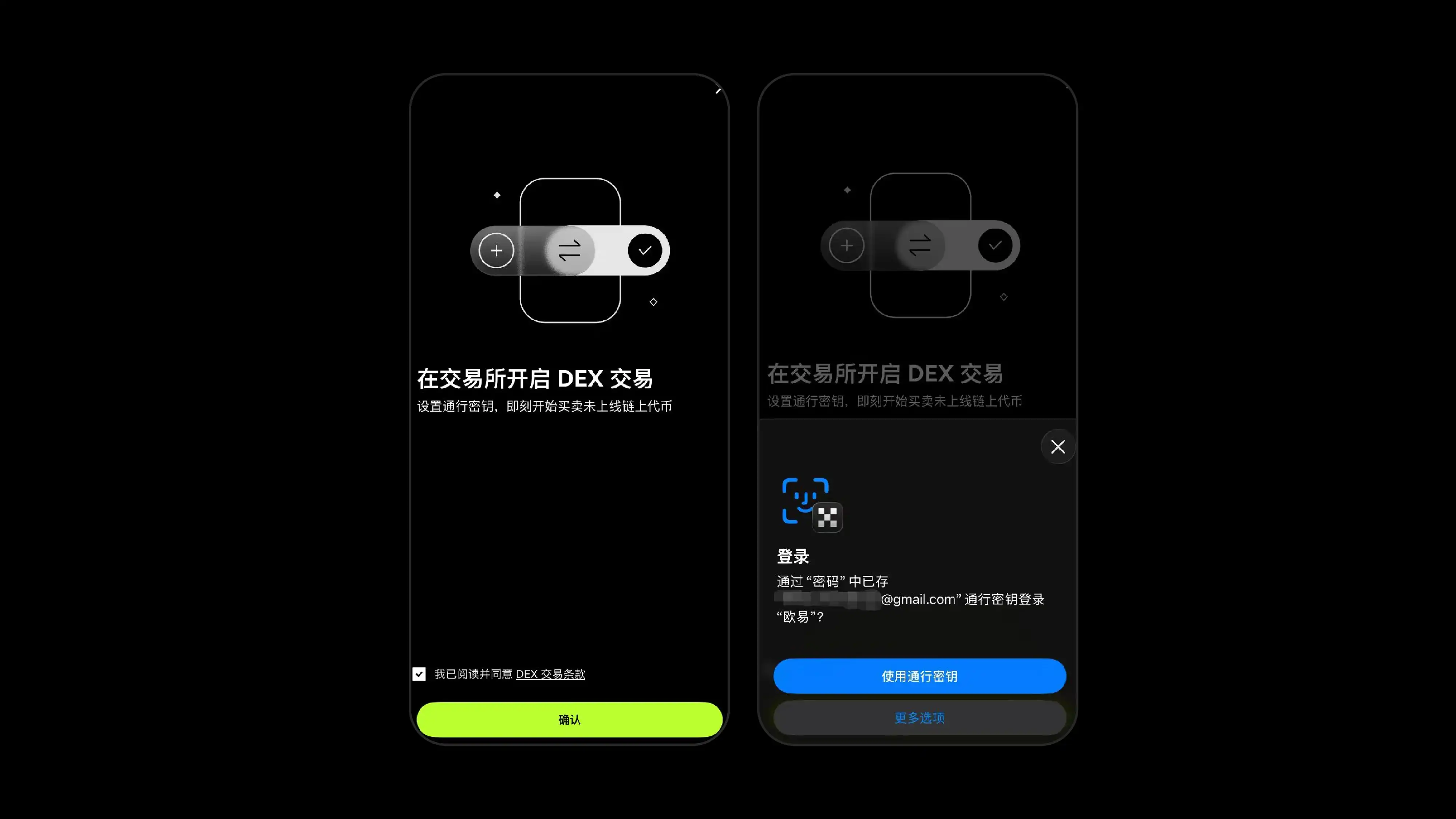
Before the first DEX trade, you need to create a dedicated self-custodial wallet. Each user can only have one DEX wallet. Once created, set a passphrase, and for each subsequent trade, simply scan your face ID to start trading off-chain assets.
Step Three: Perform DEX Trade
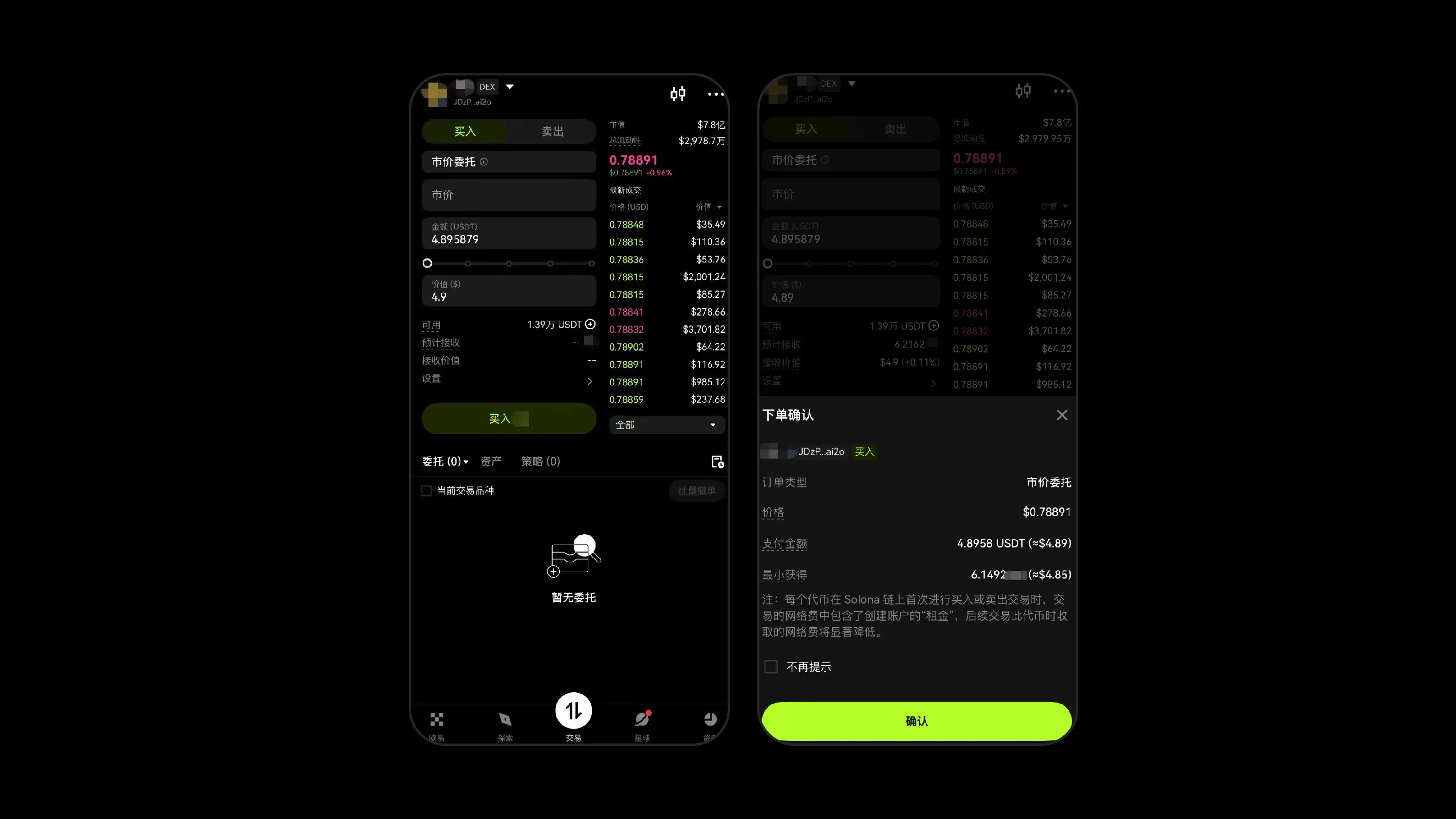
Once the wallet is successfully created, you can start operating in the DEX trading interface. Trades can be made directly using USDT, USDC, or on-chain native tokens from your exchange account. The whole process is similar to buying and selling tokens on a centralized exchange, easy and smooth, while retaining ownership of on-chain assets.
Step Four: Check DEX Assets
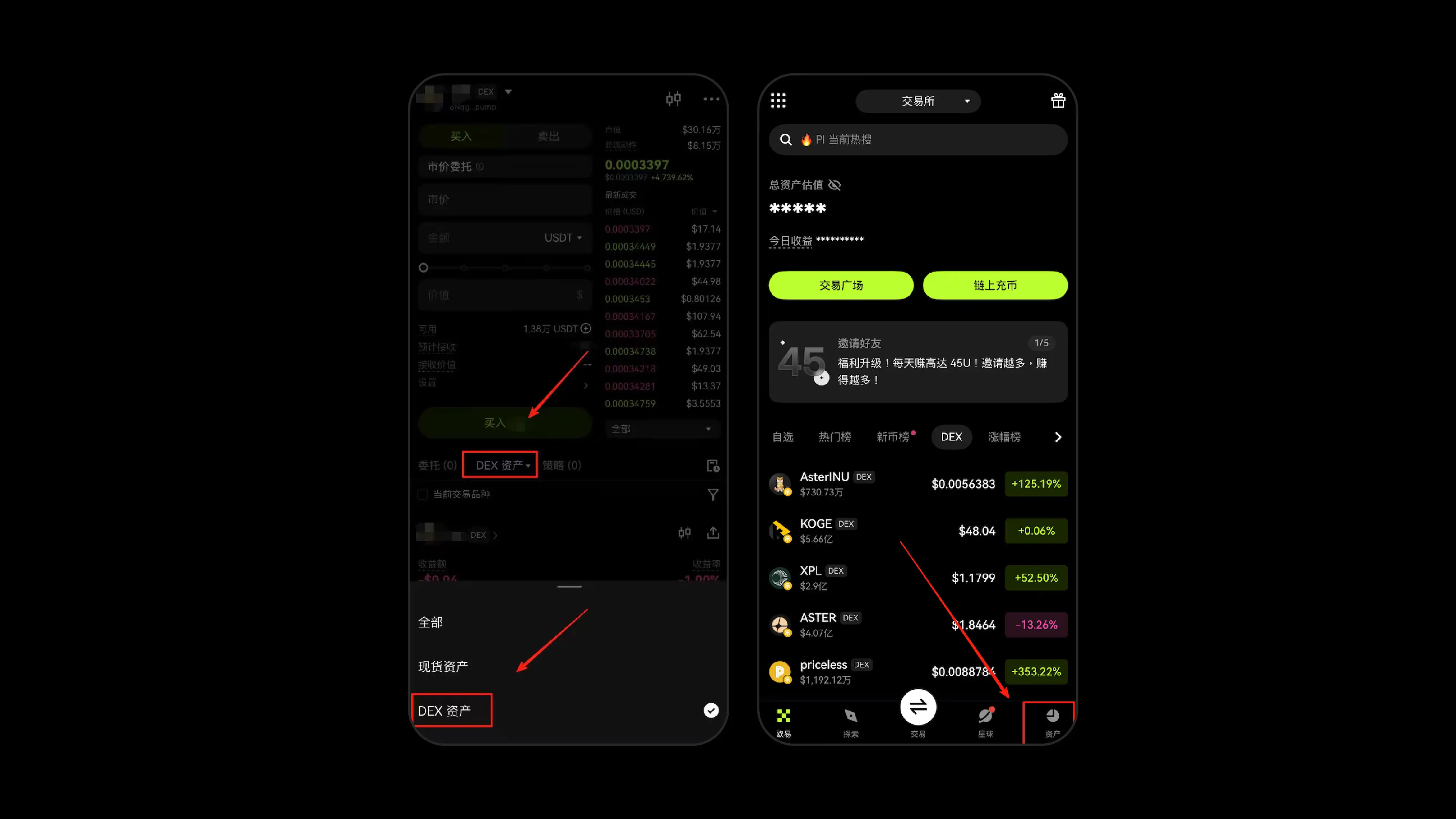
After completing the trade, you can view your DEX token holdings at any time. Simply click on the "Assets" button in the OKX App's bottom right corner, or select "Assets" on the DEX trading page, then go to "DEX Assets" to clearly see all on-chain assets.
Infinite Assets, One-Stop Trading
When an industry has been locked down by bad user experiences and high barriers for too long, a true disruptor is not someone who pumps a meme coin a thousandfold through hype, nor is it someone who traps a few players with so-called crash courses. It's someone who dares to pave a safe, high-speed, and accessible on-chain path for ordinary people in the most cumbersome and heaviest way.
The "Exchange-Embedded DEX" product is such a gamble. It bets on the future of Web3, not on which chain is faster or which hot trend is more popular, but on who can first tear down the wall blocking ordinary users from the on-chain world. It allows you to smoothly purchase on-chain tokens like on a centralized exchange without the need for cross-chain transactions, gas fee calculations, or key management worries, all while retaining full control of your assets.
Truly achieving "Infinite Assets, One-Stop Trading."
For those who have long been blocked from the shores of Web3, they don't need painful education, they don't need to experience the fear of theft or key loss. What they need is an opportunity to participate in the on-chain world safely, smoothly, and decently. When ordinary users can browse, purchase, and explore various on-chain assets like they would on an e-commerce platform, they are no longer just spectators, and the on-chain world truly begins to belong to everyone.
And this "Ferryman" is the one making freedom and security no longer an either/or choice. OKX is proving through concrete actions that a CEX is not just a starting point but can also become a bridge to the decentralized world.
Disclaimer
This article is for reference only. The views expressed in this article are those of the author and do not necessarily represent the views of OKX. This article is not intended to provide (i) investment advice or investment recommendations; (ii) an offer or solicitation to buy, sell, or hold digital assets; or (iii) financial, accounting, legal, or tax advice. We do not guarantee the accuracy, completeness, or usefulness of such information. Holding digital assets (including stablecoins and NFTs) involves high risk and may experience significant volatility. Historical performance is not indicative of future results, and past performance does not guarantee future returns. OKX is not liable for any potential losses. You should carefully consider whether trading or holding digital assets is suitable for you based on your financial circumstances. For your specific situation, please consult your legal/tax/investment professionals. OKX and its affiliates are not associated with the owners or operators of any third parties displayed or aggregated on the OKX platform. OKX is not responsible for any loss, damage, or any other consequences directly or indirectly resulting from your use of the service. In the event of any loss or damage, including but not limited to the loss of user digital assets, it is recommended that users seek solutions directly from third parties. Not all products and services are available in all regions, and in some regions, certain products and services may be restricted or unavailable. You are responsible for understanding and complying with local applicable laws and regulations.
This article is contributed content and does not represent the views of BlockBeats.
You may also like

Japan’s Three Megabanks Plan Joint Stablecoin Issuance in Fiscal 2026
MUFG, SMBC, and Mizuho reportedly plan to jointly issue fiat-pegged stablecoins in fiscal 2026, signaling Japan’s growing push into bank-led digital payment infrastructure.

Humanity Discloses H Token Dual-Chain Attack Details, With Losses on Ethereum and BSC Exceeding $36 Million
Humanity said the H token attack across Ethereum and BSC caused more than $36 million in losses after leaked ProxyAdmin keys enabled malicious contract upgrades and token minting.

White House Discusses CLARITY Act With Law Enforcement Ahead of Senate Vote
The White House discussed the CLARITY Act with law enforcement ahead of a Senate vote, focusing on illicit finance risks and developer protections.

$75 billion in foreign capital has fled, and South Korean retail investors have absorbed it all using leverage

Bitcoin Trading Guide 2026: Strategies for Experienced Traders

What Is XAUT and PAXG? Why Tokenized Gold Is Booming in 2026

Cryptocurrency CEXs are flocking to sell US stocks, and traditional brokerages are facing an "uninvited guest."

Will the SpaceX IPO Hurt Bitcoin? Here's What Traders Are Watching
Foreign selling in the South Korean stock market accelerates, with cumulative net sales reportedly reaching $75 billion this year
On June 9, The Kobeissi Letter, citing Goldman Sachs data, reported that global investors are selling South Korean stocks at an unusually rapid pace. In the latest trading session, foreign investors sold about $801 million worth of Kospi constituent stocks again; total foreign outflows last week reached about $10 billion, and the market has been in net foreign selling on nearly every trading day over the past month. According to the data cited in the report, foreign investors have sold about $75 billion worth of South Korean stocks so far this year. Meanwhile, South Korean retail and institutional investors together recorded roughly $69 billion in net buying over the same period, suggesting that the market’s main buying support has come from domestic capital rather than returning overseas funds. The information currently disclosed still mainly comes from The Kobeissi Letter’s retelling and Goldman Sachs data summaries, while public details on the statistical period and the specific definition of “selling” remain relatively limited.

Fortune Warns of Strategy’s Financing Structure Risks as Bitcoin Premium Narrows
Fortune warned that Strategy’s Bitcoin treasury model faces growing financing risks as MSTR’s net asset premium narrows and preferred stock dividend pressure increases.

Ferrari Challenge Le Mans: Carl Moon to Dominate in WEEX Livery

Sahara AI Responds to SAHARA’s Sharp Drop: No Contract or Product Security Issues Found, Internal Investigation Underway
Sahara AI responded to SAHARA’s 60% price drop, saying no token contract or product security issues have been found and an internal investigation is underway.

WEEX Deposit/Withdrawal Dynamic Island: Your Asset Status, Always in Sight
Scaling Crypto Derivatives: The Digital Asset Infrastructure Behind High-Volume Trading
In the fast-moving digital asset ecosystem, derivatives platforms face an extreme architectural test. High-leverage futures markets demand more than just standard security—they require absolute operational precision, zero-latency matching engines, and ironclad structural scalability, all while navigating intense market volatility.
As global platforms scale to meet these demands, the industry is shifting away from rigid, monolithic setups toward a more agile, "decoupled" infrastructure philosophy.
The Blueprint for High-Volume Copy TradingFor elite global exchanges like WEEX (founded in 2018), this architectural choice becomes critical when scaling high-volume retail features like social copy trading. When thousands of users automatically mirror the real-time strategies of elite traders simultaneously, it triggers sudden, monumental spikes in concurrent transactional volume.
To prevent execution latency or settlement bottlenecks during these peak volatility events, a platform's primary engine must remain entirely dedicated to risk management, copy-trade synchronization, and order matching.
The Architectural Rule: New-generation platforms must separate front-end user execution engines from heavy backend infrastructural overhead to eliminate operational friction.
By separating these layers, platforms can maintain complete sovereignty over their trading environments and user experiences while strategically aligning with institutional-grade infrastructure ecosystems. This strategic framework allows modern exchanges to leverage advanced Digital Asset Custody infrastructure such as Cobo’s behind the scenes, ensuring that backend wallet management scales elastically alongside trading spikes.
Capitalizing on Market Momentum and 400× LeverageIn a derivatives arena where platforms offer up to 400× leverage on perpetual contracts, capital efficiency and market agility are core business metrics. To capture market momentum, an exchange needs the ability to rapidly expand its asset offerings, supporting everything from legacy crypto assets to sudden, trending altcoins across a massive library of trading pairs.
Adopting a flexible, scalable Wallet-as-a-Service (WaaS) solution such as Cobo’s could completely rewrite the development timeline for high-growth exchanges. Instead of spending months of engineering capital building out custom backend wallet architectures for every new blockchain network, platforms can deploy localized infrastructure in days.
This agility allows platforms to instantly scale their listings to over a thousand trading pairs without compromising security or delaying time-to-market. It mirrors the exact operational advantages seen during high-velocity market events, similar to how advanced wallet infrastructure empowers platforms during sudden asset surges; allowing exchanges to pass that speed and liquidity directly to their global user base.
A Mature Foundation for GrowthThe synergy between trusted infrastructure ecosystems and global trading platforms represents the natural evolution of a maturing crypto market. As WEEX continues to scale its global spot and derivatives offerings for over 6 million users, adopting robust backend paradigms proves that platforms no longer have to compromise between cutting-edge trading velocity and uncompromised structural security.

Morning Report | BitMine increased its holdings by 126,971 ETH last week; trader Eugene announced his exit from the crypto market

Wang Chuan: How can one not feel anxious after the neighbor Old Wang made thirty times profit by investing in storage stocks? (Seven) - A quarter-century cycle

Get Paid to Onboard? Try WEEX’s New Homepage with Rewards for Registration, Deposit & Trade
WEEX Custom Layout: Build Your Perfect Trading Workspace in Seconds
Japan’s Three Megabanks Plan Joint Stablecoin Issuance in Fiscal 2026
MUFG, SMBC, and Mizuho reportedly plan to jointly issue fiat-pegged stablecoins in fiscal 2026, signaling Japan’s growing push into bank-led digital payment infrastructure.
Humanity Discloses H Token Dual-Chain Attack Details, With Losses on Ethereum and BSC Exceeding $36 Million
Humanity said the H token attack across Ethereum and BSC caused more than $36 million in losses after leaked ProxyAdmin keys enabled malicious contract upgrades and token minting.
White House Discusses CLARITY Act With Law Enforcement Ahead of Senate Vote
The White House discussed the CLARITY Act with law enforcement ahead of a Senate vote, focusing on illicit finance risks and developer protections.
$75 billion in foreign capital has fled, and South Korean retail investors have absorbed it all using leverage
Bitcoin Trading Guide 2026: Strategies for Experienced Traders
What Is XAUT and PAXG? Why Tokenized Gold Is Booming in 2026


