
Rhythm X Zhihu Event Process Revealed, Featuring Skills Demo, Keynote Speech, and Roundtable to Deep Dive into Agent and On-Chain Finance

 Prefer us on Google

EvoMap's mention of Hermes's plagiarism is something that many of you must be somewhat familiar with.
Just as Claude mentioned OpenClaw's plagiarism, similar incidents are bound to increase.
Because fundamentally, it's a turf war: users choosing which Agent to perform similar tasks, or where the originality boundary of a core competence within an Agent lies. This argument signifies one thing—the competition between Agents has become so intense that it can make founders lose their cool. The choice is in the user's hands.
And this will also soon be an issue that each of us will have to face. With an increasing number of Agents capable of doing many things, what should we do? This is precisely the issue we will discuss at our event.
April 21, Hong Kong. Rhythm BlockBeats and Zhihu will host the theme event "Decoding Web 4.0: When AI Agents Take Over On-Chain Permissions." The guests have been announced and can be seen in "Rhythm X Zhihu Event Guest Announcement, covering AI Agent's new financial model from academic, institutional, and personal perspectives."
What we want to discuss are specific issues that have actually occurred: How to choose Skills, how to build a trust layer, and how far we are from a completely new financial paradigm. Below are the contents you will hear and see at the event.
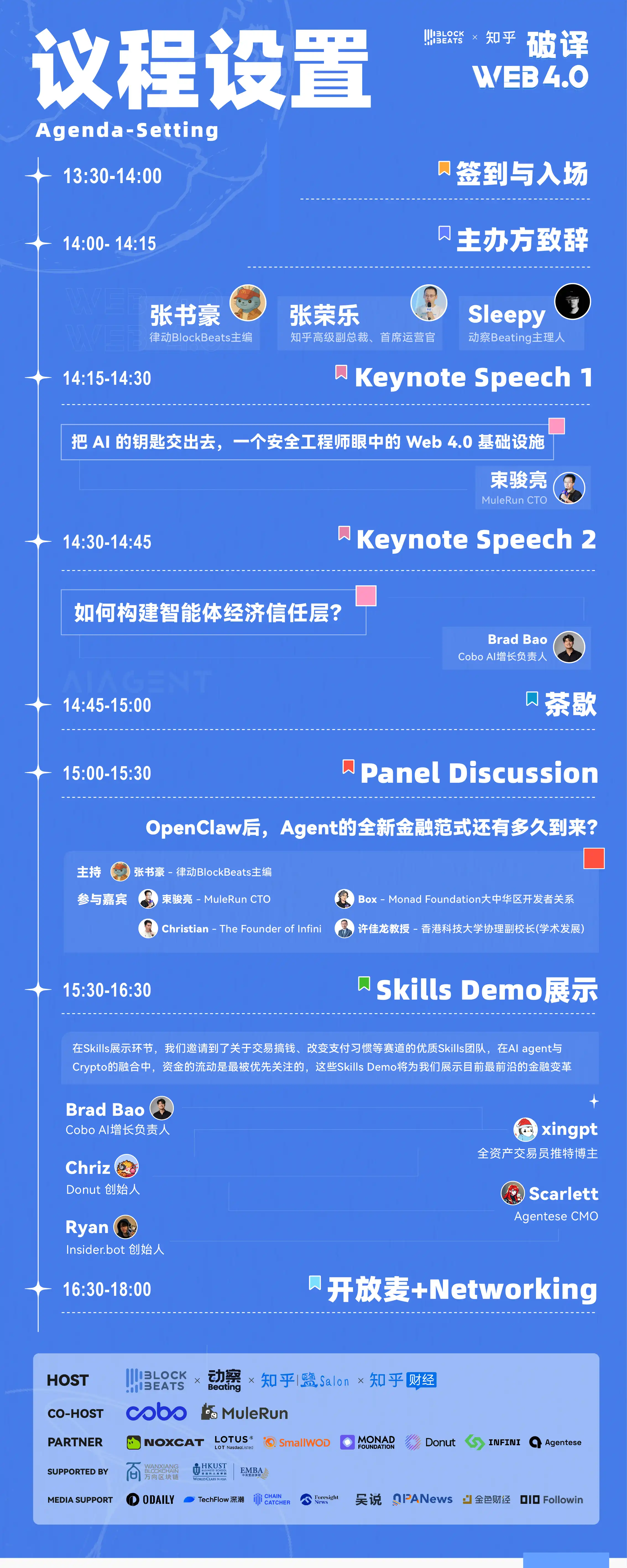
Two Keynote Speeches
Keynote: "Handing Over the Keys of AI, Web 4.0 Infrastructure through the Eyes of a Security Engineer"
Speaker: MuleRun CTO (MuleRun) Junliang Shu
In the 90s, the Bloomberg Terminal allowed analysts to dominate retail investors, and today, Agents are replaying this scenario. However, when AI starts touching your money, security becomes a matter of life and death. Listen to a security engineer discuss how to give capabilities to the Agent while retaining control for oneself.
Keynote: "Building the Trust Layer of the Intelligent Economy"
Speaker: Cobo AI Head of Growth, Brad Bao
AI is evolving from "answering questions" to "acting on our behalf." When software begins to call funds, execute transactions, and manage assets, trust is no longer an add-on but the infrastructure itself. How can we empower the Agent with enough autonomy while ensuring that humans have enough certainty to trust it? We are exploring the answers.
Roundtable Discussion
Theme: "After OpenClaw, How Far Away is the New Financial Paradigm for Agents?"
Participants include MuleRun CTO Junliang Shu, Associate Vice President of The Hong Kong University of Science and Technology Professor Jialong Xu, Infini Founder Christian, and Box from the Monad Foundation Greater China Developer Relations.
During this roundtable, you will hear about the guests' daily use of their own agents and skills, the impact of agents on the financial landscape, and the potential synergies between stablecoins and agents following the launch of the Hong Kong stablecoin.
Skill Demo, Showcasing Real-time Skills
Capital flow is the first dimension in which AI Agents and Crypto integration are being tested. We have invited several teams working on concrete initiatives in this dimension:
Brad Bao (Cobo) will start from an x402 payment to demonstrate how two AI agents take their own Hello World step. However, the true operation of the agents' economy relies not only on the occurrence of payment but also on the layer of trust behind each transaction.
xingpt is working on a global macro and commodity trading monitoring skill, exploring the difference between machine-readable signal density and human-readable financial news.
Donut Founder Chriz presents D0, an active trading agent that monitors the market 24/7 and continuously recommends trading opportunities—it doesn't wait for you to ask, it proactively reaches out to you.
Agentese CMO Scarlett takes a different approach: instead of creating a general agent, she focuses on a vertical AI Employee, narrowing the boundary of capabilities and increasing execution accuracy.
Insider.bot Founder Ryan's skill serves market prediction, emphasizing speed, flexibility, and accuracy—three words that hold different meanings in the prediction market, which will be demonstrated during the live demo.
We believe that the insights shared by these guests on the new financial model brought by AI Agents will provide everyone with a different perspective. The event hosted by Rhythm X Zhihu on April 21 in Hong Kong is still open for registration. To register, please click: https://luma.com/r3h4eqkv
-- Price
This content is provided for general informational purposes only and doesn't constitute financial, investment, legal, or tax advice. Any events, rewards, online promotions, or related information mentioned herein should not be considered a recommendation, solicitation, or invitation to purchase, sell, trade, or otherwise deal in any crypto assets. Crypto assets are highly volatile and may result in loss. The availability of WEEX services, products, and related events may vary by region. You are responsible for ensuring that your participation is in accordance with applicable local laws and regulations.
You may also like

Stablecoin issuer JPYC is about to complete its Series B financing, with participation from Life Design Fund and others, raising a total of approximately 5 billion yen

Ningde Times is planning to participate in DeepSeek's financing

AIDC, computing power leasing, and cloud: The "three-part thesis" of AI transformation in cryptocurrency mining farms

Tom Lee: Ethereum will be ensured to become the settlement layer for the future of finance and AI, continuing to be optimistic about ETH

Paradigm announced the open-source self-developed AI Agent Centaur, claiming it has completely transformed the workflow of the fund
MY Group strategic investment in AI derivatives infrastructure ClawMax 3 million USD

Viewpoint: Web3 does not need a savior, and Ethereum should maintain a high degree of neutrality
Insiders: DeepSeek is forming a Harness team to compete with Claude Code
SpaceX officially submitted its prospectus, unveiling the largest IPO in history

Cryptocurrency custody company Copper is seeking to sell the company at an estimated valuation of around $500 million
SpaceX is in discussions with other companies about computing power services similar to Anthropic
Sentient launches the latest season of the Hackathon Challenge 0, offering over $6,000 and points as rewards
NVIDIA CEO: Vera CPU opens up a new $200 billion market for NVIDIA

Helio Protocol's XAUT ecosystem has reached a strategic cooperation with Dephy and APRO

Manus plans to raise $1 billion for a buyback and seeks to be listed in Hong Kong

Bitget partners with UNICEF to launch the second year of cooperation, adding AI courses

Eightco Holdings (NASDAQ: ORBS) Reveals $336M in Digital Assets and Equity Investments
Key Takeaways: Eightco’s treasury includes $90M in OpenAI, $25M in Beast Industries, 11,068 ETH, and $283 million WLD…

Ripple Sets 2028 Deadline for Quantum-Ready XRPL
Key Takeaways: Ripple commits to a 2028 deadline for XRPL’s quantum-readiness, focusing on quantum-resistant cryptographic systems. Google’s research…
Mozilla Employs Anthropic AI to Detect 271 Firefox Vulnerabilities
Key Takeaways: Mozilla’s internal test with Anthropic’s Claude Mythos AI found 271 vulnerabilities in Firefox, all patched this…

US Law Firm Issues Apology Over AI-Caused Legal Filing Errors
Key Takeaways: Sullivan & Cromwell admitted to submitting a court filing with around 40 incorrect citations caused by…

Uzbekistan Launches State-Endorsed Crypto Mining Zone with Tax Perks
Key Takeaways: Uzbekistan has initiated a regulated crypto mining zone in Karakalpakstan, effective April 20. Companies gain tax…
Summary of SpaceX IPO Prospectus Full Text

AI patent platform Stilta completes $10.5 million seed round financing, led by a16z

GitHub updates security incident investigation: An employee's device was compromised, involving a contaminated VS Code extension

The hacker group TeamPCP claims to have obtained the source code of about 4,000 private repositories from GitHub and is selling them

Ju.com Foundation strategically invests $10 million in SuiXi, leading the "AI + Blockchain" e-commerce sector
The manufacturing startup SendCutSend has completed a $110 million financing round, led by Paradigm and others

Real Vision founder: AI and cryptocurrency are reshaping the global economy at an exponential rate, and the cryptocurrency market size could reach 100 trillion dollars
Gate founder and CEO Dr. Han: Clarification of regulations and integration with TradFi become key trends

Fintech company Mercury completes $200 million financing, led by TCV
Stablecoin issuer JPYC is about to complete its Series B financing, with participation from Life Design Fund and others, raising a total of approximately 5 billion yen
Ningde Times is planning to participate in DeepSeek's financing
AIDC, computing power leasing, and cloud: The "three-part thesis" of AI transformation in cryptocurrency mining farms
Tom Lee: Ethereum will be ensured to become the settlement layer for the future of finance and AI, continuing to be optimistic about ETH
Paradigm announced the open-source self-developed AI Agent Centaur, claiming it has completely transformed the workflow of the fund
MY Group strategic investment in AI derivatives infrastructure ClawMax 3 million USD
Contents
Latest articles




Latest coin listings on WEEX


