
RWA, TVL Hit All-Time Highs: A Huge Opportunity for the Next Decade of Traditional Finance?


Original Article Title: RWA TVL Hit a New ATH—Don't Get Left Behind
Original Article Author: Moomsxxx
Original Article Translation: Plain Talk on Blockchain
The RWA sector is growing at an astounding pace. Just a few days ago, the total value of RWA hit a new all-time high, and today it has once again surpassed this new record.
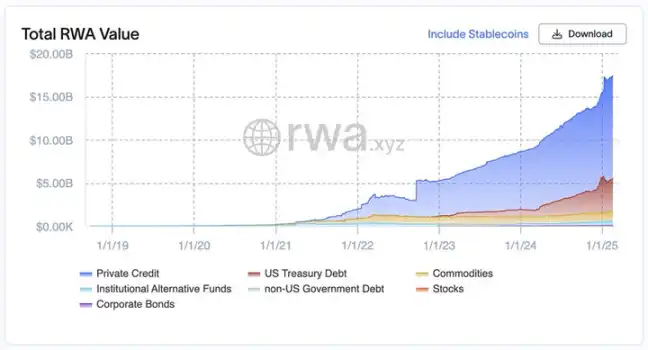
1. RWA TVL
Despite many ongoing operational frictions related to privacy solutions, digital identity solutions, interoperability, and being a bottleneck for faster adoption, the on-chain funds raised of 20-30 billion USD and around 200 billion USD in stablecoins demonstrate the increasing interest and adoption in this area of the Web3 industry.
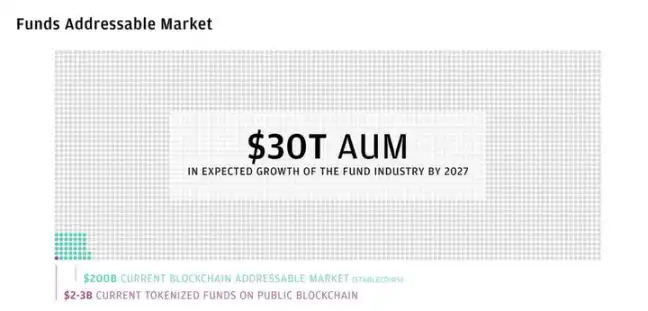
The current tokenized funds represent only a small portion of the expected growth in the fund industry in the coming years.
Likewise, the growth in private credit also reflects market participants' growing interest in opportunities beyond Bitcoin, DeFi native yields, alternative coins, and meme coins.
According to @Preqin, the global private credit market's investment size is close to $17 trillion, while according to @RWA_xyz, the size of tokenized private credit is only about $11.9 billion.
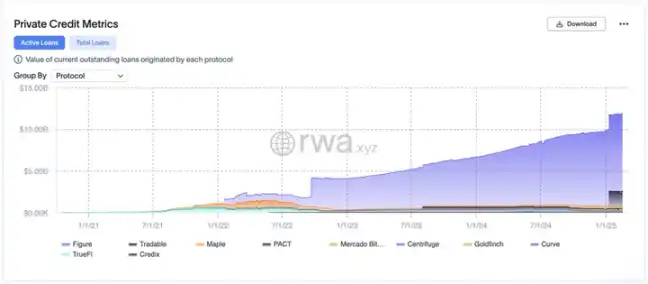
Active Loan Value - Private Credit Market (Source: RWA.xyz)
A deeper analysis of this area, I believe it is necessary to mention that since the market crash of 2022, the reliability of these loans has undergone a significant change, with teams of different platforms becoming more cautious and investing more resources to ensure higher credit quality issuance.
From July 2021 to the end of 2022, borrowing was mainly dominated by crypto trading and market-making companies. Therefore, the borrowing sector in this area collapsed in the 2022 bear market.
Subsequently, the growth mainly came from funds pool of various RWA transactions, such as consumer asset-backed securities (such as auto loans, credit card debt, student loans, small business loans, etc.), real estate bridge loans, trade finance, and other less volatile asset classes.
The proof of this point is resilient protocols like @maplefinance, as demonstrated in the liquidation event on February 3, 2025—a historic event in crypto. For more details, please see the following link: https://x.com/maplefinance/status/1886332880411832514 Additionally, over the past three years, the industry has matured significantly, with continuous emergence of technical solutions aimed at addressing regulatory and privacy obligations, further enhancing this critical area.
2. Opportunity Scale
According to @BCG data, tokenizing all global mutual funds could unlock an additional $100 billion in annual returns for investors. At the same time, "sophisticated investors" (sorry, not referring to you) could earn $400 billion by "capturing intraday value changes" (basically, day trading). Based on the historical adoption pattern of ETFs, it is reasonable to estimate that tokenized funds will represent 1% of global mutual fund and ETF assets under management in the next seven years.
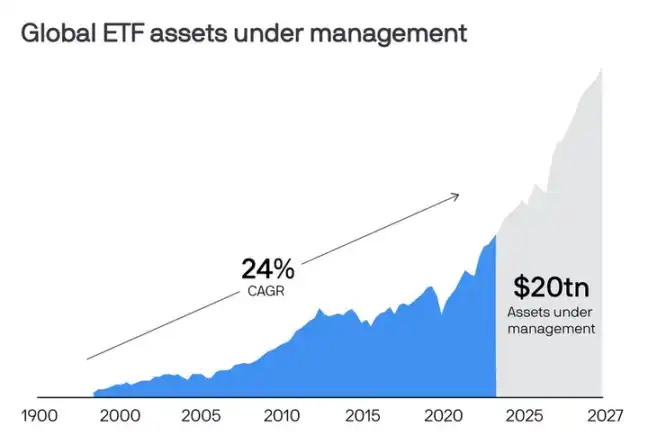
Global ETF Assets Under Management (Source - J.P. Morgan Asset Management)
This implies that by 2030, tokenized assets will exceed $600 billion.
Furthermore, if regulators allow existing mutual funds and ETFs to convert into tokenized funds (which is simpler than launching a new tokenized fund), we might see trillions of dollars in asset under management.
Given the similar growth expectations prior to the introduction of BTC ETFs, I believe we cannot dismiss the possibility that these figures may be overly conservative, and the actual growth might be astonishingly high.
However, even based on these expectations, we are still talking about at least a 200x growth.
Let me say that again, at least a 200x growth from now.
Are you still sitting there lamenting over not making money temporarily?
Give me that yield, please!
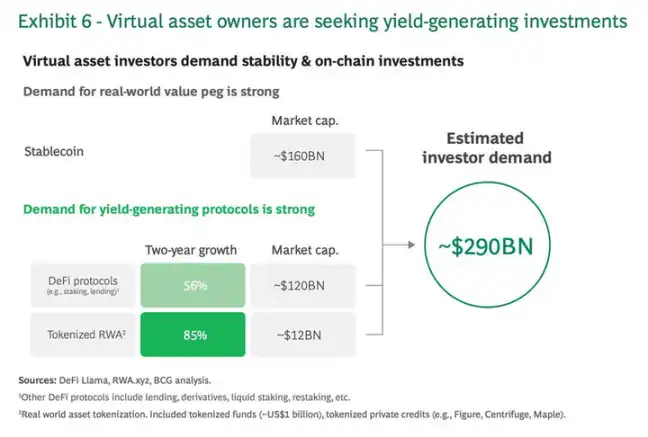
According to this @BCG study, our industry's investment demand for tokenized funds is approximately $290 billion. This figure includes stablecoin holders, tokenized RWAs, and DeFi protocol demand.
I believe this number may be high because it takes into account the growth of the DeFi protocol market cap, and this growth comes from a user base with a higher risk appetite, whose investment preferences may differ from those willing to invest in tokenized assets.
A more reasonable approach would be to consider the growth of DeFi Total Value Locked (TVL) over the past two years; nonetheless, it would still be a significant number: $580.6 billion (Source - @DefiLlama).
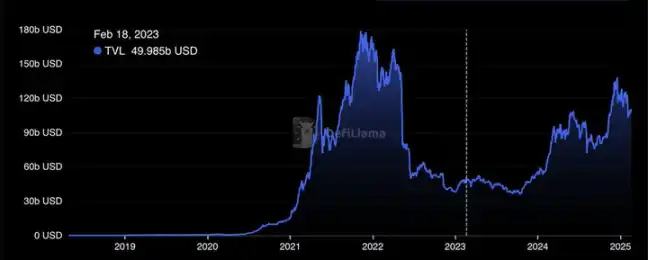
DeFi Total Value Locked (TVL)
Nevertheless, the value propositions of tokenized funds and RWAs are undeniable. They provide a channel to access real-world investment opportunities, allowing investors to better diversify their portfolios amidst market dynamics.
Imagine if, in the past few months, through @Rabby_io, you could have converted your on-chain tokens into stocks, commodities, and real estate without needing to cash out—wouldn't that be convenient?
But why must all this happen? What are the benefits for traditional finance? Lately, on Crypto Twitter (CT), I haven't seen much discussion on this topic, especially amidst the memecoin craze and controversy. We always talk about how Traditional Finance (TradFi) is stepping into the Web3 industry and adopting the technology we are building. But why are they doing this? While I plan to write an article specifically addressing this topic, below are some key points explaining why traditional finance needs and must embrace the crypto rails:
Instant settlement as shown in the following figure could potentially add around $500 billion annually to investors' portfolios. Lowering commissions saves another $330 billion, which will ultimately flow into investors' portfolios. Composability tokenized funds will be easier to lend out. Accessible trading tokenization will make it easier for investors to trade assets.
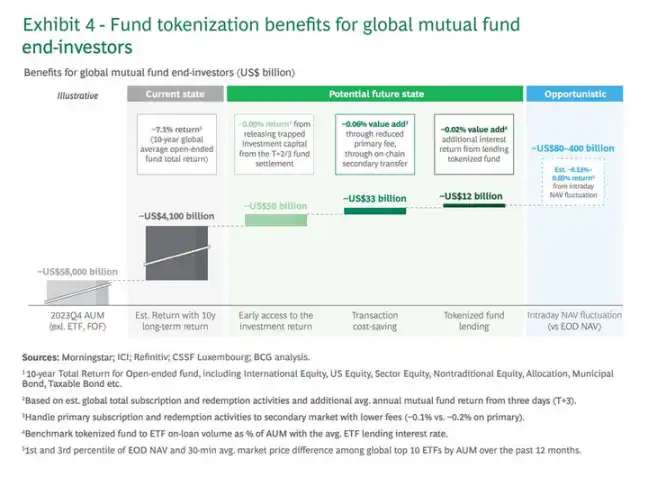
How Tokenization Enhances Returns (Source: Boston Consulting Group)
3. Sentiment Comes Second, Momentum Comes First
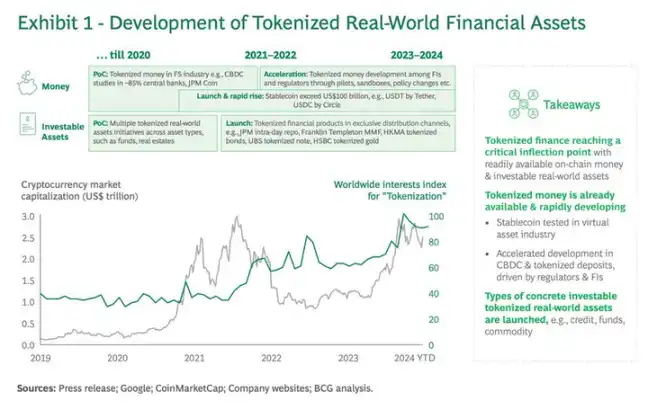
Traditional finance bids farewell, while Crypto Twitter (CT) gets rug pulled.
The chart above shows that regardless of the market conditions, especially Crypto Twitter (CT) sentiment (
You may also like

OKX Star analyzes Binance's competitive advantages: when regulation levels the playing field, competition has just begun

Full version of the debut Q&A! Federal Reserve Chairman Waller: Sticking to the 2% inflation target, establishing five special working groups, individual did not submit the dot plot

From Disruptor to Shadow Market: The Crypto Market is Becoming a Colony of Traditional Finance

Dalio's important long article: How to position in the current market environment?

DeepSeek Financing Story

Morning Report | Illinois signs the strictest digital asset tax law in the U.S.; RWA tokenization market size surpasses $43 billion, institutions accelerate the migration of on-chain assets
Morning Report | DeepSeek completes over $7 billion in financing, with a valuation exceeding $50 billion; Musk's personal wealth has surpassed the total market value of Bitcoin

Cursor, why did you get on Musk's spaceship?
In the name of charity, for the benefit of the family: How the Trump family turned charity into profit?

Will Gold Break $4,500 After Tonight's Fed Decision? What XAUT and PAXG Traders Need to Know
SharpLink CEO: How to understand that Ethereum developers have just surpassed 1 million?

Morning Report | MiCA grace period expires on July 1; Kalshi's trading volume in the first week of the World Cup breaks $5.1 billion, setting a record

The foundation of SpaceX's trillion-dollar valuation: Who is dividing Musk's annual capital expenditure of tens of billions?
How to exit after asset tokenization?
The stablecoin positioning battle escalates: When compliance is just a ticket to entry, will USD1 become the biggest winner?

A16Z: The sun bears witness, SpaceX is worth 7.5 trillion

Mergers and acquisitions in the cryptocurrency market are exceptionally active

Concerns Behind the Binance Customer Service Controversy
OKX Star analyzes Binance's competitive advantages: when regulation levels the playing field, competition has just begun
Full version of the debut Q&A! Federal Reserve Chairman Waller: Sticking to the 2% inflation target, establishing five special working groups, individual did not submit the dot plot
From Disruptor to Shadow Market: The Crypto Market is Becoming a Colony of Traditional Finance
Dalio's important long article: How to position in the current market environment?
DeepSeek Financing Story
Morning Report | Illinois signs the strictest digital asset tax law in the U.S.; RWA tokenization market size surpasses $43 billion, institutions accelerate the migration of on-chain assets


