
South Korean Retail Investors: 14 Million-strong "Ant Army" Diving into Cryptocurrency with Leverage


Original Title: Wipeouts Threaten Korea Retail Army Chasing Riskiest Investments
Original Authors: Sangmi Cha, Haram Lim, Bloomberg
Original Translator: Luffy, Foresight News
At a textile company in Seoul, Tony Kim, a manager, goes all-in on a stock whenever he sees potential.
34-year-old Tony Kim has never held two stocks simultaneously in his 140 million KRW (approximately 98,500 USD) investment portfolio. The father of two says, "Koreans, including me, are obsessed with that dopamine rush feeling as if it's engraved in our genes."

Tony Kim
For many retail investors, this trading strategy may seem reckless or unusually resilient to pressure. But among around 14 million retail investors in Korea known as the "ant army," this is just a glimpse of their extreme eagerness for returns and continuously increasing risk appetite.
This eagerness has driven funds to pour into investment accounts at a near-record pace. Over the past five years, Korean retail investors have leveraged up, leading to a doubling of margin loan balances. They have heavily entered high speculative leveraged and inverse exchange-traded funds (ETFs), accounting for 40% of the total assets of some leveraged ETFs registered in the US. At the same time, trading volumes of high-risk cryptocurrencies have surged to historic levels.
These retail investors' frenzied trading has not only reshaped the market but also made them a significant political force. Their power and anxiety have been so intense that they have even forced the South Korean government to make policy reversals for the first time.
Currently, as the global market soars to historic highs due to the artificial intelligence infrastructure boom, highly leveraged Korean retail investors are in an extremely vulnerable position. Once market sentiment shifts suddenly, speculative positions could collapse instantly, and losses could be further amplified.
Such a reversal occurred just over a week ago. The escalation of the US-China trade dispute triggered a cryptocurrency crash, causing numerous altcoins to instantly go to zero. Korean retail investors are renowned for gambling on small-cap tokens. The prices of these tokens are highly volatile, with altcoins accounting for over 80% of the total trading volume on Korean cryptocurrency exchanges, while Bitcoin and Ethereum usually comprise over 50% of the global platform's trading volume, forming a stark contrast.
For many South Korean retail investors, all high-risk operations are aimed at one goal: accumulating enough wealth in the fiercely competitive market to buy their own home. South Koreans use the term "borrowed soul" to describe this struggle, a phrase that accurately reflects the emotion and economic pressure behind the dream of homeownership.
The recent policies of the South Korean government have further intensified retail investors' risky behavior. Measures such as the mortgage loan limit implemented by the new President Lee Jae-myung and the rise in rent caused by the lease market reform have made buying a home even more out of reach. Last week, the government introduced multiple measures to cool down the overheated real estate market, including tightening loan limits in the greater Seoul area and reducing the loan-to-value ratio of mortgaged properties.
"Our parents' generation accumulated wealth through the Han River miracle real estate boom, but our generation is not as lucky," said 36-year-old Kim Su-jin. She used to be a business consultant and started investing in cryptocurrencies with all her severance pay after resigning. "In my circle, about 30 people have already 'graduated'—meaning they have earned enough money and exited high-risk investments," she said. "I also hope to 'graduate' one day."

The Han River in Seoul
Buyer Beware
The momentum of South Korean retail investors chasing gains is evident in various markets. Since Donald Trump won the U.S. presidential election last year and began his second term, the trading volume of domestic cryptocurrency exchanges in South Korea has skyrocketed, at one point reaching 80% of the trading volume of the Korean benchmark stock index Kospi; stablecoins pegged to fiat currencies have also attracted a large amount of retail funds.
Investors have also been pouring into leveraged and inverse ETFs, products that amplify returns (and losses) by 2 to 3 times through derivatives. Due to strict regulations in South Korea, such as simulated trading drills and high margin requirements for these products, retail investors have turned to overseas markets and have now become significant participants in the global leveraged ETF market.
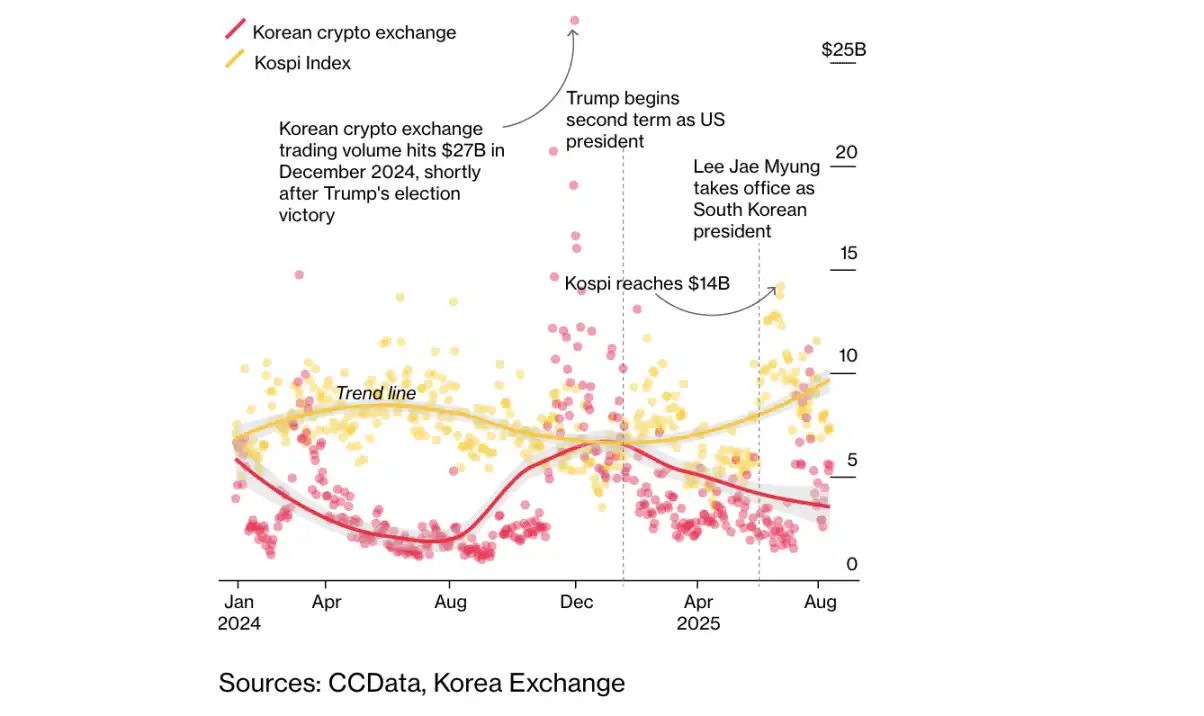
Comparison of South Korean cryptocurrency exchange trading volume and Kospi index trading volume
The high-risk behavior of South Korean retail investors not only puts household savings at risk but also puts pressure on the financial system, threatening overall economic stability. As investors flock to high-yield, high-risk assets, traditional financial instruments have gradually fallen out of favor, and banks' channels for funding have been squeezed. In the six weeks after July this year, major banks in South Korea lost nearly 40 trillion Korean won (approximately $281 billion) in deposits.
“In Korea, investment is often seen as gambling rather than long-term planning - almost as brutal as 'Squid Game',” said Choi Jae-won, an economics professor at Seoul National University. “Once the bubble bursts, individuals face a wealth backlash, leading to a worsening situation: personal loans crisis, decreased spending power, ultimately affecting the entire national economy.”
Regulatory agencies are also deeply concerned. “We worry that if the market collapses, it will have an impact on retail investors' assets and the overall economy,” said Lee Yoon-soo, a permanent commissioner at the Korea Securities and Futures Commission.
Psychiatrists point out that high-risk investments are increasingly taking a toll on individuals' mental health. “Without inherited wealth, an apartment in Gangnam (Seoul's affluent area) is a daydream,” said Park Jong-sik. Having lost around $250,000 due to investments, he now runs a clinic specializing in treating investment addiction patients. “In this anxiety-ridden society, even knowing the risks, people are still drawn to high-risk investments. It’s as if the whole system is pushing them forward, leading them into an anxiety-driven investment addiction cycle.”

Park Jong-sik
“Zeroed Overnight”
For some, the scars of an investment collapse are hard to heal. 35-year-old Han Jung-hoon went through the euphoria of “a 30-fold increase in the cryptocurrency wallet balance to 660 million Korean won,” but the Luna collapse in 2022 turned it all into nothing.
TerraUSD was a stablecoin project launched by South Korean Do Kwon, which ended in failure. In August of this year, Do Kwon pleaded guilty to fraud, and the project’s collapse wiped out about $40 billion in market value in just a few days.
“My 660 million won profit disappeared overnight, and in the end, I only got back less than 6 million won,” Han Jung-hoon said.
This collapse completely changed his life. Although he has not completely given up on cryptocurrency, he has moved away from high-risk investments, focusing on meditation, and even started a YouTube channel sharing his favorite breathing techniques. Today, he lives on the remote Jeju Island and occasionally goes on meditation trips to Bali.

Han Jung-hoon
Nevertheless, social media platforms like YouTube are still filled with bold investment success stories. Couples putting all their savings into Bitcoin, 27-year-old college students earning tens of thousands of dollars a month through high-frequency trading... These stories are exactly what attract investors like Tony Kim.
Tony Kim is currently fully invested in stocks of companies such as NVIDIA and Tesla. "I have made money through leverage, and that easy profit feeling got me hooked," he recalls. He remembers when he "made $13,000 overnight from $900," but lost all his gains in just three days. "You keep chasing that sensation of getting rich quick."
You may also like

Morning Report | BitMine increased its holdings by 126,971 ETH last week; trader Eugene announced his exit from the crypto market

Wang Chuan: How can one not feel anxious after the neighbor Old Wang made thirty times profit by investing in storage stocks? (Seven) - A quarter-century cycle

Cryptocurrency CEXs are flocking to sell US stocks, and traditional brokerages are facing an "uninvited guest."

$75 billion in foreign capital has fled, and South Korean retail investors have absorbed it all using leverage

Japan’s Three Megabanks Plan Joint Stablecoin Issuance in Fiscal 2026
MUFG, SMBC, and Mizuho reportedly plan to jointly issue fiat-pegged stablecoins in fiscal 2026, signaling Japan’s growing push into bank-led digital payment infrastructure.

Humanity Discloses H Token Dual-Chain Attack Details, With Losses on Ethereum and BSC Exceeding $36 Million
Humanity said the H token attack across Ethereum and BSC caused more than $36 million in losses after leaked ProxyAdmin keys enabled malicious contract upgrades and token minting.
White House Discusses CLARITY Act With Law Enforcement Ahead of Senate Vote
The White House discussed the CLARITY Act with law enforcement ahead of a Senate vote, focusing on illicit finance risks and developer protections.

Bitcoin Trading Guide 2026: Strategies for Experienced Traders

What Is XAUT and PAXG? Why Tokenized Gold Is Booming in 2026

Will the SpaceX IPO Hurt Bitcoin? Here's What Traders Are Watching

Foreign selling in the South Korean stock market accelerates, with cumulative net sales reportedly reaching $75 billion this year
On June 9, The Kobeissi Letter, citing Goldman Sachs data, reported that global investors are selling South Korean stocks at an unusually rapid pace. In the latest trading session, foreign investors sold about $801 million worth of Kospi constituent stocks again; total foreign outflows last week reached about $10 billion, and the market has been in net foreign selling on nearly every trading day over the past month. According to the data cited in the report, foreign investors have sold about $75 billion worth of South Korean stocks so far this year. Meanwhile, South Korean retail and institutional investors together recorded roughly $69 billion in net buying over the same period, suggesting that the market’s main buying support has come from domestic capital rather than returning overseas funds. The information currently disclosed still mainly comes from The Kobeissi Letter’s retelling and Goldman Sachs data summaries, while public details on the statistical period and the specific definition of “selling” remain relatively limited.

Fortune Warns of Strategy’s Financing Structure Risks as Bitcoin Premium Narrows
Fortune warned that Strategy’s Bitcoin treasury model faces growing financing risks as MSTR’s net asset premium narrows and preferred stock dividend pressure increases.

Ferrari Challenge Le Mans: Carl Moon to Dominate in WEEX Livery

Sahara AI Responds to SAHARA’s Sharp Drop: No Contract or Product Security Issues Found, Internal Investigation Underway
Sahara AI responded to SAHARA’s 60% price drop, saying no token contract or product security issues have been found and an internal investigation is underway.

WEEX Deposit/Withdrawal Dynamic Island: Your Asset Status, Always in Sight
Scaling Crypto Derivatives: The Digital Asset Infrastructure Behind High-Volume Trading
In the fast-moving digital asset ecosystem, derivatives platforms face an extreme architectural test. High-leverage futures markets demand more than just standard security—they require absolute operational precision, zero-latency matching engines, and ironclad structural scalability, all while navigating intense market volatility.
As global platforms scale to meet these demands, the industry is shifting away from rigid, monolithic setups toward a more agile, "decoupled" infrastructure philosophy.
The Blueprint for High-Volume Copy TradingFor elite global exchanges like WEEX (founded in 2018), this architectural choice becomes critical when scaling high-volume retail features like social copy trading. When thousands of users automatically mirror the real-time strategies of elite traders simultaneously, it triggers sudden, monumental spikes in concurrent transactional volume.
To prevent execution latency or settlement bottlenecks during these peak volatility events, a platform's primary engine must remain entirely dedicated to risk management, copy-trade synchronization, and order matching.
The Architectural Rule: New-generation platforms must separate front-end user execution engines from heavy backend infrastructural overhead to eliminate operational friction.
By separating these layers, platforms can maintain complete sovereignty over their trading environments and user experiences while strategically aligning with institutional-grade infrastructure ecosystems. This strategic framework allows modern exchanges to leverage advanced Digital Asset Custody infrastructure such as Cobo’s behind the scenes, ensuring that backend wallet management scales elastically alongside trading spikes.
Capitalizing on Market Momentum and 400× LeverageIn a derivatives arena where platforms offer up to 400× leverage on perpetual contracts, capital efficiency and market agility are core business metrics. To capture market momentum, an exchange needs the ability to rapidly expand its asset offerings, supporting everything from legacy crypto assets to sudden, trending altcoins across a massive library of trading pairs.
Adopting a flexible, scalable Wallet-as-a-Service (WaaS) solution such as Cobo’s could completely rewrite the development timeline for high-growth exchanges. Instead of spending months of engineering capital building out custom backend wallet architectures for every new blockchain network, platforms can deploy localized infrastructure in days.
This agility allows platforms to instantly scale their listings to over a thousand trading pairs without compromising security or delaying time-to-market. It mirrors the exact operational advantages seen during high-velocity market events, similar to how advanced wallet infrastructure empowers platforms during sudden asset surges; allowing exchanges to pass that speed and liquidity directly to their global user base.
A Mature Foundation for GrowthThe synergy between trusted infrastructure ecosystems and global trading platforms represents the natural evolution of a maturing crypto market. As WEEX continues to scale its global spot and derivatives offerings for over 6 million users, adopting robust backend paradigms proves that platforms no longer have to compromise between cutting-edge trading velocity and uncompromised structural security.

Get Paid to Onboard? Try WEEX’s New Homepage with Rewards for Registration, Deposit & Trade
WEEX Custom Layout: Build Your Perfect Trading Workspace in Seconds
Morning Report | BitMine increased its holdings by 126,971 ETH last week; trader Eugene announced his exit from the crypto market
Wang Chuan: How can one not feel anxious after the neighbor Old Wang made thirty times profit by investing in storage stocks? (Seven) - A quarter-century cycle
Cryptocurrency CEXs are flocking to sell US stocks, and traditional brokerages are facing an "uninvited guest."
$75 billion in foreign capital has fled, and South Korean retail investors have absorbed it all using leverage
Japan’s Three Megabanks Plan Joint Stablecoin Issuance in Fiscal 2026
MUFG, SMBC, and Mizuho reportedly plan to jointly issue fiat-pegged stablecoins in fiscal 2026, signaling Japan’s growing push into bank-led digital payment infrastructure.
Humanity Discloses H Token Dual-Chain Attack Details, With Losses on Ethereum and BSC Exceeding $36 Million
Humanity said the H token attack across Ethereum and BSC caused more than $36 million in losses after leaked ProxyAdmin keys enabled malicious contract upgrades and token minting.


