
Stablecoin Latest Report: Actual Distribution and Circulation Much More Notable Than Supply





Original Title: Stablecoins are a $300B market. What do we actually know beyond the headline?
Original Source: Dune
Original Translation: Dingdang, Odaily Planet Daily
Editor's Note: While the market is still accustomed to using "total supply" to summarize the stablecoin world, a more granular set of data is revealing another layer of reality. A single supply can only answer "how much," but it cannot explain "who holds it," "how it moves," and "why it stays." When we observe the supply scale, concentration of holdings, on-chain transaction speed, and specific activity categories on the same spectrum, what we see is no longer a static stock but a dynamic structure of how capital migrates, settles, leverages, and reprices on-chain.
This perspective is important because it may correct our intuitive judgments of the past year. The downturn in the crypto market juxtaposed with the strong performance of U.S. stocks, the panic amplified by whale selling and price retracements, easily create the perception that funds are leaving the crypto world. However, the on-chain data presented in this article, as well as the signals released by Circle's recent financial report, all suggest that funds may not have disappeared; they may have only temporarily moved away from high-volatility risk assets, with on-chain data at least proving that they are engaging in incentive-based activities rather than trading demands.
Everyone will cite that supply number. It appears in every report, every earnings call, every policy hearing. But beyond "with a circulating supply exceeding $300 billion," how much do we really know about stablecoins?
Who holds them? How high is the concentration of holdings? How fast do they circulate, and which chains are they primarily active on? What are they actually being used for—DeFi liquidity, payment tools, or simply as "cash equivalents" for parking funds?
Meta just announced plans to integrate third-party stablecoin payments on its platform; the OCC (Office of the Comptroller of the Currency) approved a national trust bank charter for Stablecoin; Payoneer announced stablecoin capabilities for 2 million businesses; Anchorage Digital launched compliant stablecoin services for non-U.S. banks. Institutions and regulators are accelerating their entry, and obviously, they need more than just a supply number.
We used the latest stablecoin data set from Dune — developed in collaboration between Dune and Steakhouse Financial — to answer some questions. Here are the results revealed by the data.
Supply Landscape
As of January 2026, the 15 largest stablecoins on EVM, Solana, and Tron had a fully diluted supply of $304 billion, representing a 49% year-over-year increase. Tether's USDT ($197 billion) and Circle's USDC ($73 billion) still hold an 89% market share.
In terms of chain distribution, Ethereum hosts $176 billion (58%), Tron $84 billion (28%), Solana $15 billion (5%), and BNB Chain $13 billion (4%). Despite the almost doubled total supply, this on-chain distribution structure has remained largely unchanged over the past year.
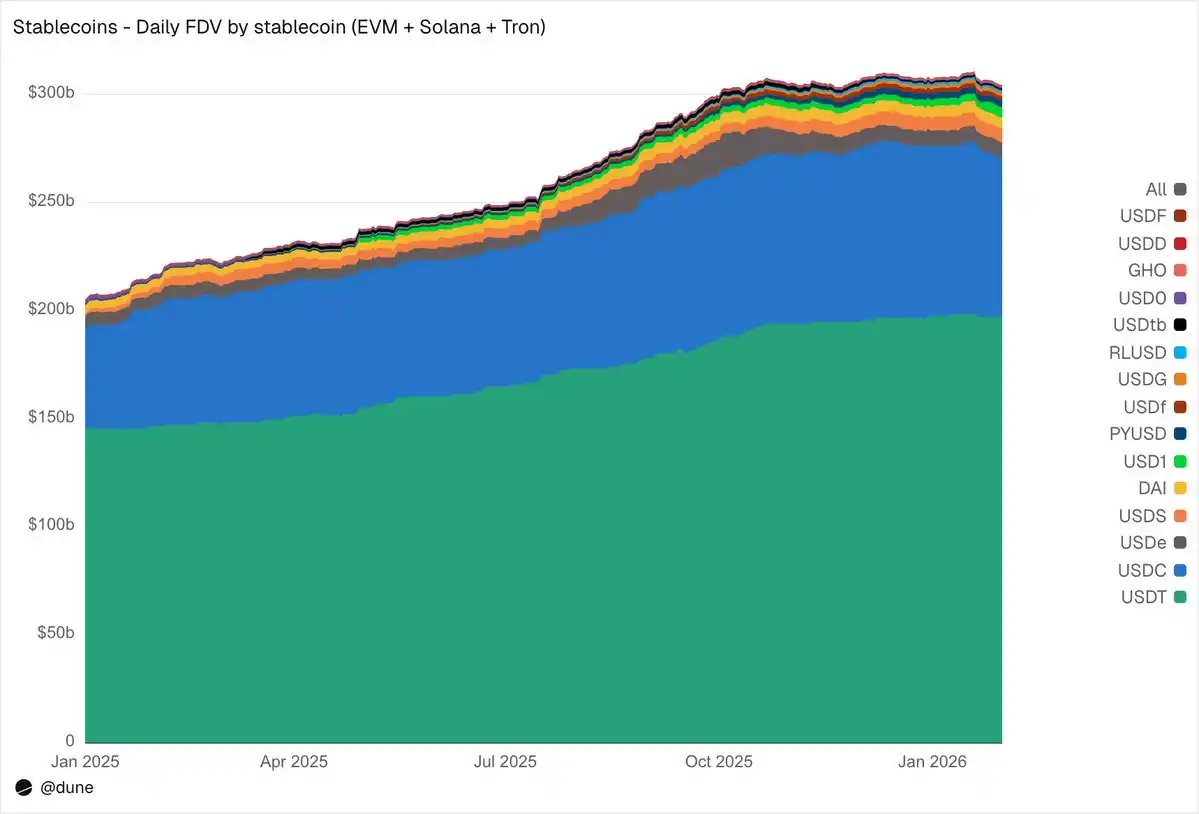
However, beneath the top two stablecoins, 2025 was the year of challenger growth. USDS (Sky/MakerDAO) grew by 376% to $6.3 billion; PYUSD (PayPal) grew by 753% to $2.8 billion; RLUSD (Ripple) surged from $58 million to $1.1 billion, marking an 1803% increase; USDG expanded 52x; and USD1 grew from zero to $5.1 billion.
Of course, not all challengers moved in the same direction. USD0 dropped by 66%; Ethena's USDe almost tripled at its October peak, ending the year with a 23% increase. Nevertheless, under the competitive layer below USDT and USDC, the number of challengers has significantly increased.
Who Holds Them?
Most stablecoin data sets can only tell you the total supply. However, because our data set tracks balances at the wallet level and combines address labels, we can answer a more critical question: Who is holding these stablecoins?
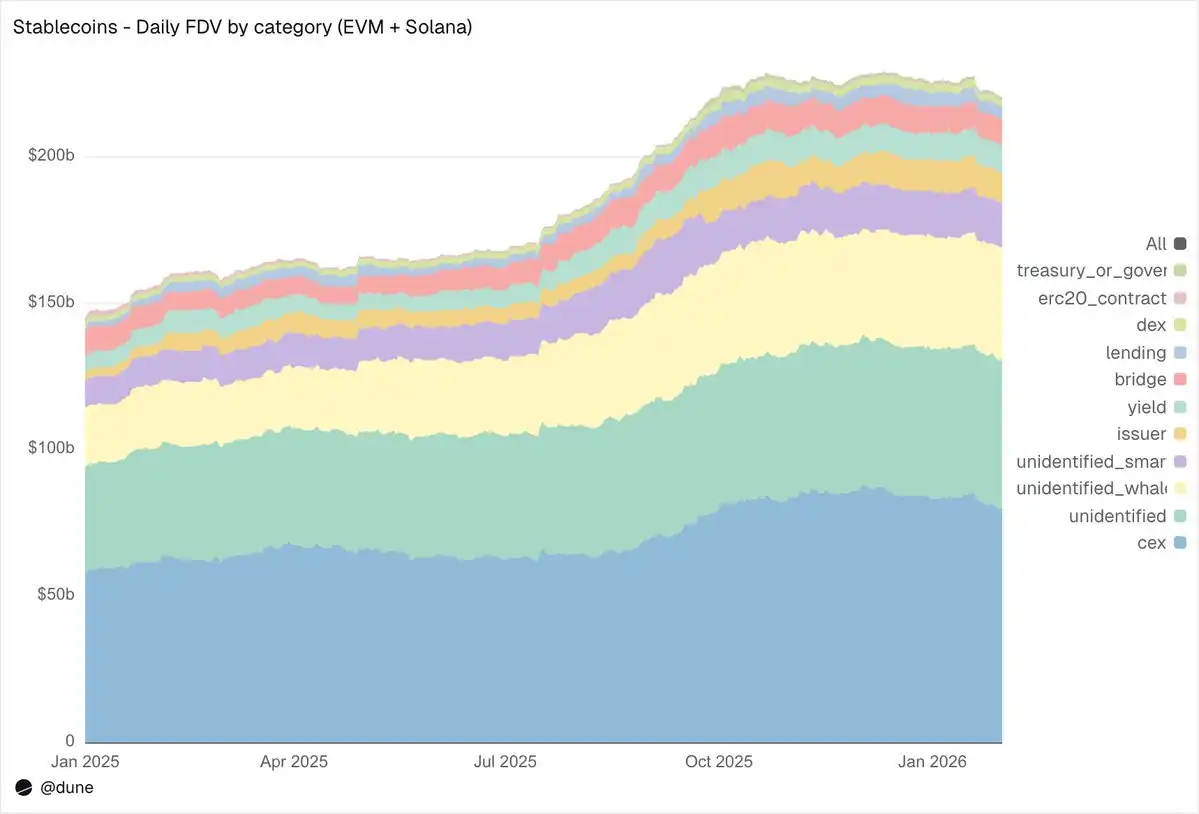
In the EVM and Solana ecosystems, centralized exchanges are currently the largest identified category, holding a scale of $80 billion, up from $58 billion a year ago. Stablecoins remain primarily the infrastructure for exchange trading and settlement.
A Whale Wallet Holding $39 Billion; Assets Under Management Nearly Doubled to $9.3 Billion, Reflecting the Growth of On-Chain Yield Strategies; Issuer Addresses — Including Treasury and Mint/Burn Contracts — Soared from $2.2 Billion to $10.2 Billion, a 4.6x Increase, Directly Reflecting the Scale of New Supply Entering the Market.
On Label Quality: Only 23% of the Supply Resides in Completely Unidentified Addresses. This is a High Identification Rate for On-Chain Data — Crucial for Understanding Where Stablecoin Risk Is Distributed.
172 Million Holders, but Extremely High Concentration
As of February 2026, a Total of 172 Million Unique Addresses Held at Least One of These 15 Stablecoins. USDT Accounts for 136 Million, USDC for 36 Million, DAI for 4.7 Million. The Distribution of These Three Stablecoins Is Very Broad: The Top 10 Wallets Hold Only 23%–26% of the Supply, with an HHI (Herfindahl-Hirschman Index, 0 Signifying Complete Dispersion, 1 Signifying Single Holder) Below 0.03.
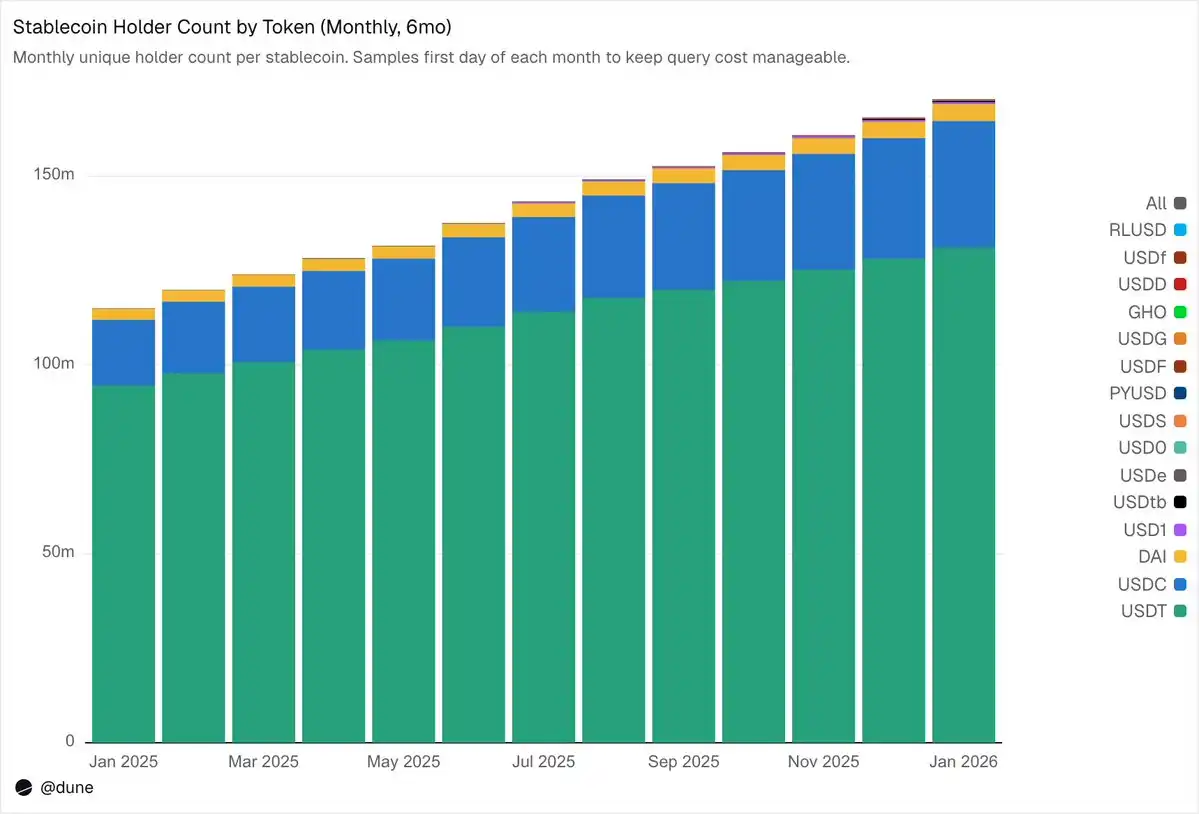
Other Stablecoins Present a Completely Different Picture. The Top 10 Wallets Often Control 60% to 99% of the Supply. For Example, In the Case of USDS, Although Its Circulating Supply Reaches $6.9 Billion, 90% Of It Is Concentrated in 10 Wallets (HHI is 0.48). The Concentration of USDF Is Higher, with the Top 10 Addresses Holding 99% of the Supply (HHI is 0.54). As for USD0, It Moves Towards an Extreme: Similarly, 99% Is Concentrated in the Top 10 Wallets, with an HHI as High as 0.84, Meaning That Even Within These Top Ten, the Supply Is Mainly Dominated by One or Two Addresses.
This Does Not Mean That These Stablecoins Themselves Have Flaws — Some Projects Have been Launched for a Short Time, While Some Have Been Aimed at Institutional Customers from the Beginning. However, This Does Mean That Their "Supply" Figures Cannot Be Understood in the Same Way as USDT or USDC. The Concentration of Holdings Will Directly Affect De-Anchoring Risk, Liquidity Depth, and Whether the So-Called "Supply Scale" Represents Real Organic Demand or Merely Reflects the Configuration Behavior of a Few Large Holders. Only When You Have Balance Data for Every Holder, Rather Than Relying Solely on Mint/Burn Events to Derive Aggregate Supply, Can Such Analysis Be Carried Out.
January 2026: Transfer Volume of $10.3 Trillion
In January 2026, the total stablecoin transfer volume within the EVM, Solana, and TRON ecosystems reached $10.3 trillion, more than double the amount in January 2025.
The on-chain distribution and supply structure present a stark contrast: Base leads with $5.9 trillion, despite a supply of only $44 billion; Ethereum is at $2.4 trillion; Tron is at $682 billion; Solana is at $544 billion; BNB Chain is at $406 billion.
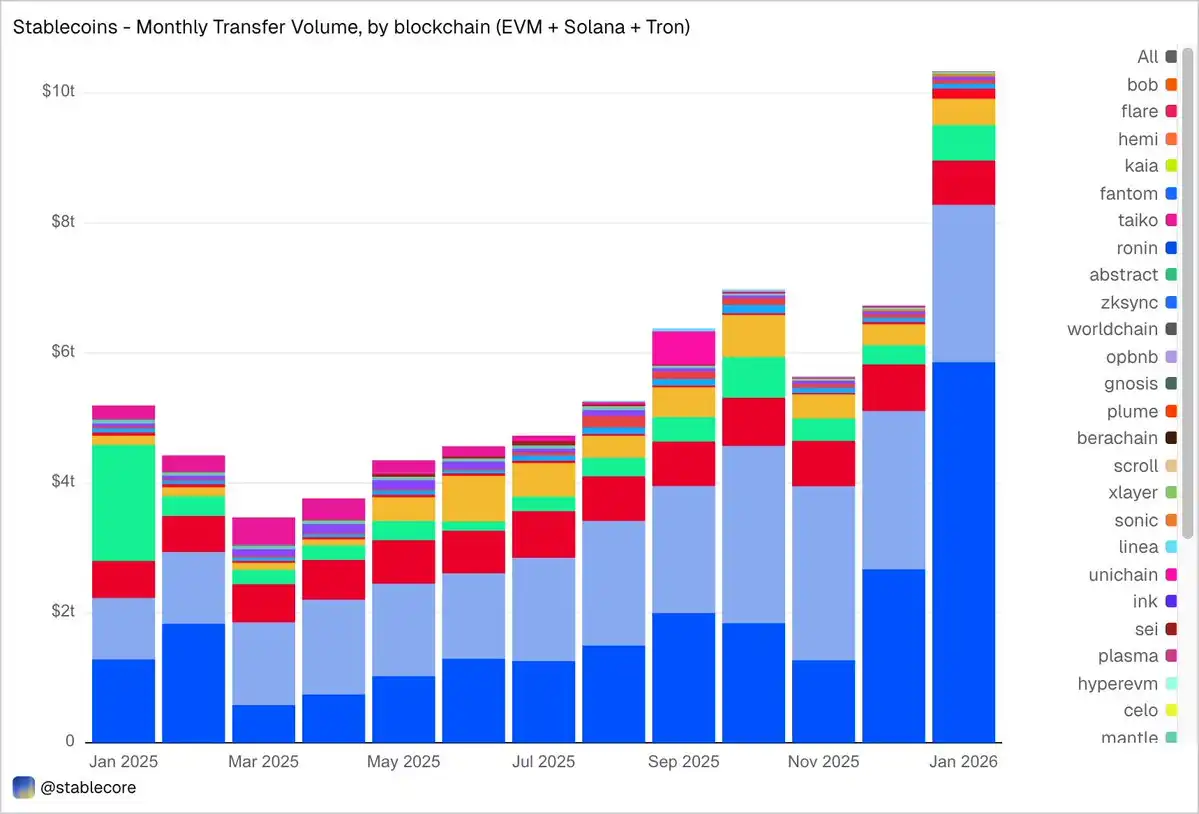
By token breakdown, USDC dominates with $8.3 trillion — nearly 5 times that of USDT ($1.7 trillion) — even though its supply is only about 1/2.7 of the latter. USDC evidently circulates more rapidly and frequently. DAI is at $138 billion, USDS is at $92 billion, USD1 is at $43 billion.
It is important to emphasize that this data is deliberately kept neutral and objective. The dataset has not been pre-filtered according to a fixed standard of "real" economic activity, so the total amount may include flows generated by arbitrage, bots, internal routing, and other automated behaviors. We have not hardcoded judgment into the data but rather provide an objective view for users to choose their own filtering method — whether to exclude bot trades, identify organic usage, or define transaction activity metrics that better reflect real-world conditions.
What Are Stablecoins Really Doing?
This is where the granularity advantage of this dataset truly shines. Transfers are not just labeled as "amount" but categorized into different activity types based on on-chain triggers. This means that we not only know that "$10 trillion flowed" but also "why it flowed."
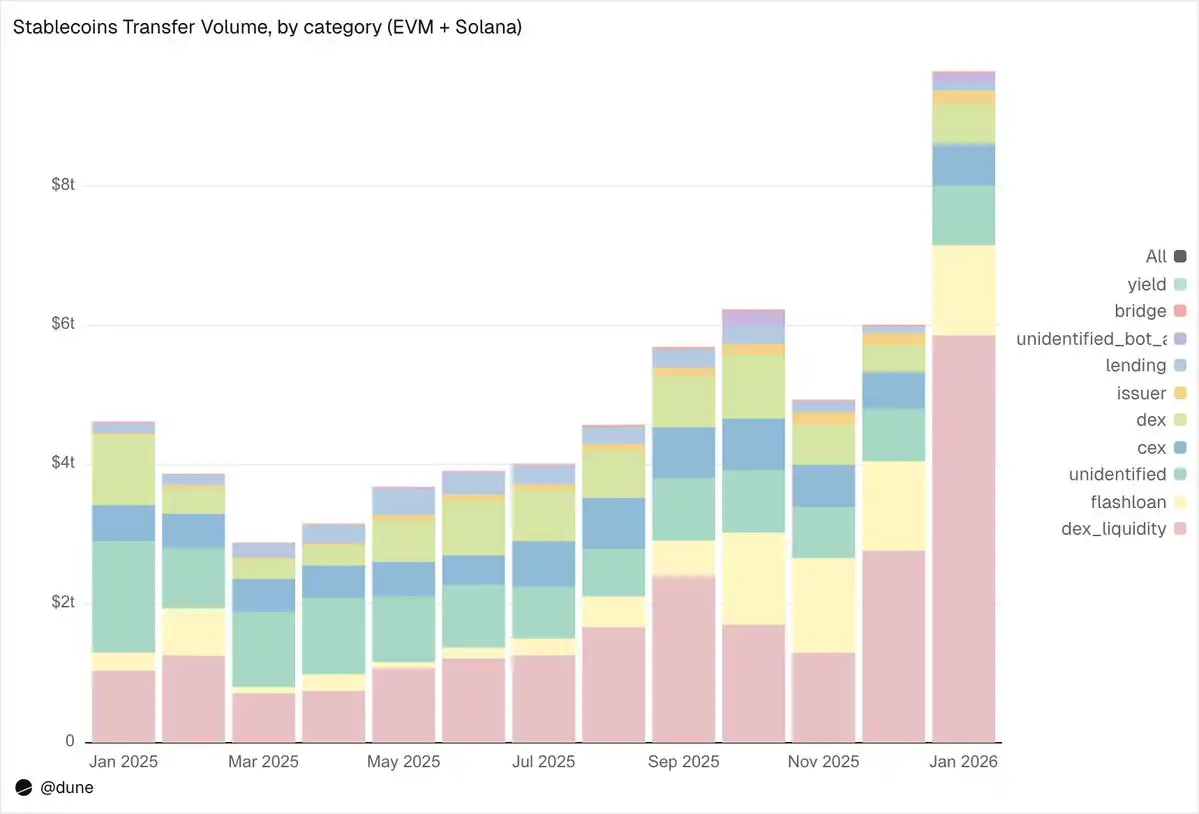
1. Market Infrastructure (DEX Trading and Liquidity)
· DEX Liquidity Provision and Withdrawal: $5.9 trillion — the largest use case, reflecting stablecoins' role as on-chain market-maker base assets.
· DEX Swaps: $376 billion — direct trading activity on automated market makers.
The combined total indicates that stablecoins are primarily used for trading collateral and liquidity infrastructure. Interestingly, the volume is more concentrated in incentive-driven liquidity mining and active capital optimization activities rather than pure trading demand.
2. Leverage and Capital Efficiency (Lending + Flash Loans)
· Flash Loans (Borrow and Repay): $1.3 trillion — Automated arbitrage and liquidation loops.
· Lending Activity (Deposit, Lend, Repay, Withdraw): $1370 billion — Represents on-chain short-term capital efficiency and structured credit layer.
3. On-Off Ramp Channels (CEX and Cross-Chain Bridges)
· CEX Flows — Deposit ($2240 billion), Withdrawal ($2240 billion), Internal Transfer ($1510 billion): Total $5990 billion.
· Cross-Chain Bridge Transfers: $280 billion — Demonstrates stablecoins as a bridge for settlement between cross-chain and centralized platforms.
4. Issuance Layer (Monetary Operations)
· Issuer Operations — Minting ($280 billion), Burning ($200 billion), Peg re-balancing ($230 billion) and other operations: Total $1060 billion, nearly 5 times the $420 billion a year ago.
5. Yield Protocols
· Yield Protocol Activity: $27 billion — Relatively small in scale, but significant in structured strategies and on-chain asset management.
Overall, 90% of the transaction volume flows through identified activity categories, providing us with a detailed view across the layers of the entire on-chain stack.
Circulation Velocity: Same Token, Different Worlds
Daily Circulation Velocity (Trading Volume divided by Supply) is perhaps the most overlooked metric in stablecoin analysis. It reveals whether stablecoins are actively used as a medium of exchange or simply held.
Among the tokens we analyzed, USDC and USDT stand out once again, but exhibit different characteristics.
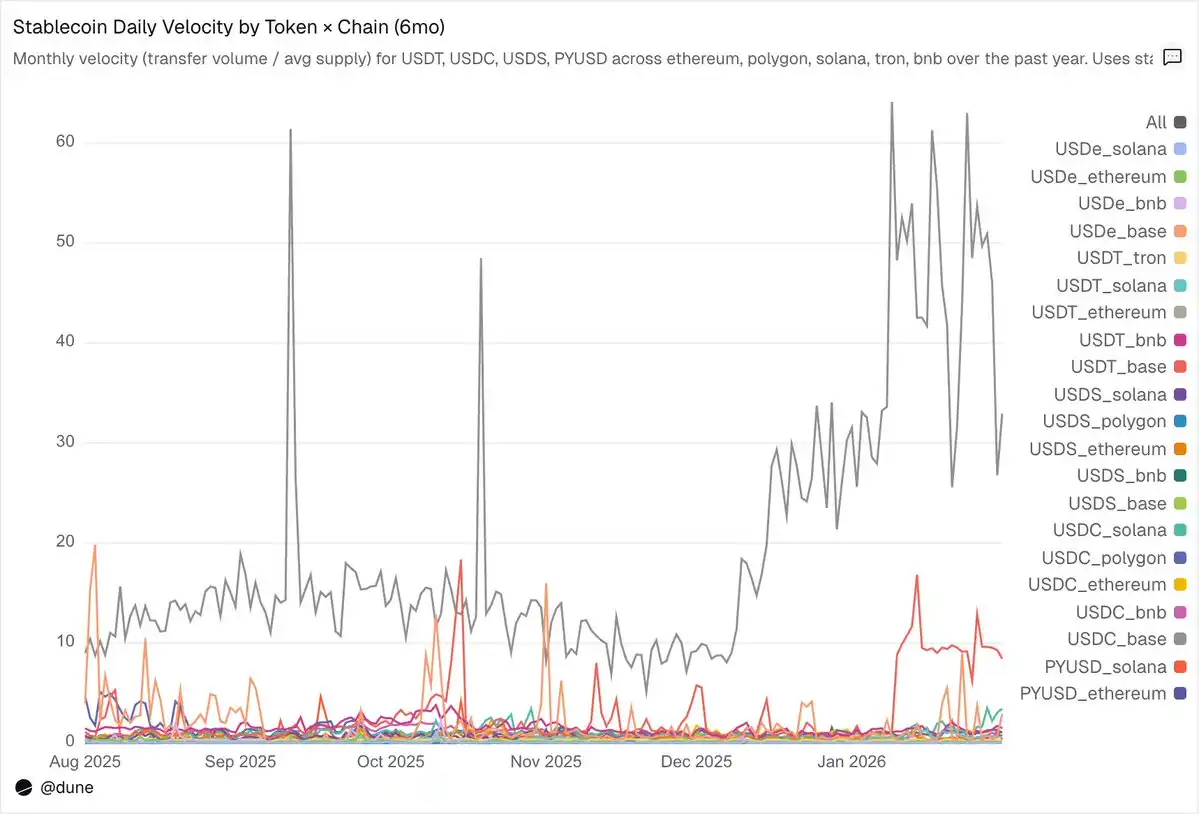
USDC circulates fastest on L2 and Solana. On Base, USDC's average daily circulation velocity is as high as 14 times — a staggering figure driven by high-frequency DeFi activity; around 1x on Solana and Polygon; and reaches 0.9x on Ethereum, with almost daily movement of nearly the entire supply.
USDT is Fastest on BNB Chain and Tron. It is 1.4x faster on BNB Chain, reflecting active trading; on Tron, it is 0.3x faster, with lower but remarkably stable volume, aligning with its role as the primary cross-border payment corridor. However, on Ethereum, USDT is only 0.2x faster, with over $100 billion in supply mostly sitting idle.
USDe and USDS are Slower by Design. USDe on Ethereum has a daily circulation speed of only 0.09x; USDS is at 0.5x. Both are yield-bearing stablecoins: USDe is typically staked as sUSDe to capture Ethena's Delta Neutral Yield strategy; USDS is deposited into the Sky Savings Rate Mechanism to earn protocol subsidy returns. As a result, a significant portion of the supply is locked in savings contracts, lending markets like Aave, or structured yield loops. The slow speed here is not a flaw but a feature—these assets are designed to accrue yield rather than facilitate frequent circulation.
The difference in chains is often more important than the token itself. For example, PYUSD has a daily circulation speed of 0.6x on Solana, four times faster than on Ethereum (0.1x). The same token exhibits completely different usage patterns in different ecosystems.
Supply and transfer volume each tell part of the story, while circulation speed bridges the two—it reveals whether a stablecoin on a chain is an active infrastructure or dormant capital.
You may also like

The survival dilemma of small and medium exchanges behind the withdrawal anomalies exposed by AscendEX

Why Is Bitcoin Falling Below $60K? 5 Key Market Drivers Explained
Bitcoin has dropped sharply amid ETF outflows, Strategy stock weakness, AI stock rallies, and changing Fed expectations. Explore the key forces driving BTC’s latest correction and what traders should watch next.

The shift in the cloud of the air: from despising stablecoins a year ago to the high-profile entry of capital today

ETH has entered a non-consensus phase, and the turning point is approaching!

Bitcoin vs. Gold in 2026: Which Asset Performs Better in Different Markets?

What is your view on Binance's competitive advantages?
I never expected that the first application of AI x Crypto would be in security auditing

Global Launch: As predictions become the most scarce asset in the AI era, Manadia is defining the next generation of the value internet

Who is footing the bill for the $64 billion accounting frenzy?

Morning Report | CoinEx becomes a key hub for Iran to evade sanctions, involving over $3.8 billion in funds; Kalshi seeks a new round of financing, with a valuation potentially rising to $40 billion

Why do cryptocurrency projects always like to change their names?

From the white-haired stock god to the billionaire fund mogul, the smart people shorting Nvidia are all getting rich using the same framework

Morning News | The draft amendment to the People's Bank of China Law aims to clarify the legal status of digital renminbi; South Korea will transfer about 40 unregistered virtual asset service providers to law enforcement agencies

The cryptocurrency industry has entered the "Show Me" era: merely relying on vision is no longer enough

Interpreting the Ethereum Foundation's new structure: Reaffirming self-sovereignty amid institutional trends

Former SpaceX engineer reconstructs the financial execution system using first principles
Standard Chartered Bank sings a 50x rhapsody again, aiming for AAVE to reach 3500 USD
Tidal Investment: We still have a positive outlook on the AI industry chain, but the reasons have changed
The survival dilemma of small and medium exchanges behind the withdrawal anomalies exposed by AscendEX
Why Is Bitcoin Falling Below $60K? 5 Key Market Drivers Explained
Bitcoin has dropped sharply amid ETF outflows, Strategy stock weakness, AI stock rallies, and changing Fed expectations. Explore the key forces driving BTC’s latest correction and what traders should watch next.
The shift in the cloud of the air: from despising stablecoins a year ago to the high-profile entry of capital today
ETH has entered a non-consensus phase, and the turning point is approaching!
Bitcoin vs. Gold in 2026: Which Asset Performs Better in Different Markets?
What is your view on Binance's competitive advantages?


