
The Grim Reaper is cryptocurrency's biggest "HODLer"

Original Article Title: The Biggest Buyer Of Crypto Is Death
Original Article Author: @PixOnChain, Crypto KOL
Original Article Translation: Saoirse, Foresight News
Crypto enthusiasts always say, "Not your keys, not your coins." This statement sounds powerful and is indeed true. However, behind this statement lies a mirrored logic — "Only your keys can truly own your cryptocurrency."
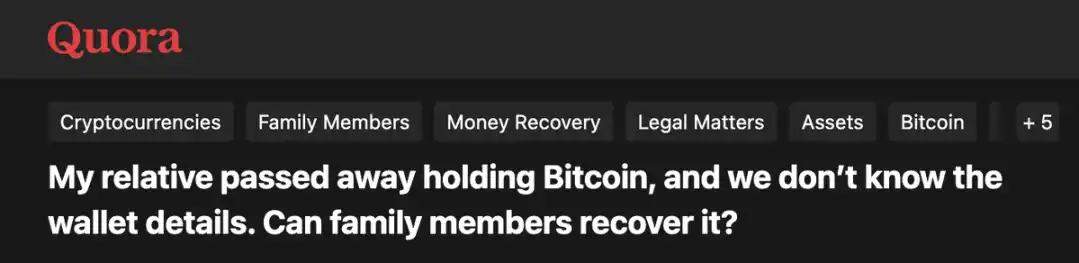
If no one else knows how to access your wallet, then at the moment you take your last breath, your cryptocurrency is effectively "gone." Of course, this is not a literal disappearance — it still exists on the blockchain ledger. But economically, it is akin to being burnt.
So, how big is this "Death Buyer" phenomenon?
Today, most cryptocurrency holders are quite young, with the majority falling between the late twenties and early forties.
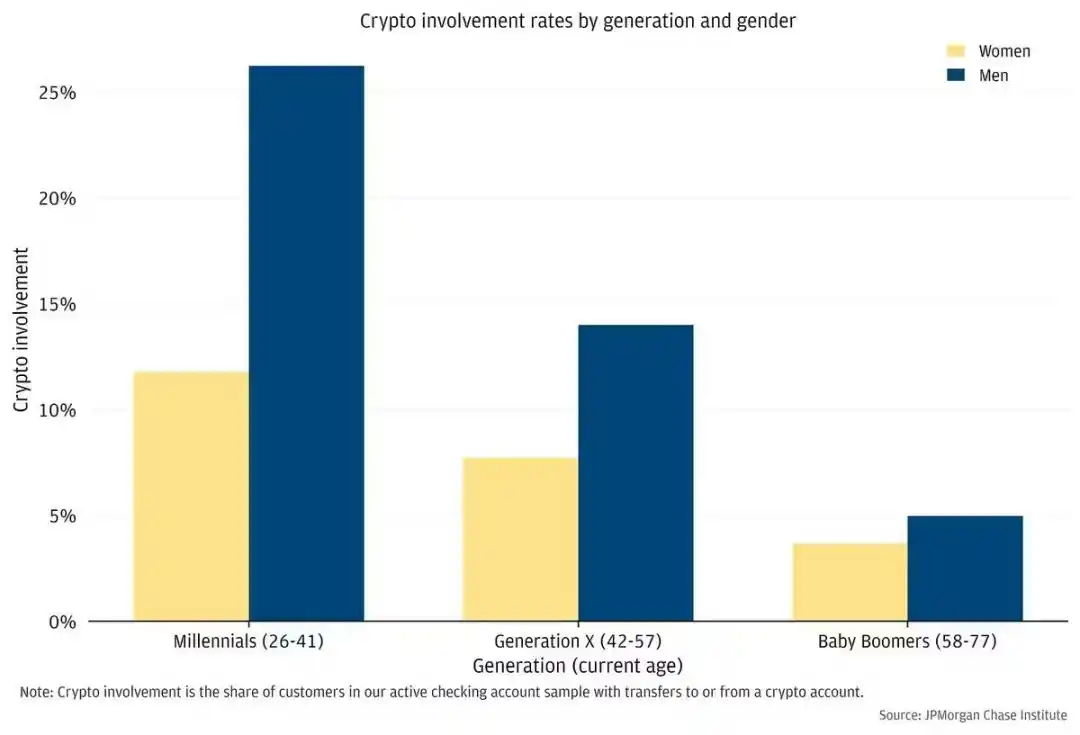
There are very few holders beyond retirement age, making the issue of "Death-Induced Cryptocurrency Loss" easily overlooked. Nevertheless, the associated data is still staggering:
· There are approximately 60 million deaths globally each year (based on a total global population of around 8 billion);
· There are around 500 million cryptocurrency holders globally (equivalent to 1 in 16 people holding cryptocurrency);
· Due to cryptocurrency holders being younger on average than the global population, their death rate is lower, with a conservative estimate of around 0.2% annually;
· Based on this calculation, approximately 1 million people (500 million × 0.2%) out of 500 million holders will pass away each year.
Currently, most cryptocurrency is still self-custodied by individuals, with very few making inheritance plans. Even if only 10% of deceased individuals' wallets cannot be accessed due to the absence of knowledge of how to access them, around 100,000 wallets become inaccessible each year. Assuming conservatively that the average balance in these inaccessible wallets is only $20,000, approximately $2 billion in cryptocurrency exits circulation yearly. Furthermore, this number will continue to grow over time — after all, the younger generation will also age.
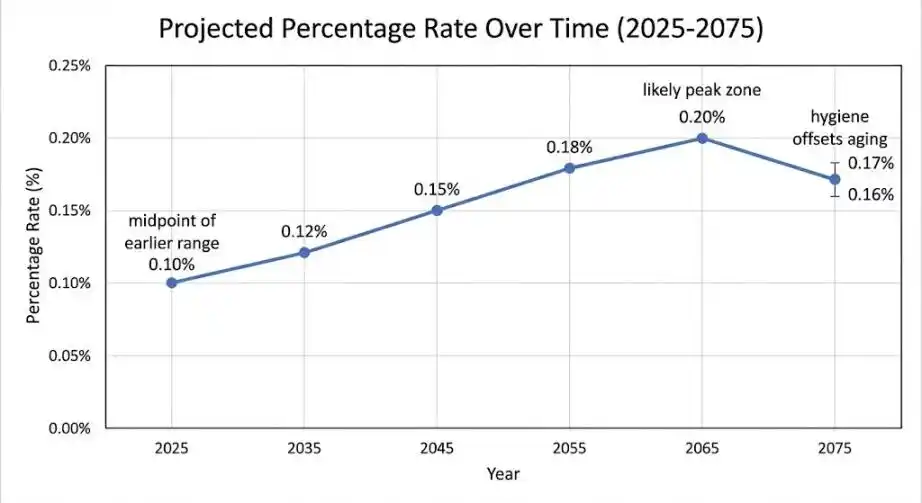
The percentage of cryptocurrency "destroyed" annually due to death
This leaves us with a key question: Since the advantage of self-custodying cryptocurrency is the removal of intermediaries, how can we avoid reintroducing intermediaries when passing on these assets?
Inheriting Assets Not Originally Designed for Inheritance

Currently, most solutions tend to lean towards two extremes: either simple yet fragile, such as storing the mnemonic phrase in a bank safe deposit box (easy to lose, easy to steal); or secure yet too complex for anyone to actually use. Neither of these solutions is satisfactory, so I have adopted a compromise—a simple three-step inheritance method that is easy to remember, difficult to crack, accessible anytime and anywhere, and ensures 100% non-custodial (i.e., without relying on intermediaries). The specific steps are as follows:
Step 1: Set Up a Dedicated Single-Page Website
Create a single-page website using a "obscure domain name" consisting of 3-4 words—this type of domain name is not something an average person would easily type into the search bar, but it should have special meaning to you for easy memorization. Additionally, prepay hosting fees for more than 10 years in advance and set up automatic renewal to ensure the long-term accessibility of the website.
Step 2: Encrypt the Mnemonic Phrase into a Numeric String
Choose a book you like, identify the most common publisher of that book, and purchase 10 copies (ensuring each book has identical page numbers and layouts). Then, convert your cryptocurrency wallet's mnemonic phrase into a numeric string: for each word in the mnemonic phrase, locate its position in the book and record the "page number - line number - word position in that line". For example, "112, 3, 5" represents "Page 112, Line 3, 5th word." Convert all mnemonic words into numeric strings using this method.
Step 3: Upload the Numeric Strings to the Dedicated Website
Simply publish the converted numeric strings in list form on your dedicated website, following this format:
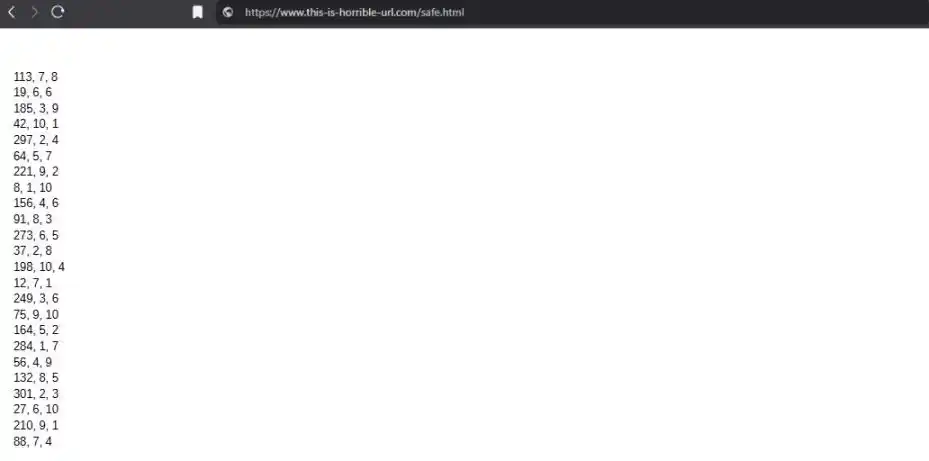
By the way, this is a numeric string corresponding to a real mnemonic phrase, linked to $500 worth of cryptocurrency. However, the website domain name is fictional, and the actual mnemonic phrase is hidden in a certain book. Just a hint: I absolutely love detective novels. Wishing you all happy "treasure hunting"~
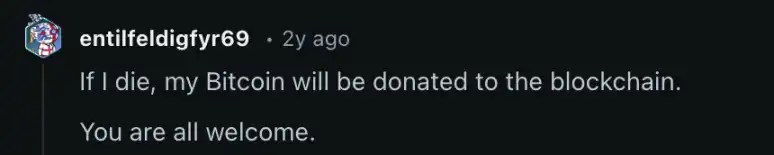
I know this may sound a bit "over the top," and some people may think it's unnecessary, but this approach can indeed make asset inheritance more flexible while ensuring security. You can further enhance security by, for example, using a rare book or a self-printed book to store the location information corresponding to the seed phrase; of course, you can also skip the hassle and simply put a hardware wallet (Ledger) and a metal plate engraved with the seed phrase in a safe deposit box. Otherwise, your cryptocurrency may end up being "donated" to the blockchain (i.e., permanently out of circulation).
You may also like

$75 billion in foreign capital has fled, and South Korean retail investors have absorbed it all using leverage

Bitcoin Trading Guide 2026: Strategies for Experienced Traders

What Is XAUT and PAXG? Why Tokenized Gold Is Booming in 2026

Cryptocurrency CEXs are flocking to sell US stocks, and traditional brokerages are facing an "uninvited guest."

Will the SpaceX IPO Hurt Bitcoin? Here's What Traders Are Watching
Foreign selling in the South Korean stock market accelerates, with cumulative net sales reportedly reaching $75 billion this year
On June 9, The Kobeissi Letter, citing Goldman Sachs data, reported that global investors are selling South Korean stocks at an unusually rapid pace. In the latest trading session, foreign investors sold about $801 million worth of Kospi constituent stocks again; total foreign outflows last week reached about $10 billion, and the market has been in net foreign selling on nearly every trading day over the past month. According to the data cited in the report, foreign investors have sold about $75 billion worth of South Korean stocks so far this year. Meanwhile, South Korean retail and institutional investors together recorded roughly $69 billion in net buying over the same period, suggesting that the market’s main buying support has come from domestic capital rather than returning overseas funds. The information currently disclosed still mainly comes from The Kobeissi Letter’s retelling and Goldman Sachs data summaries, while public details on the statistical period and the specific definition of “selling” remain relatively limited.

Fortune Warns of Strategy’s Financing Structure Risks as Bitcoin Premium Narrows
Fortune warned that Strategy’s Bitcoin treasury model faces growing financing risks as MSTR’s net asset premium narrows and preferred stock dividend pressure increases.

Ferrari Challenge Le Mans: Carl Moon to Dominate in WEEX Livery

Sahara AI Responds to SAHARA’s Sharp Drop: No Contract or Product Security Issues Found, Internal Investigation Underway
Sahara AI responded to SAHARA’s 60% price drop, saying no token contract or product security issues have been found and an internal investigation is underway.
WEEX Deposit/Withdrawal Dynamic Island: Your Asset Status, Always in Sight

Scaling Crypto Derivatives: The Digital Asset Infrastructure Behind High-Volume Trading
In the fast-moving digital asset ecosystem, derivatives platforms face an extreme architectural test. High-leverage futures markets demand more than just standard security—they require absolute operational precision, zero-latency matching engines, and ironclad structural scalability, all while navigating intense market volatility.
As global platforms scale to meet these demands, the industry is shifting away from rigid, monolithic setups toward a more agile, "decoupled" infrastructure philosophy.
The Blueprint for High-Volume Copy TradingFor elite global exchanges like WEEX (founded in 2018), this architectural choice becomes critical when scaling high-volume retail features like social copy trading. When thousands of users automatically mirror the real-time strategies of elite traders simultaneously, it triggers sudden, monumental spikes in concurrent transactional volume.
To prevent execution latency or settlement bottlenecks during these peak volatility events, a platform's primary engine must remain entirely dedicated to risk management, copy-trade synchronization, and order matching.
The Architectural Rule: New-generation platforms must separate front-end user execution engines from heavy backend infrastructural overhead to eliminate operational friction.
By separating these layers, platforms can maintain complete sovereignty over their trading environments and user experiences while strategically aligning with institutional-grade infrastructure ecosystems. This strategic framework allows modern exchanges to leverage advanced Digital Asset Custody infrastructure such as Cobo’s behind the scenes, ensuring that backend wallet management scales elastically alongside trading spikes.
Capitalizing on Market Momentum and 400× LeverageIn a derivatives arena where platforms offer up to 400× leverage on perpetual contracts, capital efficiency and market agility are core business metrics. To capture market momentum, an exchange needs the ability to rapidly expand its asset offerings, supporting everything from legacy crypto assets to sudden, trending altcoins across a massive library of trading pairs.
Adopting a flexible, scalable Wallet-as-a-Service (WaaS) solution such as Cobo’s could completely rewrite the development timeline for high-growth exchanges. Instead of spending months of engineering capital building out custom backend wallet architectures for every new blockchain network, platforms can deploy localized infrastructure in days.
This agility allows platforms to instantly scale their listings to over a thousand trading pairs without compromising security or delaying time-to-market. It mirrors the exact operational advantages seen during high-velocity market events, similar to how advanced wallet infrastructure empowers platforms during sudden asset surges; allowing exchanges to pass that speed and liquidity directly to their global user base.
A Mature Foundation for GrowthThe synergy between trusted infrastructure ecosystems and global trading platforms represents the natural evolution of a maturing crypto market. As WEEX continues to scale its global spot and derivatives offerings for over 6 million users, adopting robust backend paradigms proves that platforms no longer have to compromise between cutting-edge trading velocity and uncompromised structural security.

Morning Report | BitMine increased its holdings by 126,971 ETH last week; trader Eugene announced his exit from the crypto market

Wang Chuan: How can one not feel anxious after the neighbor Old Wang made thirty times profit by investing in storage stocks? (Seven) - A quarter-century cycle

Get Paid to Onboard? Try WEEX’s New Homepage with Rewards for Registration, Deposit & Trade

WEEX Custom Layout: Build Your Perfect Trading Workspace in Seconds

See “Buy Walls” & “Sell Walls” Instantly: WEEX Launches the Depth Chart for Smarter Trades

What Is Quick Trade on WEEX? 2 Ways WEEX Ends Chart-Panel Jumping
Morning News | Five major virtual asset platforms in South Korea have experienced 57 incidents of hacking and system failures in six years; Grayscale submits registration application for Canton ETF
$75 billion in foreign capital has fled, and South Korean retail investors have absorbed it all using leverage
Bitcoin Trading Guide 2026: Strategies for Experienced Traders
What Is XAUT and PAXG? Why Tokenized Gold Is Booming in 2026
Cryptocurrency CEXs are flocking to sell US stocks, and traditional brokerages are facing an "uninvited guest."
Will the SpaceX IPO Hurt Bitcoin? Here's What Traders Are Watching
Foreign selling in the South Korean stock market accelerates, with cumulative net sales reportedly reaching $75 billion this year
On June 9, The Kobeissi Letter, citing Goldman Sachs data, reported that global investors are selling South Korean stocks at an unusually rapid pace. In the latest trading session, foreign investors sold about $801 million worth of Kospi constituent stocks again; total foreign outflows last week reached about $10 billion, and the market has been in net foreign selling on nearly every trading day over the past month. According to the data cited in the report, foreign investors have sold about $75 billion worth of South Korean stocks so far this year. Meanwhile, South Korean retail and institutional investors together recorded roughly $69 billion in net buying over the same period, suggesting that the market’s main buying support has come from domestic capital rather than returning overseas funds. The information currently disclosed still mainly comes from The Kobeissi Letter’s retelling and Goldman Sachs data summaries, while public details on the statistical period and the specific definition of “selling” remain relatively limited.


