
《The New York Times》: Giving Trump a Golden Statue, a Meme Coin's Wild Marketing

Original Title: "Don Colossus," a Golden Statue of President Trump, Waits for Its Home
Original Author: David Yaffe-Bellany, The New York Times
Translation Author: Luffy, Foresight News
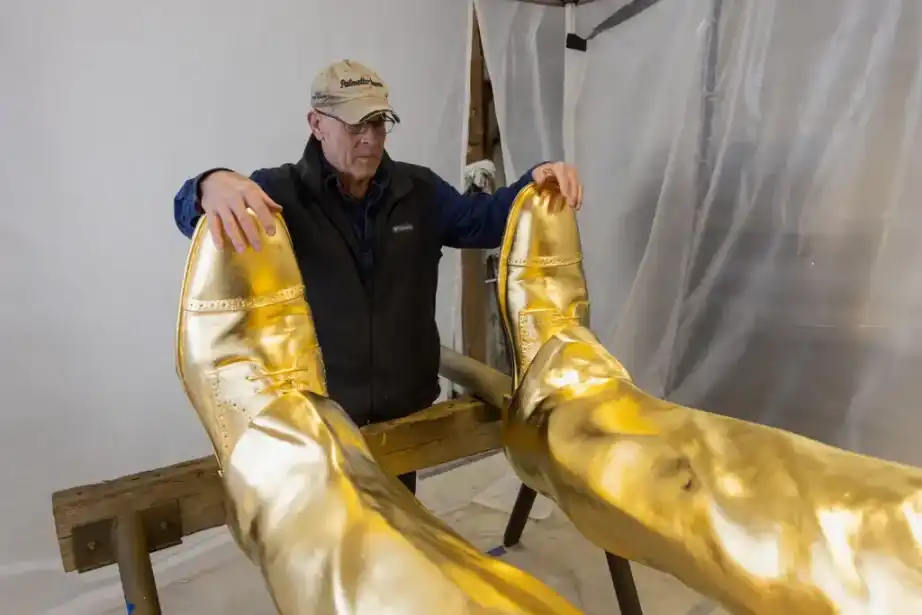
The statue of President Trump is referred to as "Don Colossus." It stands 15 feet tall, placed on a 7000-pound base, making its total height equivalent to a two-story building. This giant statue is cast in bronze, with a thick layer of gold leaf covering its surface. (Note: Don Colossus translates directly to "Giant Don," implying that Trump is a giant figure.)
For over a year, this gold-plated statue has been at the heart of one of the strangest gold rush schemes of the Trump era. A group of cryptocurrency investors spent $300,000 to have the sculptor create this statue as a tribute to Trump's outspoken support for cryptocurrency.
Subsequently, they used this statue to generate buzz for a meme coin called PATRIOT.
Now, unexpectedly, this plan seems poised to come to fruition. Last month, a pedestal made of concrete and stainless steel was completed at Trump's golf resort in Doral, Florida. According to records reviewed by The New York Times, one of the organizers of this plan, Trump's friend Mark Burns, informed a collaborator that the President plans to attend the unveiling ceremony of the statue in the area.
"The statue looks tremendous." Trump wrote in a letter to Burns in December last year.
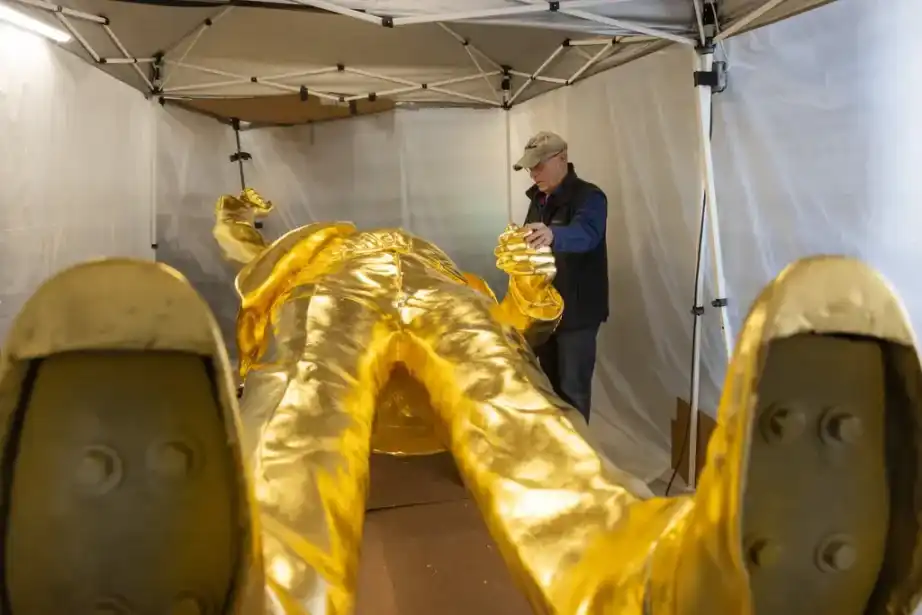
Alan Cottrill inspects the gold-plated statue of President Trump that he designed in Zanesville, Ohio
Almost everyone in the cryptocurrency space has tried to profit during Trump's presidency: either by engaging in business deals with his family or seeking regulatory relaxation from his government. However, few have been as bold as PATRIOT supporters.
A meme coin is a type of cryptocurrency that has almost no practical use other than speculation. It is usually based on viral memes or celebrity images, and its value depends entirely on the price fans are willing to pay. The key to creating a meme coin is to generate enough online hype to convince potential buyers that its price will continue to rise.
Building a giant statue is a costly social media hype strategy, but it is also a potential profit plan. According to an organizer of this scheme, investors who funded the statue received a large amount of the token, the price of which sometimes skyrocketed. For months, supporters of "Don Colossus" have been posting progress images of the statue on X platform and forming alliances within the "Make America Great Again" camp, aiming to achieve a marketing coup: to have this statue placed on Trump's official property.
By the end of 2024, the PATRIOT Meme coin was officially launched, coinciding with Trump's promise to make the U.S. the "global capital of cryptocurrency," causing the token's price to soar. During an event held in Washington on the presidential inauguration weekend, supporters of the token presented a bronze mini statue to Trump's former advisor, Steve Bannon, and interacted with other conservative figures.
However, constant project delays and internal conflicts have cast a shadow over this gold rush plan, offering a glimpse into the turmoil of the Meme coin market: a market full of various scams, where investors often end up losing everything. Last year, the price of PATRIOT plummeted, almost to zero. In a rush to complete the statue and boost the token, investors also clashed with sculptor Alan Cottrill based in Ohio.
In text messages reviewed by The New York Times, Cottrill said that investors still owed him $75,000 for the statue's intellectual property rights.
"You are using my copyrighted statue image to promote your token!" he wrote last month in a message to one of the token's supporters.
"Yeah, haha, we planned to do that from day one." Ashley Sansalone replied. Sansalone is a cryptocurrency developer who, in addition to PATRIOT, was involved in another token project called Elon GOAT.
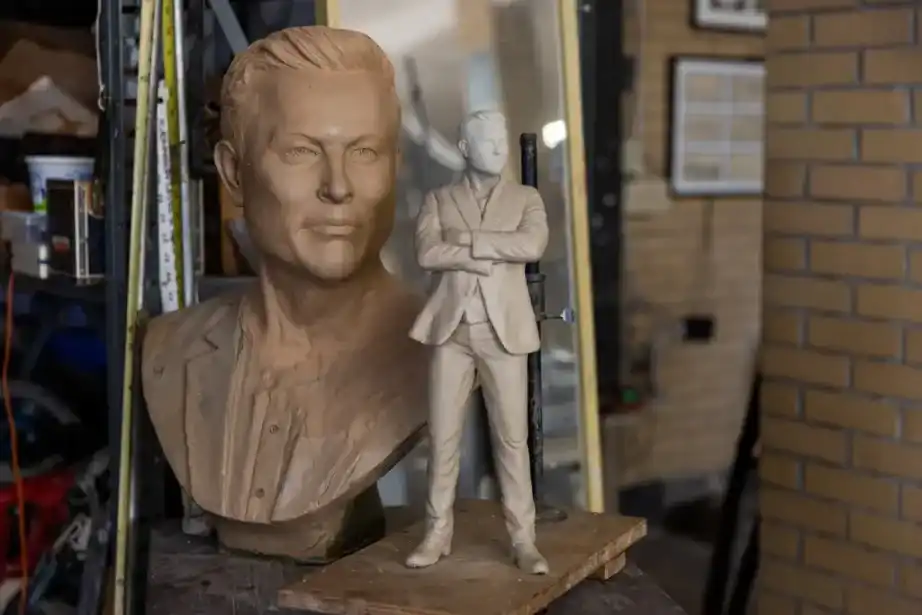
Statue of Elon Musk designed by Alan Cottrill
In a statement, Sansalone said that Cottrill would be fully paid before the statue's unveiling. "In any business agreement, a part of the payment is usually withheld until the final product is delivered," he said.
However, it is currently unclear when the statue will be officially unveiled.
Earlier this week, following inquiries to the White House and the Trump Organization about the PATRIOT token by The New York Times, President's son Eric Trump issued a statement on X platform.
“We appreciate everyone's support and enthusiasm,” he said, “but it must be made clear that we have not been involved in any matters related to this token.”
Building “Don Colossus”
The plan to build “Don Colossus” originated in a Telegram group chat, where cryptocurrency enthusiasts often discuss investment strategies and promote tokens. It was July 2024, shortly after Trump had narrowly avoided an assassination attempt in Butler, Pennsylvania, raising his fist defiantly.
Sansalone envisioned turning this moment of defiance into the core image of a meme coin. He collaborated with right-wing activist Dustin Stockton, and well-connected cryptocurrency investor Brock Pierce, who has a history of various legal and financial disputes, also joined.
Shortly after the bullet grazed Trump's ear, Sansalone reached out to 73-year-old Cottrill, whose bronze statue of Edison now stands in the U.S. Capitol. Over the years, Cottrill has sculpted statues of over a dozen U.S. presidents, including a 10-foot-tall George Washington and Thomas Jefferson memorial.
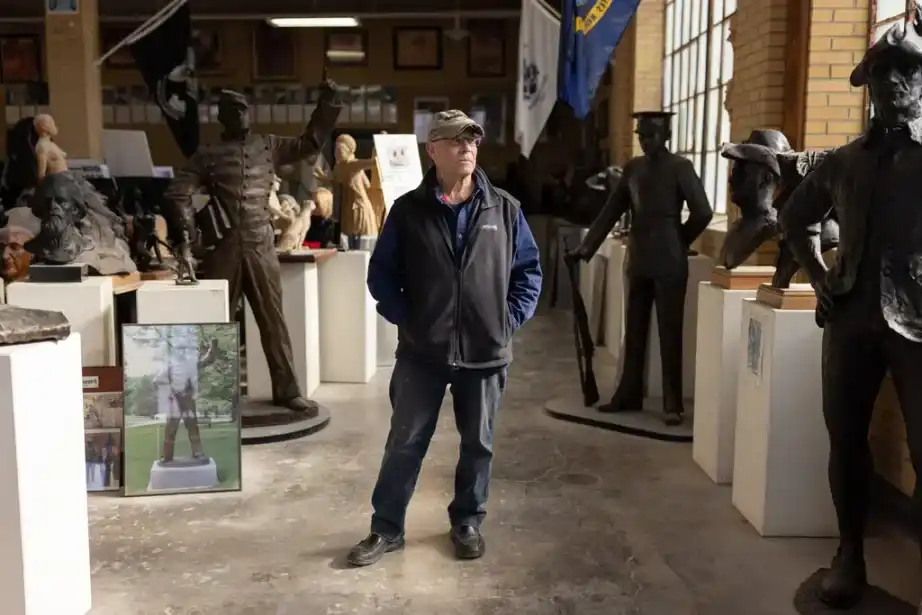
Cottrill standing in a room filled with sculptures
The group of cryptocurrency investors hoped that Trump's statue would be taller than previous works and suggested some aesthetic modifications.
“The initial image I sculpted was very lifelike,” Cottrill said in an interview last month. “Those crypto folks had me trim some of the excess neck fat and slim down the figure.”
By the time of Trump's inauguration, Cottrill had completed the statue, which was yet to be gilded with gold foil but stood as his tallest piece. In December of last year, Trump reshared a Breitbart News article on the project, stating that Stockton was in talks with the inaugural committee planning to unveil the statue during inauguration weekend.
The timing of this repost was just right: the PATRIOT token had just launched.
The official website stated: "The people's cryptocurrency, a statue that can never be erased."
However, the project soon faced two major setbacks. Severe cold weather in Washington led to a series of logistical issues, delaying the statue unveiling plan; and shortly before the inauguration, Trump launched his own meme coin, TRUMP.
Just as cryptocurrency traders were scrambling to buy this official token, Stockton and Pierce held a "Patriot Award" event at the Washington National Press Club, where they distributed miniature statue models.
"The atmosphere at the event suddenly turned cold because Trump's token price suddenly skyrocketed," Cottrill said.
By the end of January, ATRIOT's price had plummeted over 90%.
"A Piece of Land"
Despite these setbacks, this group of cryptocurrency investors continued to push forward with marketing. In February of last year, the infamous former congressman George Santos showcased a Trump miniature statue on Fox News, specifically mentioning the PATRIOT token.
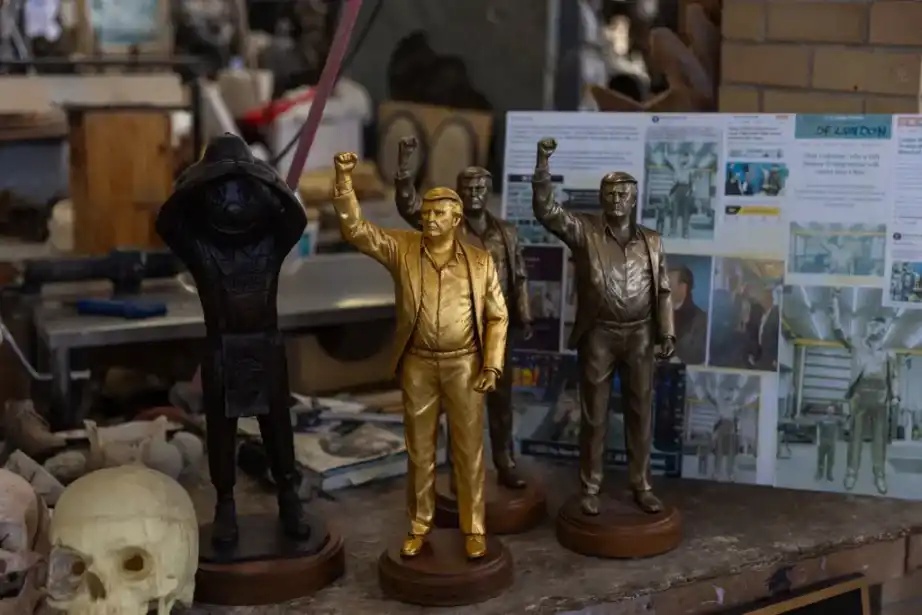
A small gold-plated Trump statue with a raised fist, surrounded by several dark-colored replicas
Stockton retweeted this video on the X platform, stating, "This kind of exposure is priceless!" In a brief phone interview, Santos said, "I was paid to advertise it, I've always been upfront about that."
Investors also courted another influential ally: Burns. This well-known pastor, a close confidant of Trump sometimes referred to as the informal "spiritual advisor" to the president.
After Pierce introduced him to the project team, Burns became involved in statue-related work. He quickly became a key figure in driving the project restart, proposing to gild the bronze statue with gold leaf.
"The President just asked me for a photo of the statue after it's been gilded," Burns wrote in a message to collaborators last November.
Trump's wish eventually came true. Sansalone revealed to the team that he had consulted a gold leaf supplier in New York who had provided decoration for Trump Tower. Cottrill also shared the latest photo of the statue's finished product.
"Too dazzling, too exquisite," Sansalone replied.
"Wow... this is going to the president," Burns wrote.
Evidently, Trump was impressed by the statue. Last month, Cottrill traveled to Florida to complete the installation of the 7000-pound pedestal at the Trump National Doral Golf Club. Stockton boasted on social media that it was a "gem." In a text message to a collaborator in January, Burns said that the White House scheduling staff is currently "actively nailing down" a date for the president to attend the statue's official unveiling.
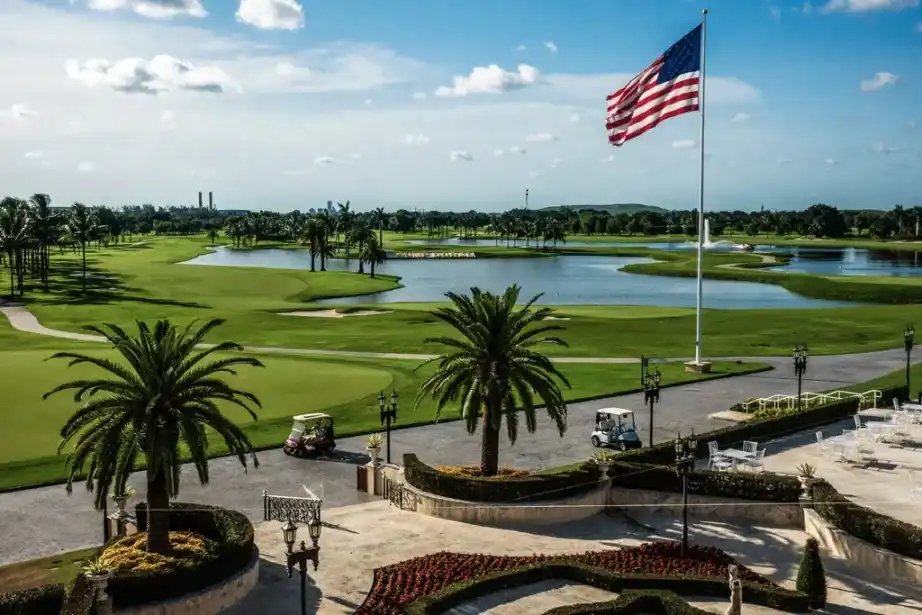
Trump National Doral Golf Course, Florida
It should have been Cottrill's shining moment, but he said he had had enough of the cryptocurrency investors behind him.
Cottrill explained that it wasn't until the fall of 2024 that he discovered these cryptocurrency investors were using the image of his work to promote a digital currency, which he believed infringed on his intellectual property.
Eventually, he reached an agreement with the investors: they would pay a $150,000 statue copyright fee. However, he said he has still not received the remainder of the payment, and coupled with other outstanding fees, they owe him a total of about $90,000.
Cryptocurrency investors requested Trump's statue to be tall enough and made some appearance modification requests
"In my view, they never actually bought this intellectual property, and they are now illegally using it," he said. "The statue will never leave my foundry unless all debts are settled."
However, the project's organizers argued that the project didn't really make any money.
Burns said he has never asked for or received any payment. Stockton, in an interview, stated that the PATRIOT token was merely a fundraising tool intended to "provide financial support for all matters related to the statue."
"I haven't seen anyone make big money off of this," Stockton said.
Trump Organization spokesperson Kimberly Benza stated that the company was only made aware of the existence of this Meme coin after inquiries were made by The New York Times earlier this week. She did not respond to questions about whether the statue unveiling ceremony would proceed as planned.
This farce did not stop the project's promotion on social media. An X account associated with the token recently posted a photo of the Colossus of Doral's pedestal and pinned a detailed message explaining how to buy the Meme coin.
"The dream is still alive," Sansalone said on January 16 during a live stream with Burns.
In addition to this giant statue, the team also hopes to gift a gold-plated mini statue to Trump. "We hope to have a piece displayed in the Oval Office," Sansalone said.
You may also like

Bitcoin Trading Guide 2026: Strategies for Experienced Traders

What Is XAUT and PAXG? Why Tokenized Gold Is Booming in 2026

Cryptocurrency CEXs are flocking to sell US stocks, and traditional brokerages are facing an "uninvited guest."

Will the SpaceX IPO Hurt Bitcoin? Here's What Traders Are Watching
Foreign selling in the South Korean stock market accelerates, with cumulative net sales reportedly reaching $75 billion this year
On June 9, The Kobeissi Letter, citing Goldman Sachs data, reported that global investors are selling South Korean stocks at an unusually rapid pace. In the latest trading session, foreign investors sold about $801 million worth of Kospi constituent stocks again; total foreign outflows last week reached about $10 billion, and the market has been in net foreign selling on nearly every trading day over the past month. According to the data cited in the report, foreign investors have sold about $75 billion worth of South Korean stocks so far this year. Meanwhile, South Korean retail and institutional investors together recorded roughly $69 billion in net buying over the same period, suggesting that the market’s main buying support has come from domestic capital rather than returning overseas funds. The information currently disclosed still mainly comes from The Kobeissi Letter’s retelling and Goldman Sachs data summaries, while public details on the statistical period and the specific definition of “selling” remain relatively limited.

Fortune Warns of Strategy’s Financing Structure Risks as Bitcoin Premium Narrows
Fortune warned that Strategy’s Bitcoin treasury model faces growing financing risks as MSTR’s net asset premium narrows and preferred stock dividend pressure increases.

Ferrari Challenge Le Mans: Carl Moon to Dominate in WEEX Livery

Sahara AI Responds to SAHARA’s Sharp Drop: No Contract or Product Security Issues Found, Internal Investigation Underway
Sahara AI responded to SAHARA’s 60% price drop, saying no token contract or product security issues have been found and an internal investigation is underway.

WEEX Deposit/Withdrawal Dynamic Island: Your Asset Status, Always in Sight

Scaling Crypto Derivatives: The Digital Asset Infrastructure Behind High-Volume Trading
In the fast-moving digital asset ecosystem, derivatives platforms face an extreme architectural test. High-leverage futures markets demand more than just standard security—they require absolute operational precision, zero-latency matching engines, and ironclad structural scalability, all while navigating intense market volatility.
As global platforms scale to meet these demands, the industry is shifting away from rigid, monolithic setups toward a more agile, "decoupled" infrastructure philosophy.
The Blueprint for High-Volume Copy TradingFor elite global exchanges like WEEX (founded in 2018), this architectural choice becomes critical when scaling high-volume retail features like social copy trading. When thousands of users automatically mirror the real-time strategies of elite traders simultaneously, it triggers sudden, monumental spikes in concurrent transactional volume.
To prevent execution latency or settlement bottlenecks during these peak volatility events, a platform's primary engine must remain entirely dedicated to risk management, copy-trade synchronization, and order matching.
The Architectural Rule: New-generation platforms must separate front-end user execution engines from heavy backend infrastructural overhead to eliminate operational friction.
By separating these layers, platforms can maintain complete sovereignty over their trading environments and user experiences while strategically aligning with institutional-grade infrastructure ecosystems. This strategic framework allows modern exchanges to leverage advanced Digital Asset Custody infrastructure such as Cobo’s behind the scenes, ensuring that backend wallet management scales elastically alongside trading spikes.
Capitalizing on Market Momentum and 400× LeverageIn a derivatives arena where platforms offer up to 400× leverage on perpetual contracts, capital efficiency and market agility are core business metrics. To capture market momentum, an exchange needs the ability to rapidly expand its asset offerings, supporting everything from legacy crypto assets to sudden, trending altcoins across a massive library of trading pairs.
Adopting a flexible, scalable Wallet-as-a-Service (WaaS) solution such as Cobo’s could completely rewrite the development timeline for high-growth exchanges. Instead of spending months of engineering capital building out custom backend wallet architectures for every new blockchain network, platforms can deploy localized infrastructure in days.
This agility allows platforms to instantly scale their listings to over a thousand trading pairs without compromising security or delaying time-to-market. It mirrors the exact operational advantages seen during high-velocity market events, similar to how advanced wallet infrastructure empowers platforms during sudden asset surges; allowing exchanges to pass that speed and liquidity directly to their global user base.
A Mature Foundation for GrowthThe synergy between trusted infrastructure ecosystems and global trading platforms represents the natural evolution of a maturing crypto market. As WEEX continues to scale its global spot and derivatives offerings for over 6 million users, adopting robust backend paradigms proves that platforms no longer have to compromise between cutting-edge trading velocity and uncompromised structural security.

Morning Report | BitMine increased its holdings by 126,971 ETH last week; trader Eugene announced his exit from the crypto market

Wang Chuan: How can one not feel anxious after the neighbor Old Wang made thirty times profit by investing in storage stocks? (Seven) - A quarter-century cycle

Get Paid to Onboard? Try WEEX’s New Homepage with Rewards for Registration, Deposit & Trade

WEEX Custom Layout: Build Your Perfect Trading Workspace in Seconds

See “Buy Walls” & “Sell Walls” Instantly: WEEX Launches the Depth Chart for Smarter Trades

What Is Quick Trade on WEEX? 2 Ways WEEX Ends Chart-Panel Jumping
Morning News | Five major virtual asset platforms in South Korea have experienced 57 incidents of hacking and system failures in six years; Grayscale submits registration application for Canton ETF
Should we escape the peak? The principle of the tail-end market in the stock market
Bitcoin Trading Guide 2026: Strategies for Experienced Traders
What Is XAUT and PAXG? Why Tokenized Gold Is Booming in 2026
Cryptocurrency CEXs are flocking to sell US stocks, and traditional brokerages are facing an "uninvited guest."
Will the SpaceX IPO Hurt Bitcoin? Here's What Traders Are Watching
Foreign selling in the South Korean stock market accelerates, with cumulative net sales reportedly reaching $75 billion this year
On June 9, The Kobeissi Letter, citing Goldman Sachs data, reported that global investors are selling South Korean stocks at an unusually rapid pace. In the latest trading session, foreign investors sold about $801 million worth of Kospi constituent stocks again; total foreign outflows last week reached about $10 billion, and the market has been in net foreign selling on nearly every trading day over the past month. According to the data cited in the report, foreign investors have sold about $75 billion worth of South Korean stocks so far this year. Meanwhile, South Korean retail and institutional investors together recorded roughly $69 billion in net buying over the same period, suggesting that the market’s main buying support has come from domestic capital rather than returning overseas funds. The information currently disclosed still mainly comes from The Kobeissi Letter’s retelling and Goldman Sachs data summaries, while public details on the statistical period and the specific definition of “selling” remain relatively limited.
Fortune Warns of Strategy’s Financing Structure Risks as Bitcoin Premium Narrows
Fortune warned that Strategy’s Bitcoin treasury model faces growing financing risks as MSTR’s net asset premium narrows and preferred stock dividend pressure increases.


