
The US Stock Market Lost $2 Trillion in 15 Minutes. Is "Tit-for-Tat Tariffs" the Straw That Broke the Bull Market's Back?


The dust has finally settled as President Trump signed two executive orders at the White House last night, announcing the implementation of a 10% "minimum benchmark tariff" on U.S. trading partners, with higher tariffs imposed on certain partners.
Trump displayed a large sign labeled "Reciprocal Tariffs," outlining which trading partners the U.S. plans to tariff and by how much. Among them, the UK at 10%, Brazil at 10%, Australia at 10%, the Philippines and Israel at 17%, the EU at 20%, Japan at 24%, South Korea at 25%, India at 26%, South Africa at 30%, Switzerland at 31%, Indonesia at 32%, Sri Lanka at 44%, Vietnam at 46%, Cambodia at 49%...
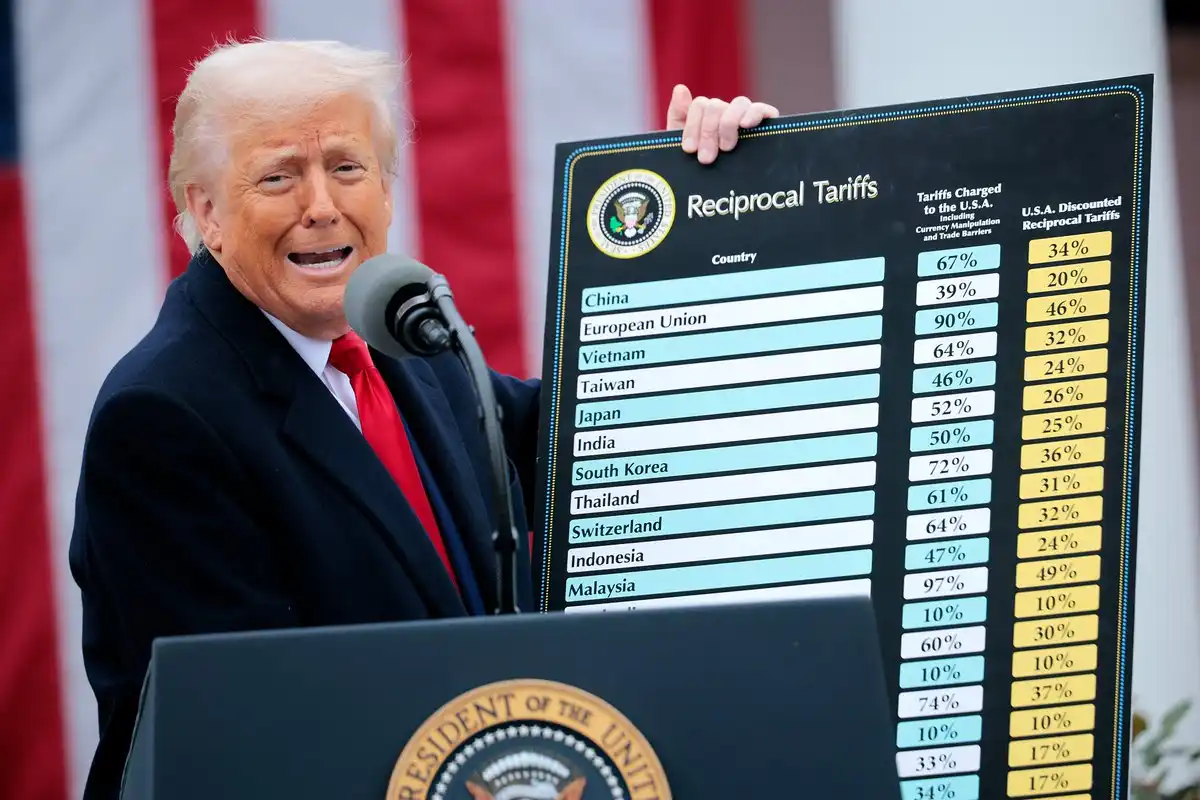
A senior White House official stated that the benchmark tariff rate (10%) will take effect on April 5, while the reciprocal tariffs will come into effect on April 9.
U.S. Treasury Secretary Benson tweeted, "I advise all countries not to take retaliatory action. We can see if there will be a different tariff floor (from the announced figures). Trump's mindset may be to temporarily stabilize things. I was not involved in the negotiations, and we will have to see if there are any negotiations before April 9 (the date when reciprocal tariffs take effect)."
Rise and Fall: Both Crypto and Stock Markets Endure Indiscriminate Attacks
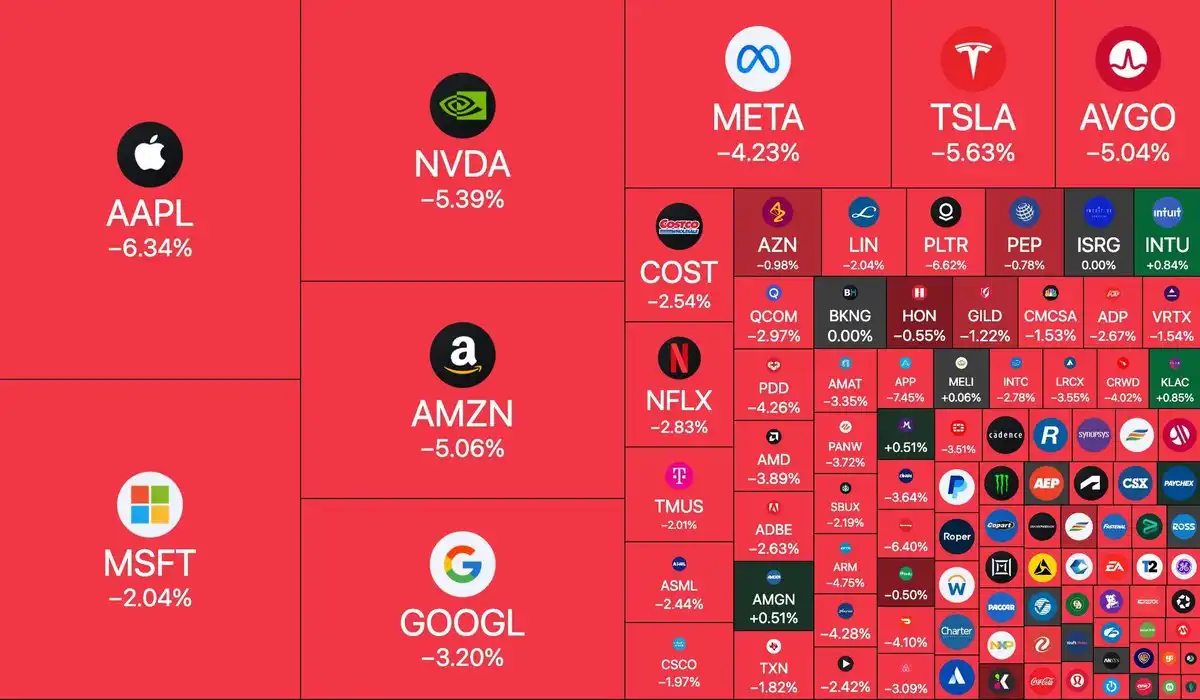
Just hours before Trump announced the tariff policy, the U.S. stock market experienced violent fluctuations. Nasdaq index futures expanded their declines to 2.4%, while S&P 500 index futures dropped by 1.6%. Reuters reported that this indicated investors expected a sharp drop after the market opened on the 3rd. After the tariff policy was implemented, the U.S. Dollar Index (DXY) resumed its decline, falling below the low point when Trump announced the comprehensive tariff, now trading at 103.24, compared to above 104 when reciprocal tariffs were announced.
Meanwhile, in the crypto market, Bitcoin once surged to $88,000, reaching a new high since March 25, rising over 5%, before retracing most of its gains and falling below $82,500. Judging by Bitcoin's current performance, it can be said to have no safe-haven attributes. At the same time, spot gold briefly broke through $3,160 per ounce, continuing to hit new historical highs.
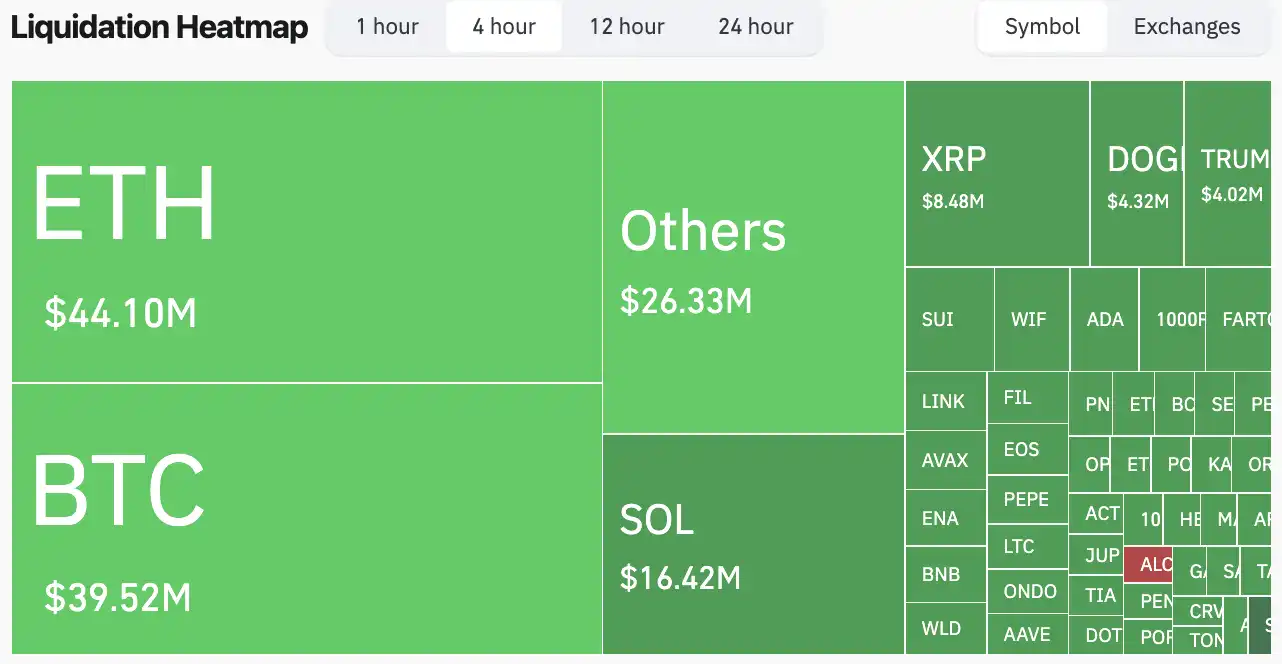
The altcoin market's experience of both rise and fall was even more pitiful, with Coinglass data showing a total of $293 million in liquidations across the network in the past 4 hours, including $187 million in long liquidations and $106 million in short liquidations.
Ridiculous Tariff Calculation Method
Trump claimed that the new tariff measures are intended to promote American manufacturing, "make America prosperous again," "jobs and factories will come back," and even declared April 2nd, the day of imposing "reciprocal tariffs," as the "liberation day" for the United States. However, at the same time, the tariff imposition in the Southeast Asian region is at the forefront, with an increase of 46% for Vietnam, 36% for Thailand, 49% for Cambodia, causing significant damage to the industry.
According to crypto KOL Fiona's sharing, after Trump's election, many entrepreneurs believed that the U.S. would impose the highest taxes on China, so many went to Southeast Asia, especially Thailand and Vietnam, to buy land and build factories. Due to the considerable number of this group, in a short period, the price of local industrial land also soared. Similar to a house-buying frenzy, they rushed to buy, along with a series of costs associated with local labor law registration, spending a considerable amount of money.
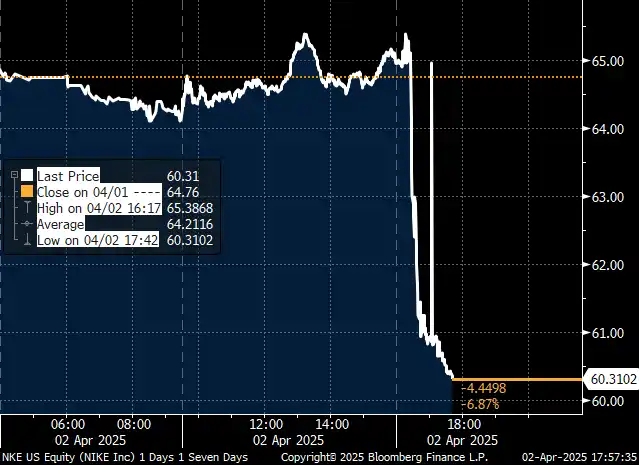
For example, Nike employs over 450,000 workers in its 130 factories in Vietnam. Currently, its stock price has dropped by over 6%, and due to the tariff impact, Nike's brand revitalization plan will also be affected. Nike's production capacity in Vietnam accounts for over 50% of its global total production. This potential tariff policy is expected to increase Nike's annual costs by over $400 million.
For the United States, implementing absolute reciprocal tariffs will not benefit American businesses and people. For example, although it may increase the U.S. federal fiscal revenue in the short term, in the long run, it will cause U.S. commodity prices to soar, thus raising the inflation rate.
Economists are concerned that Trump's tariff policy will inevitably raise U.S. inflation and damage consumer confidence. Projections from Yale University's Budget Lab show that after implementing "reciprocal tariffs," if other countries do not take retaliatory measures, short-term U.S. personal consumption expenditure prices will rise by 1.7%, the actual GDP growth rate will decrease by 0.6 percentage points in 2025; if other countries take retaliatory measures, the increase in U.S. personal consumption expenditure prices will expand to 2.1%, and the actual GDP growth rate will decrease by 1 percentage point.
Ironically, the so-called "tariff rate" data published by the Trump administration is itself a ridiculous calculation result. He claims that some countries impose tariffs on American products as high as 30%, 40%, or even over 50%, but the fact is that these numbers do not originate from real tariffs or non-tariff barriers but from a pseudo-scientific formula of "using the trade deficit divided by the counterpart's total exports."
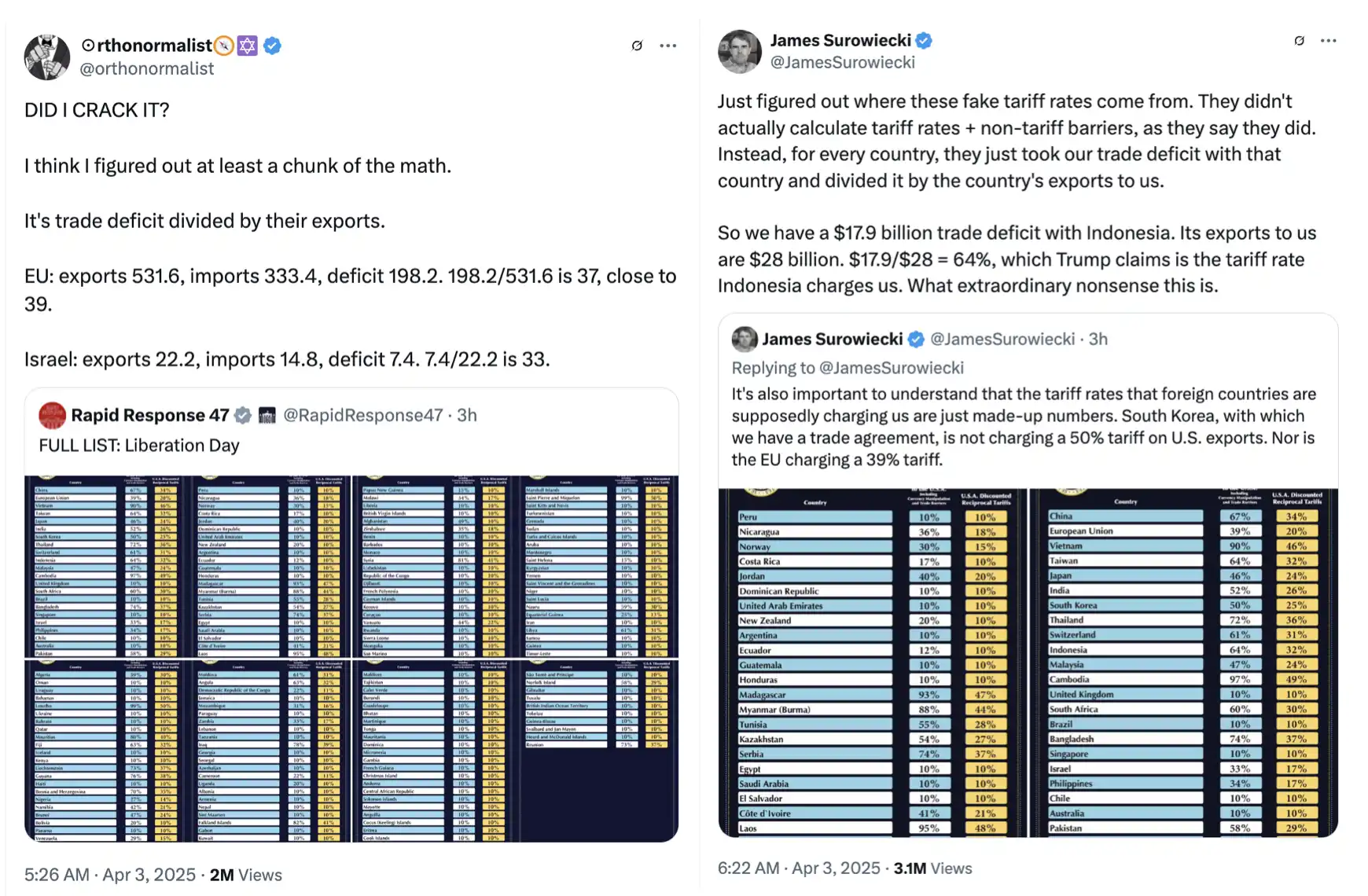
For instance, the U.S. has a $17.9 billion trade deficit with Indonesia, while Indonesia's exports to the U.S. are $28 billion. Dividing 17.9 by 28 gives 64%, and Trump declares that this is the tariff rate Indonesia imposes on the U.S. Similar methods have concocted dozens of percentage points of "false tariff rates" for the European Union, Israel, South Korea, and even neglected the existing trade agreement with South Korea.
This complete misunderstanding of "comparative advantage" and the international trade structure has turned the so-called "reciprocal tariff" into a political slogan and a tool for showmanship. What's especially ironic is that while Trump accuses other countries of unfair high tariffs, he himself imposes extreme tariffs, thus inadvertently harming American-owned enterprises, brands, and middle-class consumers that have long since moved overseas.
Moreover, high tariffs have not truly led to a resurgence of manufacturing. From Trump's first term to Biden taking over, the U.S. government has consistently pushed for industry reshoring. However, over the past 8 years, the reshoring effect has been limited. Instead, due to fluctuating trade policies and increased cost uncertainty, overseas capital has become more cautious about investing in the U.S.
It can be said that this behavior of using a "falsified tariff rate" based on the trade deficit not only demonstrates a disregard for the basic principles of the international economy but also exposes the shortsightedness and self-defeating nature of the entire policy design. Trump's tariff policy, rather than being about "Making America Great Again," could be more aptly described as a miscalculated game that has plunged reality into an inflationary and investment winter, ultimately harming others and not benefiting oneself.
Bottom Fishing or Cash Out? How Will the Crypto Market Move Next?
Last night's tariff results can be considered the worst-case scenario that the market had previously speculated, causing varying impacts on the global financial market.
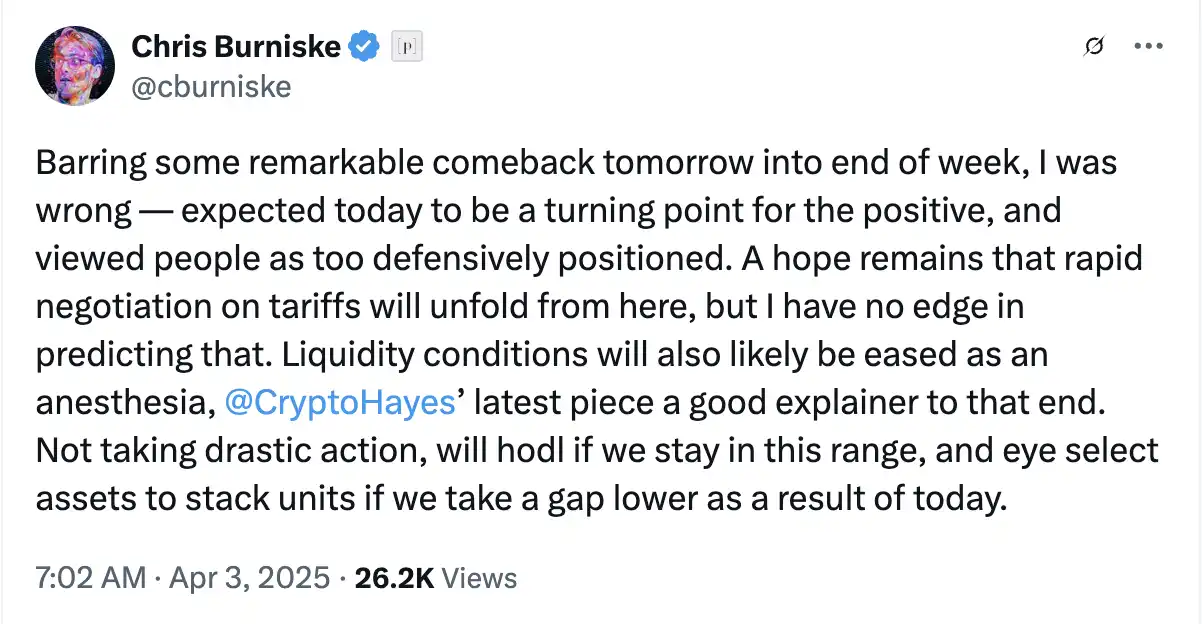
Former Ark Invest Crypto Lead and current Placeholder VC Partner Chris Burniske stated in a post that he initially expected today (April 2) to be a positive turning point, believing the market was overly defensive, but reality proved otherwise. He mentioned that he still hopes the tariff negotiations can quickly progress and said, "I will not take drastic action. If the market remains in this range, I will choose to continue holding. If there is a sharp drop due to today's movement, I will look at some targets and opportunistically increase my position."
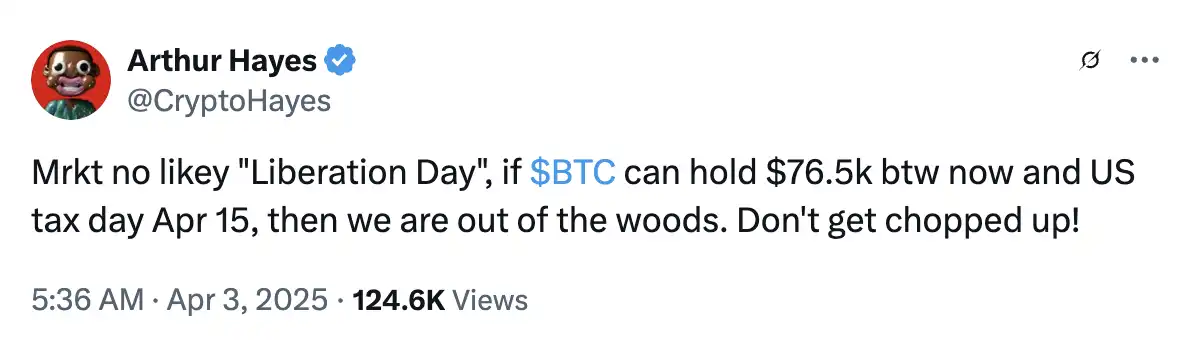
BitMEX Co-Founder Arthur Hayes remarked, "The market doesn't seem to like 'Liberation Day' very much. If Bitcoin can hold above $76,500 between now and U.S. Tax Day (April 15), then we will be out of the woods."
You may also like

10 Counterintuitive Insights on Latin American Payments

Perp DEX: The Next Generation Exchange "War"

The AI gamble of mining companies: Valuations enter a phase of differentiation, and it's hard to turn the tide

A letter from Alliance to entrepreneurs: Written on the occasion of Cursor selling for 60 billion dollars

Stablecoins Finally Find Real Returns: On-Chain Reinsurance Re Explained | Interview with Re Founder Karan Saroya

The impossible triangle is simply a pseudo problem

Will MicroStrategy fall into a death spiral? What will the macro trend be in the second half of the year?

Blockchain Capital Partner: The Core Secret of Arbitrage
STRC unanchored by 11%, can the perpetual motion machine of Strategy still operate?

Bitcoin Market Analysis 2026: Can BTC Reach $150K by Year-End?
Bitcoin ETF Outflows Hit a Record $4.4 Billion: What Are Traders Doing With Their Cash?
WEEX App Just Got Smarter – New Tabs for Faster Trades & Easy Asset Management

WEEX All-New Search Features: Find, Trade & Earn Faster Than Ever

Morning Report | Illinois signs the strictest digital asset tax law in the U.S.; RWA tokenization market size surpasses $43 billion, institutions accelerate the migration of on-chain assets
Full version of the debut Q&A! Federal Reserve Chairman Waller: Sticking to the 2% inflation target, establishing five special working groups, individual did not submit the dot plot

From Disruptor to Shadow Market: The Crypto Market is Becoming a Colony of Traditional Finance
Dalio's important long article: How to position in the current market environment?
OKX Star analyzes Binance's competitive advantages: when regulation levels the playing field, competition has just begun
10 Counterintuitive Insights on Latin American Payments
Perp DEX: The Next Generation Exchange "War"
The AI gamble of mining companies: Valuations enter a phase of differentiation, and it's hard to turn the tide
A letter from Alliance to entrepreneurs: Written on the occasion of Cursor selling for 60 billion dollars
Stablecoins Finally Find Real Returns: On-Chain Reinsurance Re Explained | Interview with Re Founder Karan Saroya
The impossible triangle is simply a pseudo problem


