
Vitalik wrote a proposal teaching you how to secretly use AI large models


Original Title: "Vitalik Wrote a Proposal to Teach You How to Secretly Use AI Large Models"
Original Translation: Deep Tide TechFlow
The whole world is talking about AI, and the discussion about crypto on the timeline has quieted down a lot.
At the same time, ETH has been hovering around 2000 for almost two months, and it seems like not many people care about what Vitalik says or does.
However, when I recently dug into his updates, I found out that AI has influenced more than just us. In the past month, a significant portion of what he has posted is related to AI, and it has gone into the level of technical solutions.
One of the most worthy of discussion is a proposal he and Ethereum Foundation's AI lead Davide Crapis jointly posted on ethresear.ch on February 11, titled "ZK API Usage Credits."
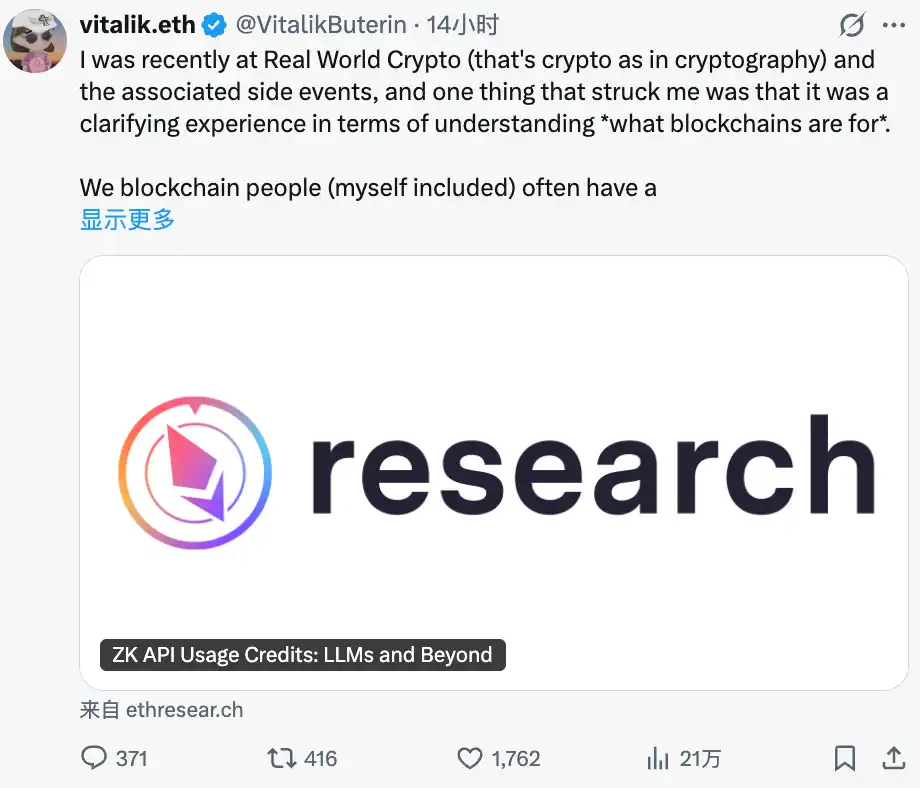
In one sentence: Using zero-knowledge proofs to anonymously call AI large models.
Currently, whether you use ChatGPT or call Claude's API, there is only one payment method:
Register an account, link an email, link a credit card.
Every conversation, every prompt, the platform knows it's from you. What you asked, when you asked, how many times you asked, all tied to your real identity.
Vitalik and Crapis's proposal offer another path.
1. The user deposits some money into a smart contract, for example, 100 USDC.
2. The contract records this deposit in an on-chain encrypted whitelist. Each time you call the API, you don't have to reveal your identity; you just need to generate a zero-knowledge proof.
3. It can prove two things to the service provider: you are on the whitelist, and your balance is sufficient. But the proof itself does not reveal which one you are on the list.
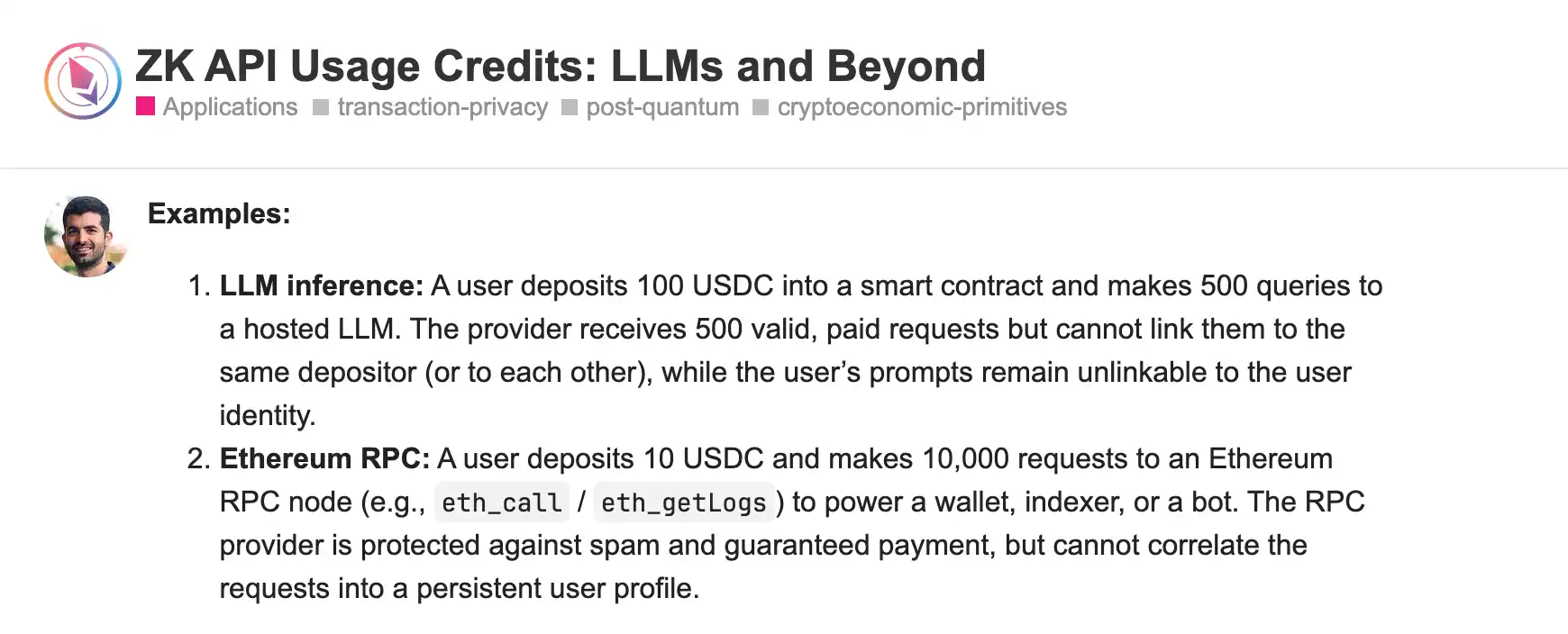
The service provider can receive the money, prevent abuse, but never know who you are throughout the process.
You can think of this proposal as something Vitalik believes in the AI age, users should not have to give up their identity to use an AI tool.
This proposal is currently at the research stage and is still far from being implemented. Major model manufacturers may not agree with this approach; at the same time, the proposal's comment section is full of rebuttals and questions, suggesting that AI model manufacturers will always find ways to know your true identity.
However, the significance of this proposal is not solely about whether it can be implemented or not.
Privacy has been Vitalik's focus for ten years. From early support for Tornado Cash to driving zero-knowledge proofs to be a core technical route of Ethereum, this line has never been interrupted. It's just that in the past few years, in the context of the cryptocurrency industry, privacy has always lacked a large enough story to carry it forward.
AI has filled in that story. When you talk to large models more than anyone else every day, privacy is a real need.
Vitalik Embracing AI
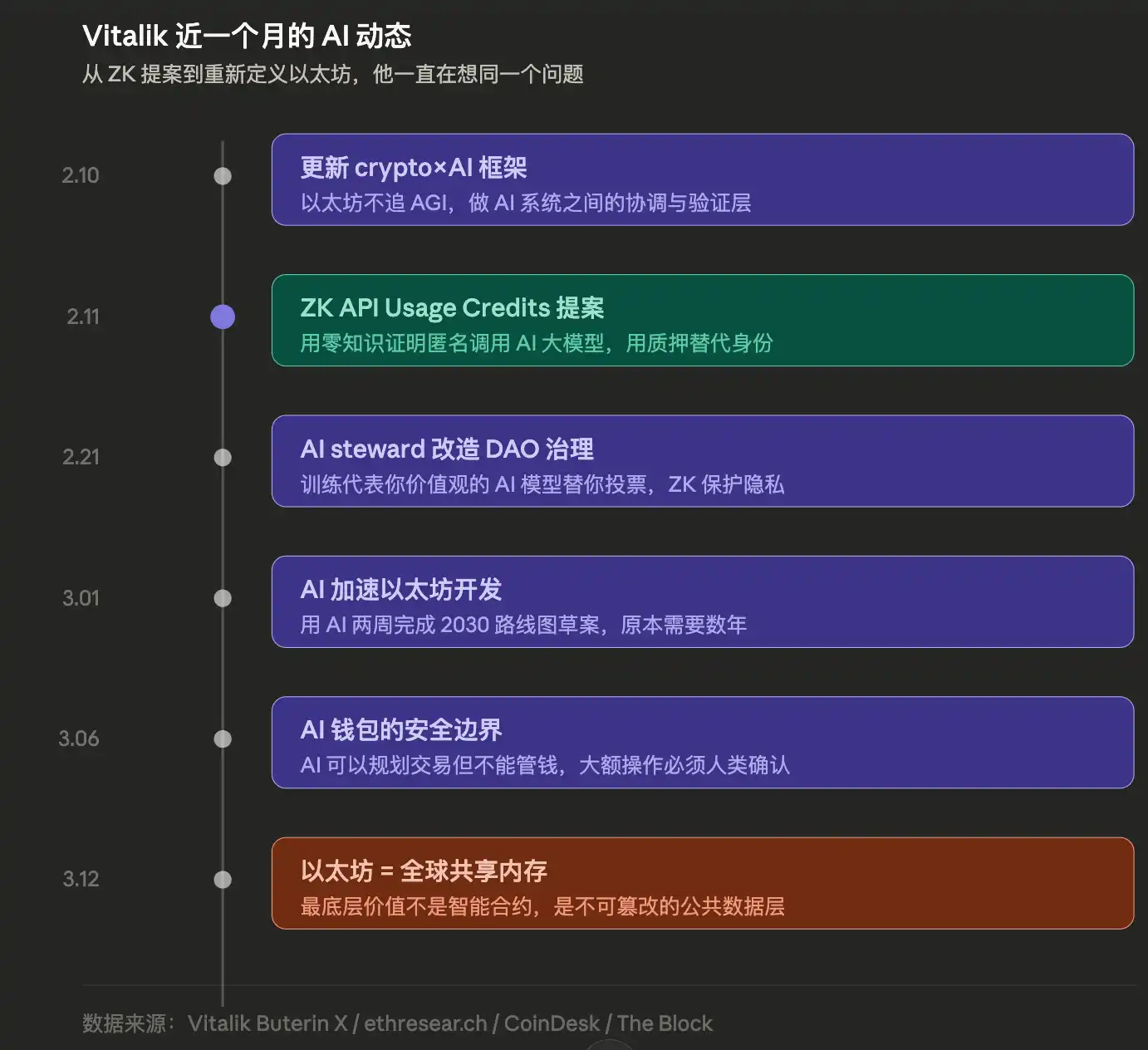
From February to now, a considerable part of what Vitalik has posted on X is related to AI, so dense that it doesn't seem like casual chat.
Yesterday he posted a long thread, saying that he recently went to a cryptography conference, where people care about privacy, care about open source, care about anti-censorship... but have no feelings for blockchain.
Among that group, he did a thought experiment:
Forget "we are the Ethereum community," start from scratch and think about where Ethereum is most useful.
His conclusion is that Ethereum's most fundamental value is as a bulletin board. A place where anyone can write, anyone can read, no one can change, and no one can delete.
In the context of AI, this may be the most important thing Vitalik has said in the past two years.
We are entering an era of infinite generation at almost no cost. Text, images, videos, identities—AI can mass-produce them. When everything can be forged, what will become scarce?
All these questions will ultimately point to the same place: a public, persistent, irreversible data layer. And a record that no one can tamper with is precisely what Ethereum can do.
Over the past two years, Ethereum's scrutiny can be summed up in one question: What do you have that can't be replaced by others?
Looking back, Vitalik has not provided a direct answer to this question.
However, the Ethereum Foundation has quietly done a few things over the past year: formed a 50-person privacy team, established a nearly 50-person privacy research cluster, released the Kohaku privacy framework, and appointed a dedicated AI lead; in the 2026 roadmap, institutional-grade privacy and faster transaction finality are listed as top priorities.
Looking back at his intensive output this month, most of it is basically about discussing Ethereum's privacy and scalability issues in the context of AI.
I think Vitalik is betting on one thing: the more powerful AI becomes, the more rigid the demand for privacy and validation infrastructure. Whether Ethereum can meet this demand is another matter, but he has clearly chosen his table.
ETH is still hovering around 2000. Most people still don't pay much attention to what he has been saying recently.
But perhaps in a few years, looking back, what should have been paid attention to is this current period.
You may also like

Former ByteDance employee's account: How I started with two Pinduoduo hard drives and made six times the profit with Seagate to achieve financial freedom?
MiCA reshuffle begins, Binance temporarily bids farewell to the EU
How does Gate redo "buying and selling stocks" from the cryptocurrency world to the stock market?
Visa and Mastercard join 140 giants to launch a new stablecoin, but the impact on the market landscape may still be limited
Circle CEO responds to OUSD's challenge: Stablecoins are a winner-takes-all business, and we will not slow down
Argentina vs Cape Verde: When a Record-Breaking Legend Meets an Unbreakable Underdog
WEEX exclusive pre-match analysis of Argentina vs Cape Verde, exploring Messi-led Argentina’s dominance and Cape Verde’s historic defensive breakout, with a breakdown of volatility, structure, and match dynamics.
WEEX Launches Depth Chart for Spot Trading
Raising interest rates to protect STRC and selling coins to maintain credit, this time the strategy has chosen the two most expensive paths
Morning Report | Samsung announces a 265.5 trillion won investment plan, focusing on semiconductor and AI computing power data centers; Vitalik publishes an article detailing the entire technology tree behind the confusion protocol (iO) mainline
In the era of AI, what is left of Bitcoin?
NeoSoul announced plans to integrate with the OKX Agentic Wallet, promoting AI agents' participation in the on-chain economy
Why Is Bitcoin Lagging Stocks in 2026? AI Stocks, ETF Outflows, and the Nasdaq Rally Explained
What you bought on CEX is really not US stocks: Analyzing the 94% liquidation monopoly and the evaporation of equity under a five-layer pipeline
In such a crowded cross-border payment arena, where is the next stop for the future?
Why Is Bitcoin Down in 2026? What We Can Learn From 2022
The large models in the United States are moving towards closure in the name of security
From the white-haired stock god to the billionaire fund mogul, the smart people shorting Nvidia are all getting rich using the same framework
Morning Report | CoinEx becomes a key hub for Iran to evade sanctions, involving over $3.8 billion in funds; Kalshi seeks a new round of financing, with a valuation potentially rising to $40 billion
Former ByteDance employee's account: How I started with two Pinduoduo hard drives and made six times the profit with Seagate to achieve financial freedom?
MiCA reshuffle begins, Binance temporarily bids farewell to the EU
How does Gate redo "buying and selling stocks" from the cryptocurrency world to the stock market?
Visa and Mastercard join 140 giants to launch a new stablecoin, but the impact on the market landscape may still be limited
Circle CEO responds to OUSD's challenge: Stablecoins are a winner-takes-all business, and we will not slow down
Argentina vs Cape Verde: When a Record-Breaking Legend Meets an Unbreakable Underdog
WEEX exclusive pre-match analysis of Argentina vs Cape Verde, exploring Messi-led Argentina’s dominance and Cape Verde’s historic defensive breakout, with a breakdown of volatility, structure, and match dynamics.


