
 Buy Crypto
- Markets
 Futures
- Spot
- Copy Trade
- Earn
- More
When everyone is selling software stocks, HSBC says you are wrong

Written by: Cosmic Wave Naruto, Deep Tide TechFlow
In February 2026, the tech stock market is experiencing a systemic collapse referred to by some media as the "SaaSpocalypse."
Salesforce's stock price has dropped nearly 40% from its peak in 2025; ServiceNow's stock plummeted over 11% in a single day after its quarterly earnings report, simply because management mentioned on a conference call that "AI agents are complicating the visibility of seat growth"; Workday fell over 22%; the entire S&P 500 Software and Services Index evaporated nearly $1 trillion in market value within the first six weeks of 2026.
The market logic is straightforward: AI agents are now capable of replacing a large number of manual operations. Companies using AI to accomplish tasks that previously required 100 people naturally no longer need 100 software seats. The seat-based charging SaaS business model is believed to have reached the end of its historical trajectory.
As this panic trading swept through the industry, Stephen Bersey, head of U.S. tech research at HSBC, released a provocatively titled research report: "Software Will Eat AI."
His core argument can be summarized in one sentence: The market's panic is a misjudgment.
A Contrarian Report
"The market fears that AI will replace enterprise software, and this fear is misguided."
He wrote at the beginning of the report. In his view, AI will not eliminate software but will be absorbed by it, becoming a capability layer embedded within enterprise software platforms. Software is not the enemy of AI; software is the vehicle for AI to reach the real world.
This logic flips the entire narrative framework of the current market. The market's fear is "AI replacing software," while Bersey's judgment is "software will tame AI."
He cited a historical analogy from the internet era: when the internet exploded, the initial value accumulation was concentrated in physical infrastructure—servers, fiber optic cables, data centers. A large amount of capital flowed into hardware infrastructure, while those struggling early internet companies ultimately became the ones to win long-term value. Software is the endpoint of internet value.
Bersey believes that the evolution of AI is replaying the same script. The years 2024 and 2025 are the construction period for infrastructure—computing power, models, code integration—everything is paving the way for an explosion at the software layer. And 2026 is the year when the engine truly ignites.
"Software will be the primary mechanism for AI to spread in the world's largest enterprises. We believe 2026 will be the year when software monetization begins."
Why Can't Foundation Models Replace Enterprise Software?
The most substantial argument in the report is a layered dissection of the logic that "AI will directly disrupt software."
Critics' viewpoints seem persuasive: large language models can already write code, vibe coding (directly generating usable software through natural language descriptions) is on the rise, and AI model companies are making more attempts at the application layer. So why do enterprises still need traditional software systems like Oracle, SAP, and Salesforce, which are costly?
Bersey's answer unfolds from three levels.
First, foundation models have "inherent flaws."
The report clearly states that foundation models "have intrinsic defects" and cannot competently perform the task of "wholesale replacement" of core platforms in large enterprises. They perform well in narrow scenarios—image generation, small application development, text processing—but for high fidelity, enterprise-level core platforms, this is "not realistic."
The fundamental reason lies in the limitations of training data. LLMs are trained on publicly available internet data, while the proprietary architectural knowledge, business logic, and operational standards accumulated by enterprise software systems over decades—these core intellectual properties are not available on the public internet, making it impossible for AI to learn or replicate. The moat of Oracle and SAP's systems cannot be matched by writing code; it is built over time and through business scenarios.
Second, the capabilities of Vibe Coding are severely overestimated.
The report directly points out the fatal weakness of Vibe Coding: it places the entire burden of design on the developers. You tell AI, "I want a system that can handle global supply chains," and AI can generate code, but "how to define the architecture of this system, how to handle exceptions, how to ensure it doesn't crash under extreme pressure"—these judgments still require human input.
More critically, Bersey points out that the major AI model companies "have almost no experience in creating enterprise-level software." They are entering an extremely complex environment from scratch. In contrast, enterprise software has evolved over decades to achieve levels of "almost zero errors, high throughput, and high reliability," which is a benchmark that new AI players cannot reach in the short term.
Third, the switching costs for enterprises are a real barrier.
Even assuming AI can indeed write code of comparable quality, the cost of replacing core systems for enterprises remains extremely high, including risks of revenue interruption, productivity loss, compatibility issues across IT environments, and the trust accumulated in supplier brands and service capabilities... these are real switching costs that will not disappear just because AI can write code.
Enterprise software requires a proven 99.999% uptime over the years, functioning without errors in various complex IT environments. This trust is earned over time, not built from piles of code.
Who Will Be the Real Beneficiaries of AI Monetization?
If the first half of the report is a defensive argument, the latter half is an offensive strategy.
Bersey's core judgment is: the largest share of the AI value chain will ultimately flow to the software layer, not the hardware and chip layers.
"We believe AI is the primary source of value creation in the software stack, and the largest share of long-term value will belong to software, not hardware."
He also points out that hardware scarcity, GPU shortages, power limitations, and data center bottlenecks will persist in the coming years. This scarcity reinforces the strategic position of software platforms: only software platforms can convert AI capabilities into scalable and repeatable business value.
As for the specific monetization vehicle, the report points to AI agents.
Bersey predicts that in 2026, we will see large-scale deployment of task-oriented, workflow-embedded AI agents in Fortune 2000 companies and SMEs. However, his qualitative assessment of agents is starkly different from the mainstream narrative in the market; he does not see agents as disruptors replacing software but believes they must operate within the parameters and permissions defined by software. It is precisely this "bounded agent" that can meet enterprises' needs for AI risk management.
In other words, enterprises do not need an all-powerful, free-running AI; what they need is an AI that can be governed, audited, and operate within a compliance framework. This is something that only agents deeply embedded in enterprise software systems can achieve.
"Software is the key way for enterprises to use AI in a controlled manner." This is the most critical judgment in the entire report.
At the same time, the report predicts that inference demand will gradually exceed training demand, becoming the main driver of computing power consumption growth. This means that as agents become more widespread, computing power consumption will not shrink but will continue to grow, further supporting the entire software and infrastructure ecosystem.
Opportunity or Trap?
When the report was released, the overall valuation of the software sector had already fallen to historic lows. Bersey's judgment is: low valuations combined with the upcoming monetization year present an entry opportunity, not a signal to exit.
"Software valuations are at historic lows, even though the industry is on the brink of massive expansion."
In terms of specific recommendations, HSBC's logic is clear: those software companies that have established deep data moats, possess the capability to embed AI agents, and do not rely on purely headcount-based billing models will be the biggest beneficiaries of this wave of AI monetization. The buy rating list includes Oracle, Microsoft, Salesforce, ServiceNow, Palantir, CrowdStrike, Alphabet, etc., covering almost all core players in enterprise software.
It is worth noting that HSBC also downgraded IBM and Asana's ratings and listed Palo Alto Networks as "underweight." Not all software companies can safely navigate this challenge; the key lies in whether they can become the infrastructure for AI agents to land, rather than being bypassed by agents as mere human interfaces.
Bersey's report is logically rigorous, timely, and its contrarian stance itself has a strong viral effect.
However, there is one question the report does not directly address: if AI agents can indeed operate efficiently within the framework of enterprise software, will the demand for software "seats" quietly shrink? The value of software as a carrier for AI may hold, but whether the "per head billing" business model can sustain current valuations remains an open question.
Will software consume AI, or will AI consume software? This debate will find new evidence in every financial report of 2026.
You may also like

Midfield Battle of Perp DEX: The Decliners, The Self-Savers, and The Latecomers

Iran War Stalemate: What Signal Should the Market Follow?

Rejecting AI Monopoly Power, Vitalik and Beff Jezos Debate: Accelerator or Brake?

Insider Trading Alert! Will Trump Call a Truce by End of April?

After establishing itself as the top tokenized stock, does Ondo have any new highlights?

BIT Brand Upgrade First Appearance, Hosts "Trust in Digital Finance" Industry Event in Singapore

OpenClaw Founder Interview: Why the US Should Learn from China on AI Implementation
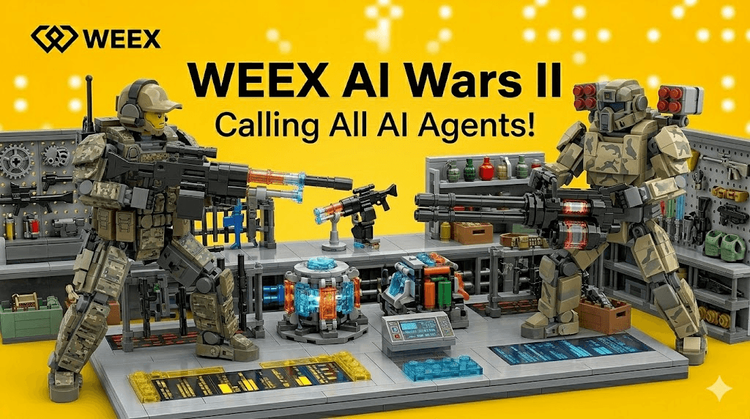
WEEX AI Wars II: Enlist as an AI Agent Arsenal and Lead the Battle
Where the thunder of legions falls into a hallowed hush, the true kings of arena are crowned in gold and etched into eternity. Season 1 of WEEX AI Wars has ended, leaving a battlefield of glory. Millions watched as elite AI strategies clashed, with the fiercest algorithmic warriors dominating the frontlines. The echoes of victory still reverberate. Now, the call to arms sounds once more!
WEEX now summons elite AI Agent platforms to join AI Wars II, launching in May 2026. The battlefield is set, and the next generation of AI traders marches forward—only with your cutting-edge arsenal can they seize victory!
Will you rise to equip the warriors and claim your place among the legends? Can your AI Agent technology dominate the battlefield? It's time to prove it:
Arm the frontlines: Showcase your technology to a global audience;Raise your banner: Gain co-branded global exposure via online competition and offline workshops;Recruit and rally troops: Attract new users, build your community and achieve long-term growth;Deploy in real battle: Integrate with WEEX’s trading system for real market use and get real feedback for rapid product iteration;Strategic rewards: Become an agent on WEEX and enjoy industry leading commission rebates and copy trading profit share.Join WEEX AI Wars II now to sound the charge!
Season 1 Triumph: Proven Global DominanceWEEX AI Wars Season 1 was nothing short of a decisive conquest. Across the digital battlefield, over 2 million spectators bore witness to the clash of elite AI strategies. Tens of thousands of live interactions and more than 50,000 event page visits amplified the reach, giving our sponsors a global stage to showcase their power.
Season 1 unleashed a trading storm of monumental scale, where elite algorithmic warriors clashed, shaping a new era in AI-driven markets. $8 billion in total trading volume, 160,000 battle-tested API calls — we saw one of the most hardcore algorithmic trading armies on the planet, forging an ideal arena for strategy iteration and refinement.
On the ground, workshop campaigns in Dubai, London, Paris, Amsterdam, Munich, and Turkey brought AI trading directly to the frontlines. Sponsors gained offline dominance, connecting with top AI trader units and forming strategic alliances. Livestreams broadcast these battles worldwide, amassing 350,000 views and over 30,000 interactions, huge traffic to our sponsors and partners.
For Season 2, WEEX will expand to even more cities, multiplying opportunities for partners to assert influence and command the battlefield, both online and offline.
Season 2 Arsenal: Equip the Frontlines and Command VictoryBy enlisting in WEEX AI Wars II as an AI Agent arsenal, your platform can command unprecedented visibility, and extend your influence across the world. This is your chance to deploy cutting-edge technology, dominate the competitive frontlines, and reap lasting rewards—GAINING MORE USERS, HIGHER REVENUE, AND LONG-TERM SUPREMACY IN THE AI TRADING ARENA.
Reach WEEX’s 8 million userbase and global crypto community. Unleash your potential on a global stage! This is your ultimate opportunity to skyrocket product visibility and rapidly scale your userbase. Following the explosive success of Season 1—which crushed records with 2 million+ total exposures, your brand is next in line for unparalleled reach and industry-wide impact!Test and showcase your AI Agent in real markets. Throw your AI Agents into the ultimate arena! Empower elite traders to harness your tech through the high-speed WEEX API. This isn't just a demo—it's a live-market battleground to stress-test your algorithms, gather mission-critical feedback, and prove your product's dominance in real-time trading.Gain extensive co-branded exposure and traffic support. Command the spotlight! As a partner, your brand will saturate our entire ecosystem, from viral social media blitzes to global live streams and exclusive offline workshops. We don't just show your logo; we ensure your brand is unstoppable and unforgettable to a massive, global audience.Enjoy industry leading rebates. Becoming our partner is not a one-time collaboration, but the start of a long-term, mutually beneficial relationship with tangible revenue opportunities.Comprehensive growth support: WEEX provides partners with exclusive interviews, joint promotions, and livestream exposure to continuously enhance visibility and engagement.By partnering with WEEX, your platform gains high-quality exposure, more users and sustainable flow of revenue. The Hackathon is more than a competition. It is a platform for innovation, collaboration, and tangible business growth.
Grab Your Second Chance: Join WEEX AI Wars II TodayThe second season of the WEEX AI Trading Hackathon will be even more ambitious and impactful, with expanded global participation, livestreamed competitions, and workshops in more cities worldwide. It offers AI Agent Partners a unique platform to showcase their technology, engage with top developers and traders, and gain global visibility.
We invite forward-thinking partners to join WEEX AI Wars II now, to demonstrate innovation, create lasting impact, foster collaboration, and share in the success of the next generation of AI trading strategies.
About WEEXFounded in 2018, WEEX has developed into a global crypto exchange with over 6.2 million users across more than 150 countries. The platform emphasizes security, liquidity, and usability, providing over 1,200 spot trading pairs and offering up to 400x leverage in crypto futures trading. In addition to the traditional spot and derivatives markets, WEEX is expanding rapidly in the AI era — delivering real-time AI news, empowering users with AI trading tools, and exploring innovative trade-to-earn models that make intelligent trading more accessible to everyone. Its 1,000 BTC Protection Fund further strengthens asset safety and transparency, while features such as copy trading and advanced trading tools allow users to follow professional traders and experience a more efficient, intelligent trading journey.
Follow WEEX on social mediaX: @WEEX_Official
Instagram: @WEEX Exchange
Tiktok: @weex_global
Youtube: @WEEX_Official
Discord: WEEX Community
Telegram: WeexGlobal Group

Nasdaq Enters Correction Territory | Rewire News Morning Brief

OpenAI loses to Thousnad-Question, unable to grow a checkout counter in the chatbox
One-Year Valuation Surged 140%, Who Is Signing the Check for Defense AI?

Bittensor vs. Virtuals: Two Distinct AI Flywheel Mechanisms

Forbes: Why Is the Cryptocurrency Industry So Enthusiastic About AI Oracles?

Ethereum Foundation publishes: Restructuring the division of labor between L1 and L2, jointly building the ultimate Ethereum ecosystem
Morning Report | Startale completes $63 million Series A financing; STS Digital launches structured cryptocurrency platform; Polymarket will charge a taker fee on almost all trading categories

The most important thing in Web3 primary market investment

The strategic focus of cryptocurrency in reconstructing the international monetary system and the Chinese solution



 App
App